










How SMEs in Qatar Can Improve Financial Decision Making
Practical, expert-led strategies to strengthen your financial decisions, control cash flow, and build a business that grows with confidence in Qatar’s evolving economy.
Running a small or medium-sized enterprise in Qatar today means operating in one of the region’s most dynamic and rapidly diversifying economies. Yet for many business owners, the most critical decisions — how to allocate capital, manage liquidity, plan for growth, or respond to regulatory change — are made without the financial clarity they deserve.
The good news: improving your financial decision-making is not about hiring an army of accountants. It is about building the right systems, asking the right questions, and having expert guidance when it matters. This guide walks you through exactly how to do that — and how GMPA LLC’s financial advisory services can help you get there faster.
Why Financial Decision Making Is the Growth Lever Most SMEs Miss
Qatar’s National Development Strategy 2024–2030 identifies SMEs as central to the country’s ambition to diversify beyond hydrocarbons. The compound annual growth rate projected for SME contributions to non-hydrocarbons GDP by 2030 is significant — but capturing that opportunity requires financially literate, strategically sound leadership at every level.
The challenge is that most SME owners are experts in their industry, not in finance. They build great products, win clients, and manage teams — but the financial engine running beneath the business is often opaque, reactive, and disconnected from strategy. Decisions get made on gut instinct, on last month’s bank statement, or not at all.
The Six Pillars of Financial Decision Making for Qatar SMEs
Based on the financial challenges most commonly facing SMEs operating in Doha and across Qatar, we have identified six interconnected pillars that determine the quality of business financial decisions.
Accurate Financial Records
Real-time, reliable books are the foundation. Without them, every decision is built on guesswork.
Cash Flow Visibility
Profit and cash are not the same thing. Many profitable Qatar SMEs fail because they run out of cash at the wrong moment.
KPI and Performance Tracking
What gets measured gets managed. Knowing your real drivers — margins, debtor days, conversion rates — changes everything.
Tax and Compliance Readiness
Qatar’s tax landscape continues to evolve. Staying ahead of obligations protects you from penalties and surprises.
Strategic Financial Planning
Short-term budgets and long-term financial roadmaps give your decisions a framework rather than a firefighting mentality.
Internal Controls and Fraud Prevention
Without proper controls, growing businesses expose themselves to fraud risk and financial leakage that quietly erodes margins.
Step by Step: How to Improve Financial Decision Making in Your SME
Here is a practical sequence that business owners and finance managers can follow to systematically strengthen the quality of financial decisions across their organisation.
- Establish a single source of financial truth. Migrate from spreadsheets and disconnected tools onto a reliable accounting system such as Zoho Books or QuickBooks. Automate data entry where possible. When your numbers are clean and current, decisions become clearer immediately.
- Build a 13-week rolling cash flow forecast. Cash flow forecasting is not just a tool for crisis management — it is your early warning system. A rolling forecast lets you anticipate shortfalls, plan supplier payments, and make investment decisions without being caught short.
- Define your five to eight most critical KPIs. Gross margin, net profit margin, debtor days, stock turnover if relevant, customer acquisition cost, and revenue per employee are common starting points. Build a simple dashboard you review monthly — not just at year end.
- Conduct a financial health check. A structured review of your financial systems, controls, and reporting identifies where money is leaking, where risk is concentrating, and where your current setup is holding growth back.
- Plan for tax obligations proactively. Stay current with Qatar General Tax Authority requirements, particularly if your business is approaching thresholds that trigger new obligations. Reactive tax management is always more expensive than proactive planning.
- Bring in strategic financial leadership. Whether through a Virtual CFO or regular financial advisory sessions, having expert financial oversight aligned to your business goals dramatically improves the quality of strategic decisions — at a fraction of the cost of a full-time hire.
Common Financial Decision Making Mistakes Qatar SMEs Make
Understanding what goes wrong is just as important as knowing what good looks like. These are the patterns we see most frequently when working with businesses across Doha and beyond.
- Confusing revenue growth with financial health — a business can be growing and deteriorating at the same time
- Making investment decisions without a cash flow forecast, leading to liquidity crises in growing companies
- Delaying bookkeeping until tax season, which destroys the real-time visibility needed for decisions
- Over-relying on a single client for revenue without modelling the risk this creates
- Underestimating the cost of informal credit terms given to customers
- Ignoring internal financial controls until fraud or error has already occurred
- Making hiring or expansion decisions without modelling the full financial impact on cash flow and margins
The Role of a Virtual CFO in Improving SME Financial Decisions
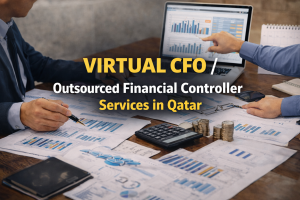
For most SMEs in Qatar, hiring a full-time Chief Financial Officer is neither practical nor necessary. But access to CFO-level thinking — strategic financial oversight, scenario planning, investor-ready reporting, and executive guidance — is now available through outsourced and virtual CFO models.
A Virtual CFO from GMPA LLC works alongside your leadership team to translate financial data into strategic decisions. This includes budgeting and forecasting, performance analysis, financing strategy, and board-ready reporting — all calibrated to where your business is now and where you want it to go.
How Qatar’s Economic Context Shapes SME Financial Strategy
Qatar’s economy is uniquely positioned. The Third National Development Strategy 2024–2030 sets out an ambitious agenda for private sector growth and SME development, with increased access to funding, enhanced banking support, and a policy environment increasingly designed to support non-hydrocarbons business activity.
For SMEs operating in this environment, financial decision making must account for sector-specific dynamics, evolving tax regulations, access to QDB funding instruments, and the increasing sophistication of Qatar’s business environment. Generic financial advice built for European or US markets often misses these local nuances entirely.
GMPA LLC operates exclusively in Qatar, which means our advisory is built around the real regulatory, financial, and market conditions you face daily — not a generic global template adapted for the region.
Frequently Asked Questions
Ready to Make Sharper Financial Decisions?
Speak to one of our UK accountants based right here in Qatar. Book your free consultation today and find out exactly where your business stands.