










Why Many SMEs in Qatar
Still Use Excel for Accounting
The hidden costs, compliance risks, and the point at which spreadsheets start working against your business
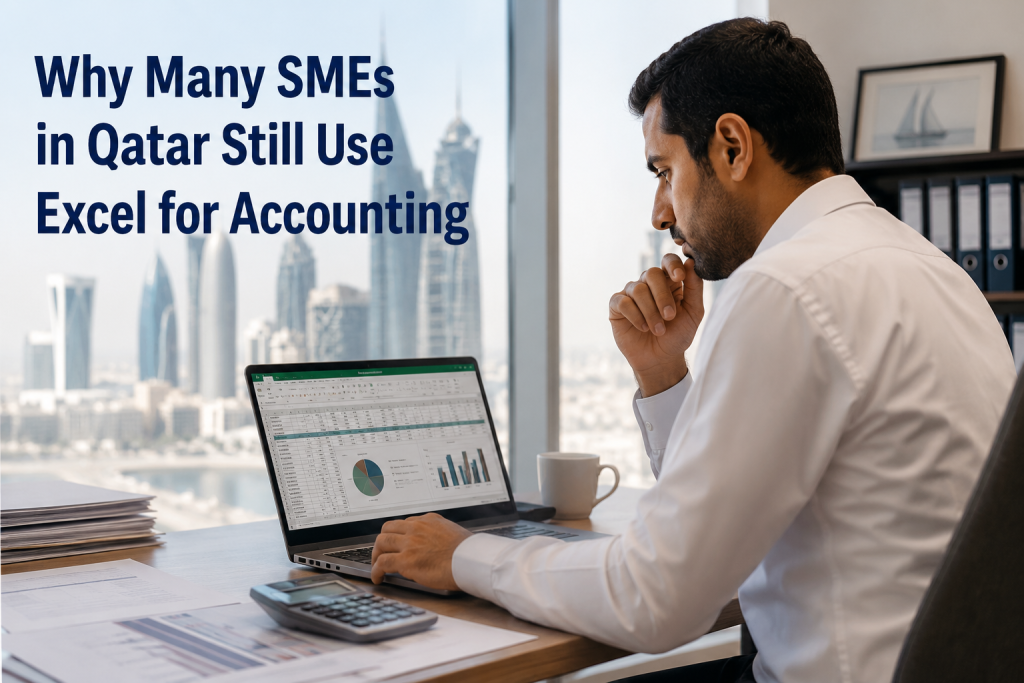
Walk into almost any small or medium-sized business in Doha today — a trading company in Al Sadd, a consultancy in West Bay, a retail outlet in the Pearl — and there is a reasonable chance their bookkeeping lives inside a shared Excel workbook. The sheet is colour-coded, lovingly formatted, and quietly accumulating errors that nobody has spotted yet.
This is not a criticism. Excel is a genuinely powerful tool, and for a newly registered business with a handful of transactions per month it is perfectly serviceable. The problem is that most Qatar SMEs keep using it long after they should have moved on — and the consequences range from inefficiency to compliance failures that carry real financial penalties.
This article explains why the pattern persists, what the genuine risks are, and how to know when your business has outgrown it.
Why Excel Became the Default
The answer is largely structural. According to the QDB SME Guidebook 2024, Qatar defines an SME as any private-sector company with fewer than 250 employees and annual turnover below QAR 100 million. Within that bracket, roughly half of all registered businesses are micro-enterprises employing ten people or fewer. At that scale, many founders have never worked in a formally structured finance department. Excel is familiar, free (or already paid for), and does not require any setup.
Zero Learning Curve
Most business owners learned Excel at school or in a previous role. There is no new software to install, no subscription to justify to a board, no onboarding process.
Cost Perception
Accounting software feels like an overhead. Excel feels like an asset already owned. The comparison is rarely made on a true cost-of-errors basis.
Qatar’s VAT Timeline
Qatar has not yet implemented VAT at the consumer level, removing one of the key compliance pressures that pushes SMEs in the UAE and Saudi Arabia toward structured software.
Limited Local Enforcement
Historically, audit requirements for smaller Qatari businesses have been lighter than in other GCC markets, reducing the urgency of maintaining audit-ready records.
Staff Turnover
Qatar’s expatriate workforce means high turnover among finance staff. A shared Excel file is easy to hand over; a configured accounting system requires knowledge transfer.
No Single Trusted Advisor
Many SME owners lack access to a UK-qualified accountant who can confidently recommend and implement the right system for their sector and size.
The Real Risks of Staying on Excel
The risks are rarely catastrophic in the short term, which is exactly why they are so dangerous. They compound quietly.
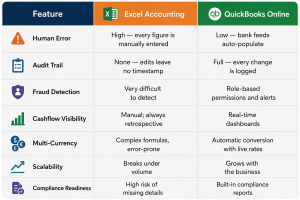
A 2019 study on SME accounting practices found that low cost was the primary reason businesses chose Excel over dedicated software — but the same research identified error susceptibility, lack of historical data integrity, and fraud vulnerability as the tool’s principal weaknesses. One misplaced formula can create a chain of incorrect figures across an entire financial year.
| Risk Area | Excel Reality | Accounting Software |
|---|---|---|
| Human Error | High — every figure is manually entered | Low — bank feeds auto-populate |
| Audit Trail | None — edits leave no timestamp | Full — every change is logged |
| Fraud Detection | Very difficult to detect | Role-based permissions and alerts |
| Cashflow Visibility | Manual; always retrospective | Real-time dashboards |
| Multi-Currency | Complex formulas, error-prone | Automatic conversion with live rates |
| Scalability | Breaks under volume | Grows with the business |
| Compliance Readiness | Requires manual restructuring pre-audit | Generates compliant reports on demand |
“An error in a single cell can produce a chain of incorrect figures. In 2012, a spreadsheet error cost JPMorgan approximately $2 billion. Qatar’s SMEs operate at a different scale — but the principle is identical.”Source: documented case studies on spreadsheet risk in financial management
The Qatar-Specific Context
Qatar’s regulatory environment is changing. The Third National Development Strategy 2024–2030 (NDS-3) explicitly positions SMEs as central to the diversification of the non-hydrocarbons economy, projecting a 36% compound annual growth rate in SME contributions to GDP by 2030. That ambition brings scrutiny.
The Qatar Central Bank (QCB) Financial Sector Strategic Plan, released alongside NDS-3, sets a target for SME credit to reach 7% of total commercial credit. Banks extending larger credit facilities to growing businesses will increasingly expect auditable, system-generated financial records — not a PDF exported from a spreadsheet.
Meanwhile, the Qatar Financial Centre (QFC) reported a record 836 new firms registered on its platform in 2024, a 156% increase on 2023. Many of those businesses are moving into professional services and financial advisory roles where clean, real-time reporting is not optional.
Qatar has not yet implemented broad VAT, but businesses with QFC registration, international trading relationships, or UK parent companies are often already required to maintain IFRS-compliant or UK GAAP-aligned records. If that applies to your business, Excel is almost certainly insufficient.
When Does Excel Stop Being Good Enough?
There is no single threshold, but from our experience working with SMEs across Doha and the UK, these are the consistent signals that a business has outgrown its spreadsheet:
- You have more than one person entering data into the same file
- Month-end close takes more than two working days
- You cannot produce a P&L or cashflow forecast without manual reformatting
- You have experienced at least one instance of a formula error going undetected for weeks
- You are applying for bank credit and the lender wants management accounts
- You have staff in multiple locations or a UK parent company requiring consolidated reports
- You are planning to grow headcount beyond ten employees in the next 12 months
- You conduct any transactions in multiple currencies
The Migration Question: What Software Works in Qatar?
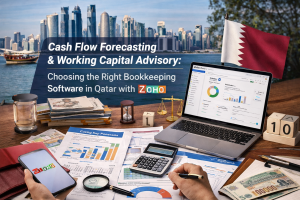
The most common platforms used by Doha-based SMEs serviced by professional advisors are Zoho Books, QuickBooks Online, and Xero. Each has genuine merits, and the right choice depends on your sector, transaction volume, and whether you need Arabic-language invoicing.
At GMPA LLC, we specialise in Zoho Books setup and automation as well as full accounting system migration for businesses making the switch from Excel. The transition, done properly, typically takes two to four weeks and produces immediate improvements in financial visibility.
What matters more than the specific software is having a UK-qualified accountant oversee the chart of accounts setup and opening balances. A poorly migrated system is little better than a well-maintained spreadsheet — the data integrity has to be correct from day one.
Frequently Asked Questions
Is it illegal to use Excel for accounting in Qatar?
No. There is no Qatari law that mandates a specific accounting software for SMEs. However, if your business is QFC-registered, audited, or subject to international reporting standards, using Excel alone will make compliance significantly harder and more expensive.
How much does it cost to move from Excel to accounting software?
Cloud accounting platforms such as Zoho Books typically start from around QAR 50–100 per month for SME-level plans. The larger cost is professional setup and data migration, which varies depending on the number of historical periods to import and the complexity of your chart of accounts. We provide a fixed-scope migration service to keep costs predictable.
Can I keep using Excel alongside accounting software?
Yes, and many businesses do — particularly for budgeting models, scenario analysis, and board-level presentations. Excel remains an excellent analytical tool. The key is that it should receive exported data from your accounting system, not serve as the system of record itself.
Does Qatar’s lack of VAT mean I don’t need structured accounting?
Qatar has not yet broadly implemented VAT at the retail level. However, businesses operating across the GCC, trading with UAE or Saudi entities, or structured under QFC rules often face indirect VAT obligations. And regardless of VAT, proper records are essential for management decision-making, bank credit applications, and audit requirements.
My business is very small — do I really need to upgrade?
If you have fewer than five transactions per week and no employees, Excel may be genuinely sufficient for now. The question to ask is: where will my business be in 18 months? If growth is planned, migrating to a proper system while you are small is far less painful than doing it under pressure later.
Sources referenced: Qatar Development Bank (QDB) SME Guidebook 2024; QDB State of SMEs in Qatar 2020; Oxford Business Group, Qatar 2024 Report on SME Development; Qatar Third National Development Strategy 2024–2030 (NDS-3); Qatar Central Bank Financial Sector Strategic Plan; QFC 2024 Annual Figures; ResearchGate — Usage of Microsoft Excel Spreadsheet as Accounting Tools in SME Company (2019); Gulf Times, QDB CEO interview on SME composition.
Ready to Move Beyond Excel?
Speak to one of our UK accountants. We will assess your current setup and recommend the right path forward — at no cost.