










For most businesses in Qatar, automated financial processes deliver better accuracy, lower long-term cost, and stronger compliance readiness than manual methods. That said, the right answer depends on your business size, transaction volume, and how soon VAT obligations or QFC reporting requirements will affect your operations.
This guide gives you a practical, Qatar-specific comparison so you can make an informed decision with confidence.
Manual financial processes rely on human data entry, spreadsheets, and paper records, while automated financial processes use software to handle transaction recording, reconciliation, reporting, and compliance tasks with minimal human intervention, reducing errors and saving time for businesses in Qatar.
✓ Manual processes suit very early-stage micro-businesses with low transaction volumes.
✓ Automated systems reduce human error, speed up reporting, and support VAT readiness.
✓ Qatar Vision 2030 and QFC regulatory requirements favour digital financial management.
✓ British expats in Doha face dual UK and Qatar obligations that automation handles far more safely.
✓ A hybrid approach is valid during transition, with professional guidance on migration timing.
What Is the Difference Between Manual and Automated Financial Processes?
Manual financial processes involve recording transactions by hand, maintaining spreadsheets, producing invoices manually, and completing bank reconciliations without software assistance. They place heavy reliance on individual staff accuracy and create risks when team members are absent or when volumes increase.
Automated financial processes use cloud accounting platforms such as Zoho Books, QuickBooks Online, or Xero to capture transactions automatically via bank feeds, generate invoices on recurring schedules, flag anomalies in real time, and produce compliance reports without manual input. For businesses operating under Qatar Financial Centre (QFC) regulations or preparing for VAT implementation, these capabilities are no longer optional extras.
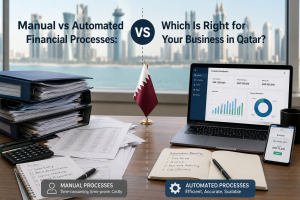
The distinction matters most for growing SMEs in Doha, where transaction volumes rise quickly and reporting expectations from shareholders, lenders, and regulators become more demanding as the business scales.
How Do Manual and Automated Processes Compare Across Key Business Criteria?
The table below provides a direct comparison across the criteria most relevant to businesses and British expats operating in Qatar and the wider GCC.
| Criteria | Manual Processes | Automated Processes |
|---|---|---|
| Error Rate | High risk of data entry mistakes | Significantly reduced through bank feeds and rule-based entry |
| Speed of Reporting | Days to weeks depending on staff availability | Real-time dashboards and instant report generation |
| VAT Readiness | Manual calculation; high compliance risk | Automated VAT calculations aligned to GCC frameworks |
| Scalability | Requires additional headcount as volume grows | Scales with transaction volume without proportional cost increase |
| Upfront Cost | Low initial cost; high hidden staff cost over time | Modest monthly subscription; ROI typically within 3 to 6 months |
| Audit Trail | Paper-based or spreadsheet; difficult to verify | Timestamped digital audit trail; audit-ready at any point |
| Dual UK and Qatar Reporting | Manual reconciliation between two sets of books; error-prone | Multi-currency and multi-jurisdiction reports generated simultaneously |
| Remote Access | Location-dependent; files locked to one machine or office | Cloud-based access from Doha, London, or anywhere in the world |
What Are the Risks of Staying with Manual Financial Processes in Qatar?
Manual financial processes carry compounding risks that grow as your business grows. According to the International Monetary Fund, businesses in digitally advancing economies that fail to adopt financial technology face rising compliance costs and reduced competitiveness as regulatory frameworks modernise. Qatar is actively modernising its financial regulation infrastructure in line with Vision 2030, making this risk particularly acute for businesses operating in West Bay, The Pearl, Lusail, and Msheireb.
The most common risks GMPA LLC identifies when reviewing manual systems include:
Month-end reconciliations completed manually frequently contain errors that only surface during annual audits, by which point corrective action is expensive and disruptive.
As Qatar prepares for VAT implementation, manual calculation of input and output tax across hundreds of monthly transactions is unsustainable without software support, creating exposure to penalties.
When the individual who manages your spreadsheets leaves, the institutional knowledge of your finance function leaves with them. Automated systems store all data securely in the cloud with user-level access controls.
Without real-time financial visibility, business owners in Doha are making strategic decisions on data that is weeks out of date. In a fast-moving market, this is a competitive disadvantage that compounds over time.
Common Financial System Weaknesses Found in Qatar SMEs
Review Your Financial Systems for Business Performance in Qatar
Why Regular Financial Reviews Are Essential for Business Growth
Business Financial Health Check and Financial Systems Review in Qatar
What Are the Real Benefits of Automated Financial Processes for Qatar Businesses?
Automation delivers measurable improvements across accuracy, speed, cost, and compliance. For SMEs operating from West Bay corporate towers or The Pearl retail units, the gains translate directly into business performance.
Accuracy and audit readiness. Cloud-based systems apply consistent rules to every transaction, eliminating the inconsistency that comes from different staff handling the same process differently. Every entry carries a timestamp and a user ID, creating an audit trail that satisfies both internal governance requirements and external regulatory inspections.
Time savings and staff efficiency. Automated bank feeds remove the need for daily manual transaction entry. Recurring invoices are sent without staff involvement. Payroll calculations run on schedule. Finance staff freed from data entry can focus on analysis, forecasting, and the strategic work that actually grows your business.
VAT and QFC compliance readiness. As Qatar progresses toward broader tax implementation, businesses already operating automated systems will be significantly better positioned than those still relying on spreadsheets. Automated systems can apply GCC-standard VAT rules to every transaction, generate return-ready reports, and integrate with e-invoicing platforms as regulations evolve.
Multi-currency and cross-border capability. For British expats in Doha managing income in both QAR and GBP, automated platforms handle multi-currency transactions, apply the correct exchange rates, and produce reports in either currency. This is essential for UK Self Assessment obligations that continue after an individual relocates to Qatar.
Is Automation Right for Every Business in Qatar?
Automation is the right direction for the vast majority of businesses in Qatar, but timing and approach matter. A sole trader with fewer than fifty transactions per month and no external reporting obligations can start manually while evaluating their software options. However, once a business reaches the point where it employs staff, takes on client contracts, or needs to produce quarterly management accounts, manual processes become a liability rather than an economy.
A hybrid approach is sometimes appropriate during the transition period. This involves maintaining automated transaction capture and reconciliation in a cloud system while management reporting is reviewed and approved by a qualified accountant. GMPA LLC supports clients through this transition, ensuring that the chart of accounts, opening balances, and historical data are migrated correctly so the new system produces reliable outputs from day one.
For British expats managing businesses across Qatar and the UK simultaneously, a hybrid approach without proper professional oversight carries real risk. UK HMRC obligations, particularly Self Assessment and potential Making Tax Digital requirements, demand accurate, timely records. The safest course is to implement automation early and have a UK-qualified accountant familiar with both jurisdictions oversee the setup.
Which Businesses in Qatar Benefit Most from Automated Financial Systems?
Across our client base in Doha and the wider Qatar market, GMPA LLC consistently sees the strongest impact from automation in the following business types:
| Business Type | Why Automation Matters Most |
|---|---|
| British expat-owned SMEs in Doha | Dual UK/Qatar reporting obligations demand real-time, multi-currency data |
| Construction and contracting firms | High transaction volumes, WIP tracking, and subcontractor payments need system control |
| Hospitality and retail businesses | Daily sales reconciliation and inventory-linked accounting require automation |
| Professional services and consultancies | Recurring billing, time tracking, and client profitability analysis are simplified |
| QFC-licensed businesses | QFC reporting requirements demand structured, audit-ready financial records |
| Ecommerce and import/export businesses | Multi-currency transactions and cross-border documentation require platform-level support |
How Do You Transition from Manual to Automated Financial Processes Without Disrupting Your Business?
The transition from manual to automated processes is one of the most common projects GMPA LLC manages for clients across Doha, Lusail, and Msheireb. Done well, it takes between four and eight weeks and produces clean, reliable financials from the first month of operation. Done badly, it creates data integrity problems that take months to unwind.
The key steps in a successful transition are:
Select software appropriate to your size and jurisdiction. GMPA LLC recommends Zoho Books for most Qatar-based SMEs due to its GCC VAT alignment, bilingual interface, and strong automation features. QuickBooks Online and Xero are well suited where UK-linked reporting is a priority.
Opening balances must be agreed and verified before any live transaction entry begins. Migrating incorrect balances into an automated system simply automates the error. A qualified accountant should sign off on opening balances before the system goes live.
Connect your Qatari business bank accounts and configure categorisation rules for recurring transactions. This is where the efficiency gains begin to compound. Staff time spent on data entry drops immediately.
The best software is only as good as the people using it. GMPA LLC provides hands-on training for finance staff as part of every system implementation, ensuring the team understands approval workflows, expense submission, and report interpretation.
Monthly reviews by your accountant during the first three months catch configuration issues before they become systemic problems. After a settled quarter, most clients move to quarterly reviews with confidence in their numbers.
Why Does This Choice Matter More for British Expats Running Businesses in Qatar?
British expats in Doha face a financial reporting obligation that most locally-based entrepreneurs do not: they remain subject to UK taxation on certain income streams even after relocating. HMRC Self Assessment, offshore income declarations, and in some cases UK corporate tax obligations continue alongside any Qatar-specific requirements.

Managing these dual obligations manually creates unacceptable risk. Automated systems allow a single data set to generate both the management accounts needed for Qatar operations and the income summaries required by a UK tax adviser. This removes the risk of discrepancies between the two sets of records and makes year-end UK Self Assessment preparation significantly faster and less expensive.
GMPA LLC serves clients across Doha and the wider Qatar market and provides dedicated support to British expats with continuing UK tax obligations, ensuring both sides of the reporting picture are handled correctly by a team that understands both jurisdictions.
Frequently Asked Questions
GMPA LLC helps businesses across Doha and Qatar move from manual to automated financial systems with confidence. Book your free consultation today.
Speak to One of Our UK Accountants
View Our Services
This article was produced by the GMPA LLC Team, led by Saira Khan, Co-Founder of GMPA LLC, whose team has over 15 years of experience advising British expats and SMEs operating across the UK and Qatar. GMPA LLC provides financial systems implementation, Virtual CFO services, VAT readiness, and accounting advisory to businesses across Doha, West Bay, The Pearl, Lusail, and Msheireb.