










Written by Saira Khan, Co-Founder of GMPA LLC, whose team has 15+ years of UK accounting experience advising British expats and SMEs operating across the UK and Qatar.
How to Build Efficient Financial Reporting Systems in Qatar
Building an efficient financial reporting system in Qatar means designing structured, IFRS-compliant processes that capture accurate data, automate routine tasks, and deliver timely management information. For SMEs and British expats operating in Doha, a well-built system reduces compliance risk, supports VAT readiness, and gives business owners the visibility they need to grow with confidence.
Definition
An efficient financial reporting system in Qatar is an integrated set of processes, controls, and accounting tools that records business transactions accurately, produces IFRS-compliant reports on time, and gives management clear, reliable data for strategic decisions and regulatory compliance.
Key Takeaways
Why Do Qatar Businesses Need an Efficient Financial Reporting System?
Qatar’s business environment is growing at pace. According to the Qatar Finance Centre (QFC), the country’s financial services sector registered strong growth through 2024 and 2025, driven by diversification away from hydrocarbons under the Qatar National Vision 2030 framework. In that environment, businesses that cannot produce timely, accurate financial reports are at a significant disadvantage when approaching banks, attracting investors, or responding to regulatory inquiries.
For SMEs operating in commercial districts such as West Bay, Lusail, and Msheireb, the pressure is particularly acute. Businesses registered under the Ministry of Commerce and Industry (MoCI) or the QFC must maintain accounts that are audit-ready, IFRS-aligned, and capable of supporting VAT compliance once Qatar’s VAT framework is fully implemented across all sectors.
British expat business owners face an additional layer of complexity: they often need financial reporting that works simultaneously for Qatari regulators and for HMRC back in the UK. Without a properly built system, this dual-reporting burden becomes costly and error-prone. You can explore related challenges in our guide to Common Financial System Weaknesses Found in Qatar SMEs.
What Are the Core Components of a Financial Reporting System in Qatar?
Before you can build efficiently, you need to understand what the system must contain. Any reporting framework used by a Qatar-based business should include the following components:
| Component | Purpose in Qatar Context | Tools / Standards |
|---|---|---|
| Chart of Accounts | Classifies all income, expenses, assets, and liabilities consistently | Zoho Books, Xero, QuickBooks |
| Bookkeeping Processes | Ensures every transaction is recorded accurately and on time | Daily bank reconciliation |
| IFRS-Compliant Reporting | Required for regulated entities, listed companies, and QFC-registered firms | IASB IFRS standards |
| Month-End Close Procedure | Locks the period and triggers management reporting cycle | Standardised checklists |
| KPI Dashboard | Gives management real-time visibility of performance against targets | Zoho Analytics, Power BI |
| Internal Controls | Prevents fraud, reduces errors, and supports audit readiness | Segregation of duties, access controls |
| Cash Flow Forecasting | Anticipates future funding needs and prevents liquidity gaps | Rolling 13-week forecast model |
How Do You Set Up a Chart of Accounts for a Qatar Business?
The chart of accounts is the foundation of your entire financial reporting system. Without a logical, well-structured chart of accounts, every report downstream will be unreliable. For a Qatar-based SME, the chart of accounts should be structured into five core categories: assets, liabilities, equity, income, and expenses.
Within each category, codes should be assigned numerically and logically. Assets typically run from 1000 to 1999, liabilities from 2000 to 2999, equity from 3000 to 3999, income from 4000 to 4999, and expenses from 5000 upward. This numbering convention is consistent across platforms such as Zoho Books, Xero, and QuickBooks, making future migrations straightforward.
For businesses operating across multiple revenue streams in Qatar, for example a Doha-based SME with both professional services and trading income, the chart of accounts should segment income by revenue type from the outset. This makes margin analysis possible at the reporting stage rather than requiring manual extraction later.
British expats running UK-linked businesses from Qatar should also consider whether the chart of accounts needs to accommodate both QAR and GBP reporting. A dual-currency setup can be configured within most cloud platforms and saves significant time at year-end. For a deeper look at how your systems compare, read our page on how to review your financial systems for better business performance in Qatar.
Which Accounting Software Works Best for Financial Reporting in Qatar?
Choosing the right accounting platform is one of the most consequential decisions a Qatar-based business will make. The right software automates data entry, enforces consistent categorisation, and produces reports that are audit-ready with minimal manual intervention. The wrong choice creates bottlenecks, data silos, and reconciliation headaches.
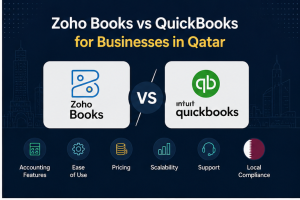
| Platform | Best For | Qatar Strengths | UK Compatibility |
|---|---|---|---|
| Zoho Books | SMEs and growing businesses | Multi-currency, VAT module, Arabic language | Partial (requires configuration) |
| Xero | British expat-owned businesses | IFRS-friendly reporting, strong UK integration | Excellent |
| QuickBooks Online | Businesses with simple reporting needs | Easy setup, widely used by accountants | Good |
| Sage Intacct | Larger SMEs and multi-entity groups | Advanced reporting, consolidation tools | Excellent |
At GMPA LLC, we regularly help businesses in The Pearl, West Bay, and Lusail migrate to the right platform and configure it correctly from the outset. A properly configured system means your reporting runs on autopilot rather than relying on manual extraction and spreadsheet manipulation every month-end. Our dedicated Zoho Books Setup and Automation Services in Qatar page covers this in full detail.
What Is the Step-by-Step Process to Build a Financial Reporting System in Qatar?
Building the system correctly from the start prevents the expensive rework that most businesses eventually face. The following seven-step process is what GMPA LLC applies when implementing financial reporting infrastructure for Qatar-based clients.
Step 1: Business and Regulatory Scoping
Identify your legal structure (QFC, MoCI, or free zone registration), your industry sector, and your reporting obligations. British expats must also confirm their UK tax residency status and any HMRC reporting requirements that remain active.
Step 2: Design the Chart of Accounts
Map all revenue streams, cost categories, assets, and liabilities into a numbered account structure. For multi-currency businesses, set up QAR as the primary currency and GBP or USD as secondary currencies from day one.
Step 3: Select and Configure Your Accounting Platform
Choose a cloud-based system that matches your reporting complexity and integrate it with your bank feeds, invoicing tools, and payroll system. A poor platform choice at this stage creates migration costs later.
Step 4: Establish Month-End Close Procedures
Document a clear month-end checklist covering bank reconciliation, accounts receivable and payable review, accruals posting, payroll reconciliation, and report generation. Assign ownership of each task to a named team member or your GMPA LLC adviser.
Step 5: Build Your KPI Dashboard
Define the five to ten key performance indicators that matter most to your business. Common examples for Qatar SMEs include gross margin, debtor days, creditor days, operating cash flow, and revenue per employee. Build a visual dashboard that refreshes automatically from your accounting system.
Step 6: Implement Internal Controls
Enforce segregation of duties so that no single person can both initiate and approve a transaction. Set up multi-level approval workflows for payments, expenses, and journal entries. Limit system access by role to reduce fraud exposure.
Step 7: Review and Optimise Quarterly
A financial reporting system is not a one-time project. Conduct a structured quarterly review to assess reporting accuracy, close times, and whether your KPI set still reflects current business priorities. See our guide on why regular financial reviews are essential for business growth.
How Does IFRS Affect Financial Reporting for Businesses in Qatar?
Qatar has adopted International Financial Reporting Standards as the recognised framework for financial reporting, particularly for entities regulated by the Qatar Financial Markets Authority (QFMA), the Qatar Central Bank (QCB), and the Qatar Finance Centre (QFC). As the International Accounting Standards Board (IASB) notes, IFRS is now required or permitted in over 140 jurisdictions globally, making compliance not just a local obligation but a competitive advantage when dealing with international partners, banks, and investors.
For practical purposes, IFRS compliance means your financial reporting system must be capable of producing an income statement (profit and loss), a balance sheet, a cash flow statement, and a statement of changes in equity. These four statements must be accompanied by disclosure notes that explain accounting policies, significant judgements, and related-party transactions.
Many SMEs in Doha make the error of treating IFRS as an annual exercise. In practice, IFRS affects day-to-day accounting decisions: how revenue is recognised, how leases are recorded, and how financial instruments are measured. Building these rules into your accounting system from the outset ensures year-end reporting is a consolidation exercise rather than a scramble to restate months of transactions.
Should British Expats in Qatar Use Manual or Automated Financial Processes?
This is one of the most common questions we receive from British expats running businesses in Doha. The short answer is that manual processes are rarely efficient at any meaningful scale and carry disproportionate risk for businesses with dual UK-Qatar reporting obligations. For a full comparison, read our dedicated guide on Manual vs Automated Financial Processes: Which Is Right for Your Business in Qatar.
The key distinction is not simply speed. Automated systems enforce consistency. Every transaction is categorised the same way, every period is closed on the same schedule, and every report is generated from the same underlying data set. Manual processes rely on individual judgment at each step, creating variability that accumulates into material differences by year-end.
For British expats in particular, automated systems also make it far easier to extract the data needed for UK Self Assessment returns, corporate tax filings, and any reporting required under the Common Reporting Standard (CRS), which covers financial account information exchange between Qatar and the UK.
What Are the Most Common Mistakes When Building Financial Reporting Systems in Qatar?
Based on our experience working with SMEs and British expats across Doha, West Bay, Lusail, and Msheireb, the following mistakes appear repeatedly:
Spreadsheets have no audit trail, no access controls, and no automated bank reconciliation. Businesses that outgrow them but keep using them create significant compliance and fraud risk.
A chart of accounts that lumps all expenses into one or two codes makes meaningful management reporting impossible. The fix requires a full recode of historical data, which is expensive and disruptive.
Without a documented close procedure, transactions are posted late, periods are left open, and reports produced mid-month are unreliable because the prior period is still being adjusted.
Profit does not equal cash. Many profitable Qatar SMEs run into liquidity problems because they do not produce cash flow statements or maintain a rolling cash flow forecast alongside their P&L.
For British expat business owners, mixing personal and business finances not only distorts management accounts but creates problems with HMRC when reporting UK income and expenses. The financial system must enforce a clear boundary from day one.
How Do You Know If Your Current Financial Reporting System Needs an Overhaul?
There are clear warning signs that a financial reporting system has become a liability rather than an asset. If your management accounts are consistently produced more than fifteen working days after month-end, if you cannot readily answer questions about gross margin by product or service line, or if your bank reconciliation routinely surfaces unresolved differences, the system needs attention.
Other indicators include a heavy reliance on manual journal entries, frequent requests from your external auditor for additional schedules and explanations, and an inability to produce a cash flow statement without significant manual work. These are not minor inefficiencies. They represent genuine business risk and compliance exposure.
GMPA LLC offers a structured Business Financial Health Check and Financial Systems Review in Qatar that benchmarks your current processes against best practice and produces a prioritised action plan for improvement. The review covers bookkeeping quality, system configuration, reporting timeliness, KPI coverage, and internal controls.
Frequently Asked Questions
Do Qatar businesses have to follow IFRS for their financial reports?
IFRS is required for entities regulated by the QFMA, QCB, and QFC. Many private SMEs are not legally mandated but adopt IFRS voluntarily because banks and investors expect IFRS-compliant accounts when assessing creditworthiness or investment decisions in Qatar.
How long does it take to build a financial reporting system from scratch in Qatar?
For a straightforward SME, a well-structured system can be operational within four to eight weeks, covering platform setup, chart of accounts design, bank feed integration, and a trained month-end close procedure. More complex businesses with multiple entities or currencies take longer.
Can British expats in Doha use UK accounting software for their Qatar business?
Yes, platforms such as Xero and QuickBooks Online are used widely by British expats in Doha because they support multi-currency, produce IFRS-friendly reports, and integrate well with UK accountants and HMRC-compliant tools. Configuration is important to ensure Qatari requirements are also met.
What reports should a Qatar SME produce every month?
At a minimum: a profit and loss statement, a balance sheet, a cash flow statement, an aged debtors report, an aged creditors report, and a variance report comparing actuals to budget. More sophisticated businesses also produce a KPI dashboard and a rolling twelve-month cash flow forecast.
Does GMPA LLC help with financial reporting system setup in Qatar?
Yes. GMPA LLC works with SMEs and British expats across Doha, West Bay, The Pearl, Lusail, and Msheireb to design, implement, and optimise financial reporting systems. We also support clients with continuing UK tax obligations, making us uniquely positioned for British expats who need dual-jurisdiction financial management.
External Source
The International Financial Reporting Standards Foundation (IFRS Foundation) publishes the full set of IFRS standards adopted in Qatar and across the GCC. For guidance on specific standards and their application, visit www.ifrs.org. The Qatar Finance Centre (QFC) also publishes regulatory guidance for entities registered within its jurisdiction at www.qfc.qa.
Ready to Build a Financial Reporting System That Works?
GMPA LLC serves businesses and British expats across Doha, West Bay, The Pearl, Lusail, and Msheireb. Our UK-qualified advisers combine deep knowledge of Qatari business requirements with hands-on experience of HMRC obligations, giving you a single point of contact for both jurisdictions.
| Speak to One of Our UK Accountants — Book Your Free Consultation | View Our Services |
This article was prepared by the GMPA LLC advisory team in Doha, Qatar. GMPA LLC provides financial reporting, bookkeeping, VAT advisory, and virtual CFO services for SMEs and British expats operating across Qatar and the wider GCC. For UK tax matters, GMPA LLC works alongside its sister firm GMPA LLC, based in London and Essex.