









|
Fintech Accounting in Qatar: Specialist Support for QFC Firms in Doha Written by Saira Khan, Co-Founder of GMPA LLC, whose team has 15+ years of UK accounting experience advising British expats and SMEs operating across the UK and Qatar. Reviewed and updated for 2026 |
Fintech accounting Qatar services cover bookkeeping, IFRS reporting, QFC regulatory compliance and cross border tax filing built specifically for financial technology firms operating from the Qatar Financial Centre, helping payment platforms, digital wallets and lending startups meet Qatar Central Bank requirements while managing UK tax duties at the same time.
Key Takeaways
|
Why Do Fintech Firms in the QFC Need Specialist Accounting Support?
A fintech operating through the Qatar Financial Centre is not accounting for a normal trading business. Transaction volumes are high, revenue often arrives through third party payment rails, and regulators expect clean audit trails for every wallet, transfer and settlement. A general accountant without QFC experience can miss reporting requirements that a specialist accounting firm in Qatar would catch immediately. Payment processors, digital lending platforms and e money issuers each carry their own nuances in how revenue is recognised, how client money is ring fenced, and how reserves are reported at year end. Getting this wrong does not just risk a late filing, it can trigger a deeper regulatory review from the QFC Authority, which slows down licensing renewals and investor conversations at the exact moment a founder needs momentum. Our Business Financial Health Check and Financial Systems Review service is often the first step for a fintech founder who wants to know whether their current bookkeeping setup will survive a QFC compliance review, and it usually surfaces gaps long before an external auditor does.
What Accounting and Compliance Challenges Do Fintech Firms Face in Qatar?
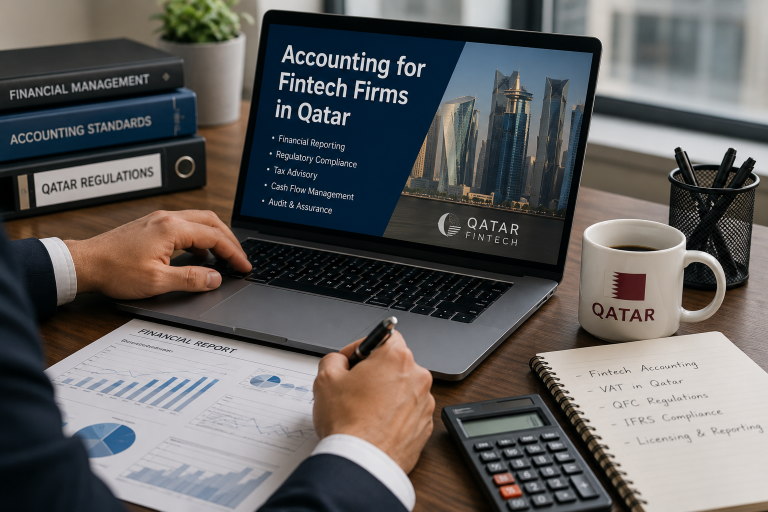
Fintech founders in Doha tell us the same three problems come up again and again. First, reconciling payment gateway settlements against internal ledgers when funds move through multiple currencies and providers, often with settlement lags that make month end close far messier than a standard trading business. Second, producing IFRS aligned financial statements that satisfy both QFC Authority filing rules and any investor due diligence process, since most funding rounds for a Qatar fintech now involve at least one international investor who expects Western reporting standards. Third, keeping pace with the Qatar Central Bank fintech licensing framework, which continues to evolve as the sector matures. According to the Qatar Central Bank fintech sector strategy, the number of licensed fintechs in Qatar is targeted to grow three to five times over the coming years, which means the regulatory environment around reporting and disclosure will keep tightening rather than loosening. Founders who wait until a filing deadline to think about compliance tend to find themselves reacting under pressure rather than planning ahead, which is exactly the pattern a good accounting partner should remove.
|
Common pain point Payment gateway settlement mismatches, delayed IFRS reporting, unclear QFC filing calendar, no visibility on UK tax exposure for the founder. |
How GMPA LLC resolves it Automated reconciliation workflows, a fixed IFRS reporting calendar, a mapped QFC compliance timeline, and combined UK plus Qatar tax planning under one advisor. |
How Does QFC Regulation Affect Fintech Accounting and Tax Reporting?
Firms registered with the QFC operate under their own legal, regulatory and tax environment, separate from mainland Qatar rules. This includes a 10% corporate tax rate on locally sourced profits, a defined annual filing calendar with the QFC Authority, and specific disclosure obligations for firms handling digital assets through frameworks such as the QFC Digital Assets Lab. More than 800 new firms registered with the QFC in 2024 alone, and fintech was one of the categories driving that surge, so the Authority has been actively refining its expectations around reporting quality as the number of licensed firms grows. Fintech directors need an accountant who tracks these obligations proactively rather than reacting after a deadline has passed, and who understands the difference between a standard QFC filing and one for a firm handling client money or tokenised assets. Our Accounting System Migration and Implementation service is frequently used by fintech clients moving away from spreadsheet based bookkeeping toward a proper cloud accounting system that can handle transaction volume at scale, integrate with payment gateways directly, and produce audit ready reports without manual rework each quarter.
What Should Fintech Founders in West Bay, Lusail and The Pearl Know About Bookkeeping Systems?
Most QFC fintech firms are based in West Bay, with a growing number choosing offices in Lusail and Msheireb, and founders often working remotely from The Pearl or splitting time between Doha and the UK. Wherever the team sits, the bookkeeping system needs to handle multi currency wallets, automated bank feeds, and a chart of accounts built for payment processing rather than a generic retail template. A chart of accounts copied from a standard SME setup will not capture the difference between processing fees, chargebacks, float balances and client held funds, and that gap tends to show up at the worst possible time, during an audit or a funding round. We set up cloud accounting platforms configured specifically for fintech transaction types, so monthly reports reconcile cleanly, management can see real time cash position across every wallet, and QFC filings are never a last minute scramble.
How Do British Expat Founders Manage UK and Qatar Tax Obligations Together?
Many fintech founders operating in the QFC are British expats who still hold UK company directorships, rental property, or pension contributions back home. This means Qatar accounting cannot be handled in isolation from UK obligations such as Self Assessment, dividend planning, or non resident landlord rules. A founder who treats the two jurisdictions as completely separate often ends up paying an accountant in the UK and a separate firm in Qatar, with neither side aware of what the other is filing, which creates real risk around double reporting or missed allowances. GMPA LLC serves clients across Doha and the wider Qatar market and supports British expats with their continuing UK tax obligations, giving founders one advisor who understands both systems rather than two separate firms working without visibility of each other. This matters particularly around dividend extraction from a QFC entity, since how and when profits are drawn out affects UK tax exposure just as much as it affects the Qatar side of the business. For founders also planning cash flow around growth or a fundraise, our Financial Advisory Services in Qatar team can build the forecasting model alongside the compliance work, so tax planning and growth planning move together rather than as two disconnected conversations.
In House vs Outsourced Fintech Accounting in Qatar
| Factor | In House Team | Outsourced with GMPA LLC |
| QFC filing calendar management | Depends on staff availability and turnover | Fixed calendar tracked and managed for you |
| UK tax knowledge for founders | Usually limited to Qatar only | Combined UK and Qatar expertise under one advisor |
| Payment reconciliation setup | Built from scratch, slower to launch | Templates already proven with fintech clients |
| Cost at early stage | Salary, visa and office overhead | Scales with your transaction volume |
Frequently Asked Questions
|
Do QFC registered fintech firms need a different accountant than a mainland Qatar business? Yes. QFC firms follow a separate legal and tax framework, so the accountant needs direct experience of QFC filing rules rather than only mainland Qatar accounting practice. |
|
Can GMPA LLC handle both my Qatar accounts and my UK tax return? Yes. GMPA LLC serves clients across Doha and the wider Qatar market and also supports British expats with their continuing UK tax obligations, so both sides are managed together. |
|
What is the corporate tax rate for a fintech firm registered with the QFC? QFC firms are subject to a 10% corporate tax rate on locally sourced profits, alongside 100% foreign ownership and full profit repatriation. |
|
How quickly can a fintech founder move from spreadsheets to a proper accounting system? Most migrations are completed within a few weeks once transaction data, bank feeds and payment gateway integrations are mapped correctly. |
Sector figures referenced above are drawn from Qatar Financial Centre reporting and Qatar Central Bank fintech sector strategy publications.
Ready to put your fintech accounting on a proper footing in Qatar?
|