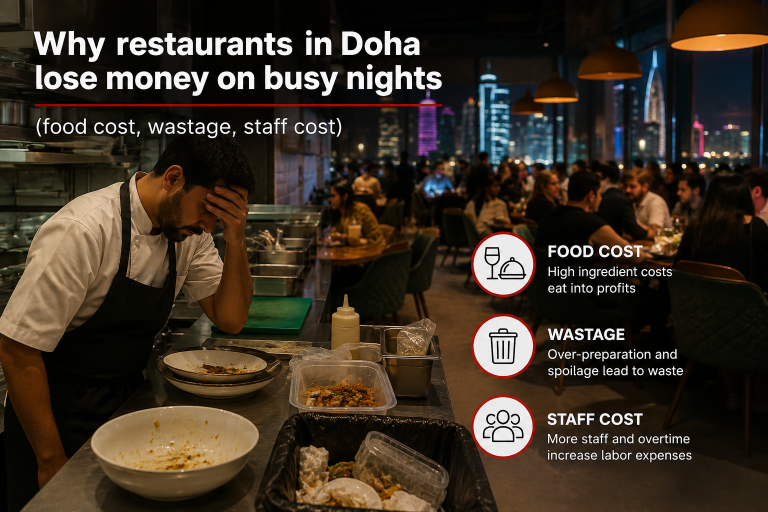
Why Restaurants in Doha Lose Money on Busy Nights: Restaurant Profit Margin and Restaurant Accounting in QatarWritten by Raja Zaman, Head of Business Performance at GMPA LLC, with 10 years of experience in accounting and tax and over 10 years managing stores for Tesco and Iceland. Reviewed and updated for 2026.
A packed dining room in West Bay or a queue out the door in The Pearl looks like success. In practice, a busy night in Doha is often the exact point where a restaurant loses money without anyone noticing, because food cost, wastage and staff cost all spike together while the till is ringing. This guide explains why restaurant profit margin in Qatar can shrink on the nights that feel most successful, and what restaurant accounting in Qatar needs to look like to catch it in time.
Key takeaways
Why do busy nights hide a falling restaurant profit margin in Qatar?Revenue is the number owners watch on a busy night, but revenue and profit are not the same thing. When cover count doubles on a Thursday or Friday in Doha, food cost, staff hours and wastage do not scale up in a straight line, they often scale up faster than sales. Kitchens push suppliers for rush deliveries at a premium, staff go into overtime, and portion control slips under pressure. A venue can post its best revenue night of the month and still lose money once every cost line is properly reconciled. This is exactly the gap that our accounting and bookkeeping for hospitality and restaurants in Qatar service is built to close, by reviewing figures weekly rather than waiting for month end. What food cost problems cause restaurants in Doha to lose money?Food cost percentage is the single biggest driver of restaurant profit margin in Qatar, and it is also the number most likely to drift quietly. Industry research shows gross profit margin for a typical restaurant is generally strong, often in the 70% to 80% range before other costs, but net profit margin usually lands between 3% and 10% once every expense is counted, and food cost is the biggest reason the two figures are so far apart. On peak nights in Doha, rush purchasing at higher prices, over portioning under time pressure and last minute menu substitutions all push food cost up at the exact moment sales are highest. Without daily reconciliation between POS reports, supplier invoices and stock counts, this slippage is invisible until the monthly figures land, by which point several busy weekends may already have lost money. How does staff cost eat into restaurant profit margin across Qatar?Staff cost in Qatar hospitality includes basic salary, overtime, service charge pooling and the visa and accommodation costs tied to expatriate labour law requirements. A busy night usually means calling in extra shift staff or extending existing shifts into overtime, and overtime is paid at a premium rate under Qatar labour law. If a venue does not track labour cost as a percentage of sales in real time, it is easy to assume a full floor and a full kitchen on a Friday night automatically means a good result, when in fact the overtime bill has quietly matched or exceeded the extra covers served. Our bookkeeping services in Qatar build labour cost tracking into the weekly reporting cycle rather than leaving it for the payroll run at month end. Why does wastage spike on the busiest nights in Doha restaurants?Wastage is highest exactly when a kitchen is under the most pressure. Prep quantities are usually built around expected covers, and on an unexpectedly busy night kitchens either over prep as a safety margin, which creates spoilage, or under prep and then rush order replacement stock at a premium, which pushes food cost up instead. Qatar’s hot climate adds another layer, with cold chain and storage costs rising in summer months and any breakdown in refrigeration during a busy service leading to fast spoilage of fresh stock. Tracking wastage as its own line item, separate from food cost generally, is one of the clearest ways a restaurant in Doha can see exactly where busy night profit disappears. What is a healthy restaurant profit margin in Qatar?Most restaurants globally, and this holds broadly true across Doha and the wider Qatar market, operate on a net profit margin of somewhere between 3% and 15%, with premium venues at the higher end and casual or high volume operations often nearer the lower end. Given margins this thin, a small error in food cost tracking or an unnoticed overtime spike on a handful of busy nights can be the difference between a profitable quarter and a loss making one. The table below sets out where nightly reconciliation catches problems that monthly reporting misses. Nightly reconciliation or monthly bookkeeping, which protects restaurant profit margin better?
What Qatar tax and compliance rules affect restaurant profit margin?Most restaurants and cafes trading in Qatar need Dhareeba registration with the General Tax Authority, along with annual corporate income tax filing where applicable and municipality trade licence renewal. Qatar’s hospitality and food service sector has continued to expand, and the Planning and Statistics Authority has reported sustained growth in visitor numbers and hospitality occupancy in recent years. Growth of this kind is good news for revenue, but it also means higher transaction volume, and higher transaction volume raises the cost of getting Dhareeba filing, payroll treatment or VAT readiness wrong. Restaurants moving off older desktop software or disconnected spreadsheets onto a cloud system built for hospitality reporting will find our accounting system migration and implementation services in Qatar cover exactly this kind of transition without disrupting daily trading. Which areas of Doha and Qatar does GMPA LLC support for restaurant clients?GMPA LLC supports restaurant and hospitality clients across Doha and the wider Qatar market, including venues in West Bay, The Pearl, Lusail and Msheireb, alongside independent operators further afield. Work is carried out remotely using cloud accounting software, so a venue’s location within Qatar does not limit the level of support it receives, and reporting can consolidate across multiple outlets and districts where a group operates more than one dining concept. Can GMPA LLC help British expat restaurant owners with UK tax obligations too?Yes. GMPA LLC supports British expats and SMEs operating across the UK and Qatar with continuing UK tax obligations alongside a Qatar based restaurant or hospitality business, including UK self assessment, rental property income back home and coordinating filing deadlines across both countries. Many restaurant owners in Doha still hold UK property, a UK pension or a UK registered company alongside their Qatar operation, and this dual jurisdiction view is a core part of the service. Frequently asked questionsWhy does a full restaurant on a busy night not always mean a profitable night? Because food cost, overtime and wastage all rise sharply on peak nights, sometimes faster than revenue, and without daily reconciliation this can go unnoticed until the monthly figures are prepared. What is a normal restaurant profit margin in Qatar? Net profit margin typically falls between 3% and 15%, depending on venue type, with the lower end being common for high volume or casual dining formats. Does a small independent cafe in Doha still need Dhareeba registration? In most cases yes, Dhareeba registration applies to trading entities regardless of size, and a small independent cafe should confirm its filing position with a qualified accountant rather than assume it is exempt. Can GMPA LLC support a restaurant group with more than one outlet across Doha? Yes, reporting is structured by outlet from the start, so groups running venues across different districts of Doha or elsewhere in Qatar receive both consolidated and outlet level reporting.
Reviewed and updated for 2026. |