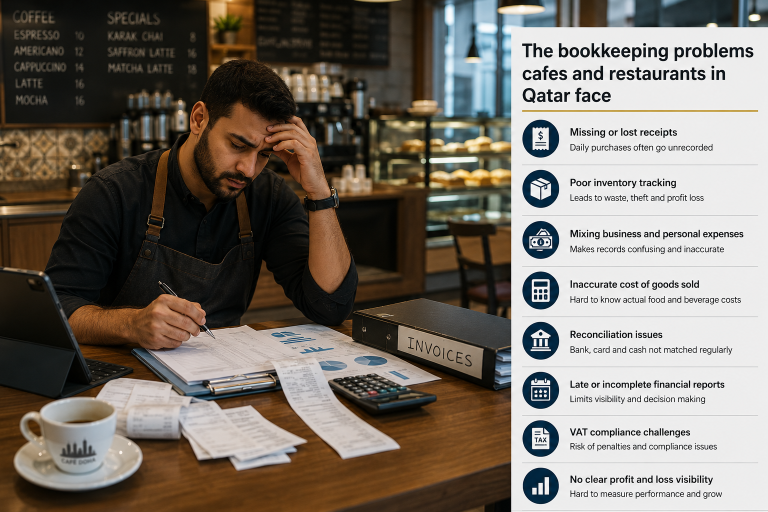
Restaurant Bookkeeping Doha: The Bookkeeping Problems Cafes and Restaurants in Qatar Face in 2026 |
|||||||||||||||
|
|||||||||||||||
|
Restaurant bookkeeping in Doha means recording and reconciling daily sales, food cost, payroll and Dhareeba tax filings for cafes and restaurants across Qatar, a task made harder by thin margins, mixed cash and card takings and multiple delivery platforms operating side by side. |
|||||||||||||||
Key takeaways
|
|||||||||||||||
What bookkeeping problems do cafes and restaurants in Doha commonly face?Cafes and restaurants in Doha typically run into four recurring bookkeeping problems: daily cash and card takings that never quite match the POS report, food cost that creeps upward without anyone noticing until the profit and loss statement lands, payroll that is harder to calculate than a standard office role, and tax filing deadlines that catch owners off guard because nobody flagged them early enough.
None of these problems are unusual for the hospitality sector specifically, but they show up faster and more often in Qatar because trading volume is high, staff turnover among expatriate workers is common, and many venues are still relying on monthly reconciliation built for a slower moving business. Our piece on why restaurants in Doha lose money on busy nights covers how these same pressure points show up specifically during peak trading periods. | |||||||||||||||
Why does daily cash and card reconciliation break down in restaurants?Reconciliation breaks down because a single restaurant in Doha usually collects revenue through several channels at once, dine in cash, dine in card, delivery apps such as Talabat and Snoonu, and sometimes catering invoices settled separately. Each channel deposits money on a different schedule, and each platform deducts its own commission before the payout lands in the bank. If bookkeeping only happens once a month, small mismatches between the POS report, the bank statement and the delivery platform statement quietly pile up, and by the time anyone notices, it can take days to trace where the gap actually started. Weekly reconciliation against all three sources at once, rather than waiting for a bank statement at month end, is the practical fix most owners have never had time to put in place. |
|||||||||||||||
How does food cost and wastage get missed in restaurant bookkeeping?Food cost and wastage get missed because generic bookkeeping treats a restaurant like any other retail business, recording supplier invoices and sales without tracking the relationship between the two. A rising food cost percentage is one of the earliest and clearest signs that something in the kitchen has changed, portion sizes have drifted, a supplier has quietly raised prices, or spoilage has increased, but it only shows up if someone is tracking food cost as a percentage of sales on a weekly basis rather than reading a single profit and loss line once a month. For a full breakdown of how wastage and food cost silently erode margin during busy periods specifically, see our guide on why restaurants in Doha lose money on busy nights. |
|||||||||||||||
What payroll problems are specific to Qatar restaurant and cafe staff?Payroll in a Doha restaurant is rarely as simple as a fixed monthly salary. Service charge pooling has to be split fairly across front of house staff, overtime is tied to shift patterns that change week to week around events and holidays, and Qatar labour law requirements for expatriate staff, including end of service benefits and correct leave accrual, need to be calculated accurately from day one rather than estimated. When payroll bookkeeping is treated as an afterthought, these calculations are often done inconsistently between pay periods, which creates disputes with staff and inaccurate labour cost reporting for the owner. |
|||||||||||||||
What Qatar tax and compliance obligations catch restaurant owners off guard?Most restaurant and cafe operators in Qatar must register on the Dhareeba portal with the General Tax Authority and file an annual corporate tax return, generally due within four months of the financial year end, and audited financial statements are required once annual revenue passes QAR 500,000. According to the General Tax Authority, penalties for registration failures and late filing can reach into the hundreds of thousands of riyals, and accounting records must be retained for a set number of years in case of review. Owners are often caught out not because the rules are hidden, but because nobody in the business is tracking the deadline calendar alongside day to day bookkeeping. A specialist accountant builds compliance checkpoints into the same weekly process that handles sales and food cost, rather than treating tax filing as a separate annual scramble. |
|||||||||||||||
In house bookkeeping or outsourced restaurant bookkeeping in Doha, which solves these problems?Both models can work, but they solve these problems differently. The table below sets out how each approach handles the issues raised above.
|
|||||||||||||||
Which areas of Doha and Qatar does GMPA LLC support?GMPA LLC supports restaurant and cafe owners across Doha and the wider Qatar market, including venues in West Bay, The Pearl, Lusail and Msheireb, alongside independent operators further afield and hospitality groups managing outlets across the wider GCC. All bookkeeping is handled through cloud accounting software, so a venue’s district within Doha never limits the level of support it receives. For a full breakdown of how this is structured for hospitality specifically, our accounting and bookkeeping for hospitality and restaurants in Qatar page covers the full service in detail. |
|||||||||||||||
Can GMPA LLC help British expat restaurant owners with UK tax alongside Qatar bookkeeping?Yes. GMPA LLC supports British expats and SMEs operating across the UK and Qatar with continuing UK tax obligations alongside their Qatar based restaurant or cafe, including UK self assessment, income from UK rental property, and coordinating filing deadlines across both countries so nothing is missed. This dual jurisdiction view matters for many restaurant owners in Doha who still hold UK property, UK pension arrangements or a UK registered company alongside their Qatar operation. |
|||||||||||||||
How do I fix these bookkeeping problems for my restaurant or cafe?Fixing these problems starts with a short review of your current setup, how often reconciliation happens, whether food cost is tracked weekly, how payroll is calculated, and where your Dhareeba filing position currently stands. From there, a scope of work is built around your outlet count and transaction volume rather than a fixed package applied to every client regardless of size. There is no obligation attached to the initial review, and no pricing pushed before your situation has actually been looked at. |
|||||||||||||||
Frequently asked questionsDo small independent cafes in Doha need Dhareeba registration? In most cases yes, Dhareeba registration applies regardless of size, and a small independent cafe should confirm its filing position with a qualified accountant rather than assume it is exempt. How often should a restaurant reconcile its books? Weekly is the practical minimum given daily cash and card mix, food cost movement and multiple sales channels. Monthly reconciliation alone tends to hide problems for too long. Can GMPA LLC support restaurants with multiple outlets across Doha and Qatar? Yes, reporting is structured by outlet from the start, so groups running venues across different districts of Doha or further afield in Qatar get consolidated and outlet level reporting together. Do you help British expats who still file UK tax returns? Yes, this is a core part of the service given our UK background, coordinating Qatar hospitality bookkeeping alongside ongoing UK filing obligations for expat owners. |
|||||||||||||||
|
|||||||||||||||
|
Reviewed and updated for 2026. |