










QFC vs Mainland Qatar: Which Is Right for Your Business in Doha and Across Qatar? (2026 Guide)
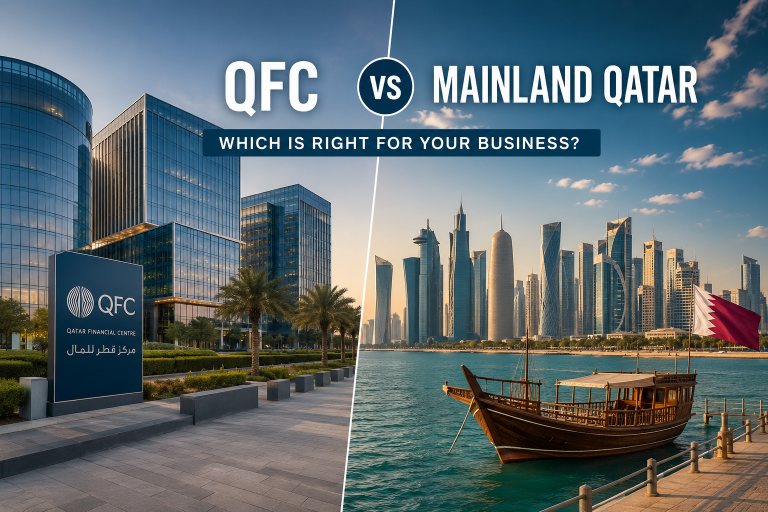
Choosing between the Qatar Financial Centre and a mainland company depends almost entirely on who your customers are. If you serve other businesses internationally, the QFC usually suits you best. If you plan to sell directly to Qatari consumers or bid on government contracts, mainland registration is the stronger route.
|
Key Takeaways 1. The QFC operates under English common law and permits full foreign ownership with no minimum share capital for most activities. |
| QFC versus mainland Qatar refers to the choice between two separate legal jurisdictions for company registration in Qatar. The QFC is a common law financial and professional services jurisdiction based in Doha, while mainland companies register through the Ministry of Commerce and Industry under Qatar’s civil law framework. |
Founders and expats weighing up a new venture in Qatar often assume the decision comes down to tax rates. In practice, the deciding factor is almost always your client base and your business activity. This guide sets out the practical differences between the two routes for 2026, with a clear framework for making the right call.
What Is the QFC and What Is a Mainland Company?
The Qatar Financial Centre was established in 2005 and is regulated by the QFC Authority and the QFC Regulatory Authority. It operates under English common law, the same legal tradition used in the UK, Singapore and Hong Kong, and maintains its own independent courts. It was built to attract international professional and financial services firms, and it permits 100 percent foreign ownership with no minimum share capital requirement for most activities.
A mainland company is registered with the Ministry of Commerce and Industry and governed by Qatar’s civil law commercial framework. The most common structure is a Limited Liability Company, often referred to as a WLL. Mainland registration suits trading, retail, construction, hospitality, manufacturing and most consumer facing service businesses operating anywhere in Doha or the wider country.
What Is the Main Difference Between QFC and Mainland Qatar?
The clearest dividing line is permitted business activity. The QFC maintains a defined list centred on financial services, consulting, legal work, accounting, fintech, IT, media and headquarters functions. Trading, retail, manufacturing and construction sit outside that list entirely. If your business involves any of these activities, mainland registration is your only realistic option in Qatar.
The mainland framework, by contrast, covers almost every legitimate commercial activity through MOCI licensing. Qatar’s Foreign Capital Investment Law, Law Number 1 of 2019, opened most commercial, service and industrial sectors to full foreign ownership on the mainland, although a small number of restricted activities such as commercial agencies and security services still require a Qatari partner.
Which Structure Lets You Trade With Government and Local Consumer Clients?
Mainland companies have unrestricted access to Qatar’s domestic market, including retail sales, consumer contracts and full participation in government tenders. In an economy where government linked and state adjacent entities represent a significant share of commercial activity, this matters enormously for businesses whose revenue depends on public sector work.
QFC companies can serve business clients physically based in Qatar, including firms in West Bay, Lusail, The Pearl and Msheireb, but this is generally on a business to business basis. Direct retail trade is not permitted, and participation in general government procurement is more limited than for mainland entities. If public sector contracts are central to your plan, mainland registration is the more reliable route.
How Do Setup Costs and Timelines Compare Between QFC and Mainland Qatar?
Mainland LLCs require a minimum share capital of QAR 200,000, roughly USD 55,000, deposited into a verified corporate account once the Commercial Registration is finalised. Registration through MOCI typically takes eight to twelve weeks, covering trade name reservation, ministerial approval, notarisation of the Articles of Association and sector specific approvals.
The QFC imposes no fixed minimum share capital for most non financial activities, and registration through the QFC Authority typically completes within two to four weeks. This makes the QFC considerably more accessible for early stage professional services businesses that do not want a large upfront capital commitment.
| Feature | Mainland (LLC / WLL) | QFC |
| Governing authority | Ministry of Commerce and Industry | QFC Authority |
| Legal framework | Qatar civil law | English common law |
| Foreign ownership | Up to 100 percent in most sectors | 100 percent guaranteed across all permitted activities |
| Minimum share capital | QAR 200,000 | None for most activities |
| Local consumer and government access | Full access | Business to business only, limited government access |
| Permitted activities | Trading, retail, manufacturing, construction, services | Finance, consulting, legal, fintech, IT, media |
| Typical registration time | 8 to 12 weeks | 2 to 4 weeks |
Which Option Is Better for British Expats Running a Business in Qatar?
For British expats, the QFC versus mainland decision sits alongside a separate and ongoing question: continuing UK tax obligations. Leaving the UK does not automatically end HMRC’s interest in your affairs. Under the Statutory Residence Test, many British expats based in Doha remain partially or fully UK tax resident, particularly in the early years abroad or where UK property, a UK company or frequent UK visits continue.
A British founder who registers a QFC entity for consulting or financial services work, while also retaining a UK registered company, will typically face two parallel filing programmes: UK annual accounts and corporation tax through Companies House and HMRC, alongside the QFC’s own annual filing cycle. The same principle applies to expats who choose mainland registration instead. The structure you pick in Qatar changes your Qatar side compliance calendar. It does not remove your UK obligations. GMPA LLC serves clients across Doha and the wider Qatar market, and supports British expats with continuing UK tax obligations including Self Assessment, dividend planning and UK corporate filings, alongside whichever Qatar structure they choose.
Which Should You Choose, QFC or Mainland Qatar?
|
Consider the QFC if: you provide professional, financial, consulting, legal, fintech, IT or media services, your clients are primarily other businesses rather than consumers, you want guaranteed full foreign ownership with no minimum capital, and English common law contracts matter to your operations.
Consider mainland registration if: your activity involves trading, retail, manufacturing, construction or hospitality, winning government tenders is central to your revenue, or you need to sell directly to consumers anywhere in Doha or the wider country. |
Some businesses eventually operate both. A QFC entity handles international and professional services work, while a separate mainland company manages domestic trading or government facing contracts. Each entity is registered and taxed independently, and this dual structure is common among mid sized professional services firms serving both private and public sector clients across Qatar.
According to the Qatar Financial Centre Authority, QFC registered firms benefit from full foreign ownership, access to more than 80 double taxation treaties and a 10 percent corporate tax rate applied only to Qatar sourced profit, with foreign sourced income generally exempt.
How Can GMPA LLC Help You Decide Between QFC and Mainland Qatar?
GMPA LLC advises founders, SMEs and British expats in Doha, West Bay, The Pearl, Lusail and Msheireb on choosing and setting up the right structure, and on managing ongoing compliance once registered. If you already operate a QFC entity, our QFC annual filing requirements checklist sets out the full 2026 deadline calendar, and our guide on preparing your QFC firm for its first audit covers what auditors expect in year one. We also support British expats and SMEs with continuing UK obligations alongside their Qatar entity, whichever structure they choose.
| Frequently Asked Questions | |
| Can a QFC company serve clients based in Qatar? Yes, primarily on a business to business basis. QFC companies can hold contracts with Qatari counterparties and invoice clients physically based in Qatar, but direct retail trade and most government tender participation fall outside QFC permissions. |
|
| Is full foreign ownership guaranteed on the mainland? For most sectors, yes, following Qatar’s Foreign Capital Investment Law. A small number of activities, including commercial agencies and security services, still require a Qatari partner. |
|
| Which structure suits a consulting business run by a British expat? The QFC is usually the stronger fit for a consulting or professional services business, given its common law framework, full foreign ownership and absence of minimum share capital. UK tax obligations still need separate consideration regardless of the Qatar structure chosen. |
|
| Can I operate a QFC entity and a mainland company at the same time? Yes. This dual structure is common among professional services firms in Doha that serve both international clients and the local or government market. Each entity is registered and taxed separately. |
|
| Do I still need to file a UK Self Assessment return once I set up in Qatar? It depends on your residency status under HMRC’s Statutory Residence Test. Many British expats in Doha and across Qatar remain obligated to file, particularly in transition years or where UK income or property is retained. |
This article is intended for general guidance only and does not constitute regulated legal or tax advice. Regulatory requirements may change. Always confirm current rules with the QFC Authority, the Ministry of Commerce and Industry, or a qualified adviser. Source: Qatar Financial Centre Authority (qfc.qa).
Written by Saira Khan, Co-Founder of GMPA LLC, whose team has 15+ years of UK accounting experience advising British expats and SMEs operating across the UK and Qatar. Updated for 2026.
| Speak to One of Our UK Accountants, Book Your Free Consultation | View Our Services |