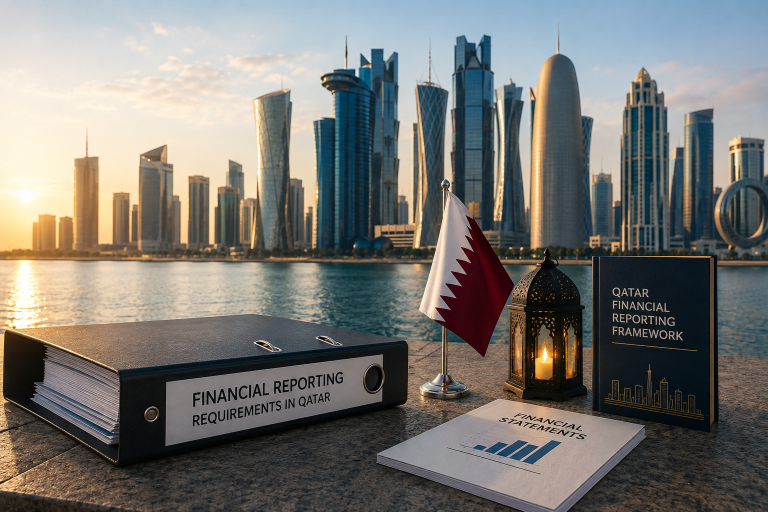
Financial Reporting Requirements for Businesses in Qatar: A 2026 Guide for Doha and Qatar CompaniesWritten by Saira Khan, Co-Founder of GMPA LLC, whose team has 15+ years of UK accounting experience advising British expats and SMEs operating across the UK and Qatar. Updated for 2026. |
|||||||||||||||
|
If your company operates in Qatar, you are required to keep accurate accounting records, prepare financial statements in line with recognised international standards, and submit those statements to the relevant regulator within a set deadline after your financial year ends. The exact rules depend on whether you are registered onshore through the Ministry of Commerce and Industry or through the Qatar Financial Centre, and whether your business is publicly listed, privately held, or a branch of a foreign company. |
|||||||||||||||
|
Key Takeaways
|
|||||||||||||||
|
Definition: Financial reporting requirements in Qatar refer to the legal obligations placed on registered businesses to maintain accounting records, prepare annual financial statements under an approved standard, have them independently audited where required, and submit them to the correct regulator by a fixed statutory deadline. |
|||||||||||||||
What Are the Financial Reporting Requirements for Businesses in Qatar?Every registered business in Qatar, whether based in Doha, West Bay, Lusail, or Msheireb, must keep proper accounting records and prepare an annual financial statement. Oversight is shared between three main bodies: the Ministry of Commerce and Industry for mainland companies, the Qatar Financial Centre Regulatory Authority for QFC-registered entities, and the Qatar Central Bank for banks and financial institutions. The General Tax Authority separately requires audited statements to accompany your annual tax return. Together these bodies define what your business must record, how it must be reported, and when it must be filed. For businesses that also answer to UK obligations, such as British owned SMEs or expat directors, this creates a second layer of reporting that needs to be planned for alongside the Qatar requirements rather than treated as a separate task once a year.
|
|||||||||||||||
Who Must Prepare Audited Financial Statements in Qatar?A statutory audit becomes mandatory once a company’s capital or profit exceeds QAR 100,000, and it also applies automatically to any company headquartered outside Qatar operating through a branch. In practice this threshold is low enough that the large majority of active SMEs across Doha fall within it, not just large corporates. Publicly listed companies and QCB regulated banks and financial institutions must also be audited without exception. Free zone and wholly foreign owned businesses tend to face additional layers of reporting and licensing renewal checks on top of the standard audit requirement. |
|||||||||||||||
Which Accounting Standards Apply to Companies in Qatar?Qatar has adopted International Financial Reporting Standards as its recognised accounting framework, and the Qatar Financial Markets Authority requires listed companies to prepare statements in line with IFRS. QFC registered entities may also be permitted to apply UK GAAP, US GAAP, or AAOIFI standards depending on their activity, which is a detail that often catches businesses moving from a UK reporting background by surprise.
|
|||||||||||||||
What Are the Financial Reporting Deadlines in Qatar?Most mainland companies must file their audited financial statements together with their annual tax return within four months of their financial year end, with the General Tax Authority able to grant an extension of up to a further four months at its discretion. QFC registered companies typically face a separate deadline of around three months after year end for their annual report to the Companies Registration Office, and QFC firms under Article 40 of the Financial Services Regulations must also submit a report on persons with control over the firm within four months of year end. Accounting records themselves must be kept for a minimum of ten years, and public listed companies must publish their financial statements in both Arabic and English newspapers fifteen days before their annual general meeting. |
|||||||||||||||
What Documents Make Up a Complete Financial Statement in Qatar?A complete financial statement filed in Qatar generally needs to include the following, each prepared to the applicable accounting standard and, for mainland filings, submitted in Arabic.
|
|||||||||||||||
How Do QFC Reporting Requirements Differ from Mainland Qatar Requirements?Businesses registering through the Qatar Financial Centre, a common route for firms based around West Bay and the wider GCC financial hub, follow a distinct set of rules from those registered directly with the Ministry of Commerce and Industry.
|
|||||||||||||||
What Happens If a Business Misses Its Reporting Obligations in Qatar?Missing a filing deadline or submitting non compliant financial statements can lead to financial penalties, rejected filings, reputational damage with regulators and banking partners, and in more serious cases a suspension of your ability to trade. One 2026 development that raises the stakes further is the introduction of Qatar’s Global Minimum Tax regime under the OECD Pillar Two framework, which requires large multinational groups operating in Qatar to submit a GloBE Information Return within fifteen months of their reporting fiscal year end, adding a new compliance layer on top of standard statutory reporting. Businesses should also expect updated presentation requirements as IFRS 18 begins to affect how financial performance is shown in reporting periods from 2026 onward, so reviewing your reporting systems this year rather than next is a sensible precaution. |
|||||||||||||||
How Should British Expats in Qatar Handle UK and Qatar Reporting Together?Many British business owners and directors in Doha continue to carry UK reporting duties alongside their Qatar obligations, whether that is a UK registered company, rental income back home, or ongoing HMRC filing as a non resident. The two systems run on different calendars, different standards, and different definitions of taxable presence, so treating them as one combined annual process rather than two separate deadlines tends to save both time and unnecessary tax exposure. GMPA LLC supports clients across Doha and the wider Qatar market with exactly this dual perspective, helping British expats and SME owners meet their Qatar reporting requirements while staying on top of continuing UK tax obligations at the same time. If you are building out your reporting function from scratch, our guide on financial controls every SME in Qatar should implement is a useful next step once your statutory filing obligations are covered. |
|||||||||||||||
Frequently Asked QuestionsWhat is the audit threshold in Qatar? A statutory audit is required once a company’s capital or profit exceeds QAR 100,000, and it applies automatically to any branch of a foreign headquartered company. Do all companies in Qatar need an auditor? Most active trading companies do once they pass the QAR 100,000 threshold, though certain passive holding companies and government owned special purpose entities can be exempt unless specifically asked to file. What accounting standard does Qatar use? Qatar has adopted IFRS as its core recognised standard, with QFC entities able to apply UK GAAP, US GAAP, or AAOIFI in certain approved cases. How long must Qatar companies keep financial records? Accounting books, registers, and supporting documents must be retained in Qatar for a minimum of ten years from the end of the relevant financial year. Do QFC companies have different reporting rules to mainland companies? Yes. QFC entities report to the QFC Authority and QFCRA in English on a broadly three month deadline, while mainland companies report to the Ministry of Commerce and Industry and GTA in Arabic on a broadly four month deadline. |
|||||||||||||||
|
Reporting rules in Qatar continue to develop each year, and the Qatar Financial Centre’s own compliance guidance is worth bookmarking as a primary reference point for QFC registered businesses. For a broader look at getting your numbers in order before reporting season, see our related posts on financial planning tips for rapidly growing companies and financial forecasting strategies for business owners. If you would rather hand the whole process to a specialist, our financial advisory services in Qatar page covers how we support that end to end. |
|||||||||||||||
|