What Is Driving Qatar’s Fintech Boom in 2026?
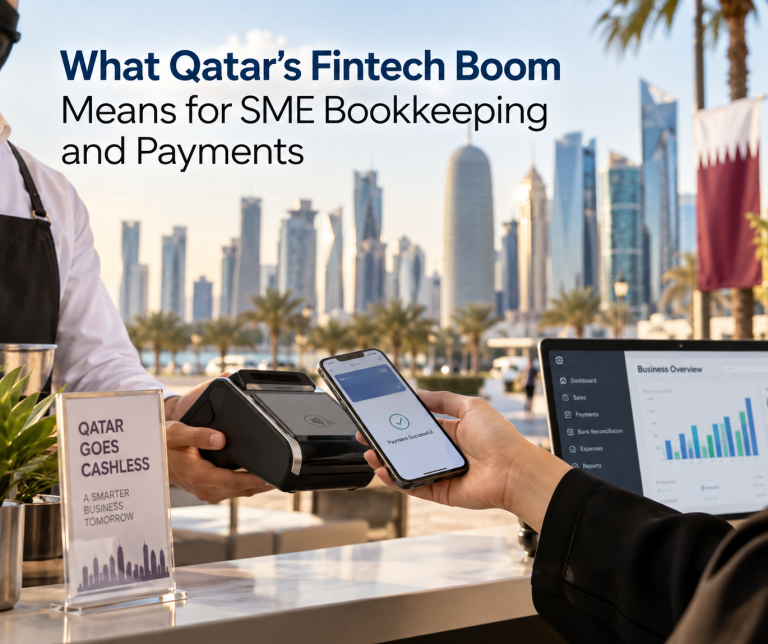
Qatar’s fintech sector reached roughly 526.6 million US dollars last year and is projected to grow to over 2 billion US dollars by 2034, expanding at close to 16 percent annually, according to IMARC research covered by The Peninsula Qatar. This growth is being driven by three main forces. First, Qatar Central Bank’s National Fintech Strategy is actively building a regulatory sandbox and licensing framework that makes it easier for new payment providers to launch. Second, digital adoption in Qatar is among the highest in the region, with internet penetration close to 99.7 percent and the majority of in store transactions now completed by contactless payment. Third, government backed programmes under Qatar National Vision 2030 are pushing SME digital transformation as a strategic priority, not an optional upgrade.
For SME owners in Doha, this means the payment and banking infrastructure around their business is changing faster than most internal bookkeeping processes are keeping up. A business still reconciling invoices manually in a spreadsheet is now operating several steps behind the payment systems its customers and suppliers are using.
Qatar FinTech Hub also plays a supporting role, connecting new payment and financial technology providers with local banks, merchants and government partners so that fintech products reach SMEs faster than they would in a less coordinated ecosystem. Together with the regulatory sandbox run by Qatar Central Bank, this means new bookkeeping integrations and payment tools are being tested and released at a pace most Doha SMEs have not seen before, and the businesses paying attention now will be the ones set up to use them first.
How Does Qatar’s Fintech Growth Affect SME Bookkeeping?
Fintech growth changes bookkeeping in three practical ways. Payment data now arrives in real time rather than in batches, which means bank feeds and automated reconciliation tools produce far more accurate day to day records than manual entry. Digital wallets and merchant QR payments generate transaction data that needs to be categorised correctly for reporting purposes, not just recorded. Open banking initiatives being developed by Qatar Central Bank will eventually allow bookkeeping platforms to pull data directly from business bank accounts with the owner’s consent, removing a layer of manual work entirely.
SMEs that continue to rely on manual bookkeeping are not just working harder than they need to. They are also missing the early warning signs that automated reconciliation and dashboard reporting are designed to surface, such as slowing customer payments or rising reconciliation gaps. Our Bookkeeping Services in Qatar are built around exactly this shift toward automated, fintech connected records.
Categorisation matters as much as capture. A payment landing through a digital wallet or a merchant QR code still needs to be correctly assigned to the right income category, cost centre or client account, and Qatar’s growing mix of payment rails means SMEs are handling more transaction types than they were even two years ago. Businesses that set up their chart of accounts and automation rules properly at the start avoid a backlog of unclassified transactions that becomes far harder to unpick months later.
What Do Fawran and Instant Payments Mean for Doha Businesses?
Fawran is Qatar’s instant payment system, built to allow account to account transfers that settle in seconds rather than the one to two business days typical of older bank transfers. For SMEs, faster settlement means cash appears in the business account sooner after a customer pays, which directly improves working capital and reduces the need to chase overdue invoices. Point of sale transaction volumes in Qatar have already surpassed 32 million transactions in a single month this year, reflecting how quickly instant and contactless payments have become the default rather than the exception.
The practical bookkeeping implication is that reconciliation needs to happen more frequently, not just at month end. A business receiving instant payments throughout the day benefits from daily or weekly reconciliation cycles rather than a single monthly catch up, otherwise the speed advantage of instant payments is lost to a slow manual bookkeeping process behind it. This is a core part of our Zoho Books Setup and Automation Services in Qatar, where bank feeds are configured to reconcile automatically as payments land.
There is also a working capital benefit that goes beyond bookkeeping neatness. When cash settles instantly rather than sitting in transit for a day or two, SMEs have a clearer, more current view of what they can actually spend on stock, payroll or supplier payments at any given moment. Forecasting built on delayed settlement data understates real available cash, and in a market moving toward instant payments, that gap between reported cash and actual cash can quietly undermine decision making if bookkeeping systems are not updated to match.
How Are West Bay, The Pearl, Lusail and Msheireb Businesses Adapting?
Adoption is not uniform across Doha. Businesses based in West Bay, home to many regional headquarters and financial services firms, tend to adopt digital payment infrastructure earliest because their clients and banking partners already expect it. The Pearl and Lusail, both home to a high concentration of retail, hospitality and lifestyle SMEs, are seeing rapid uptake of contactless and QR based payments driven by consumer demand rather than B2B pressure. Msheireb, as Qatar’s flagship smart city development, is positioned as a testbed for integrated digital infrastructure, and SMEs operating there often have access to newer payment and connectivity systems before they reach the wider market.
Across the wider GCC, Qatar is competing directly with the UAE and Saudi Arabia for fintech investment and talent, which is accelerating the pace of change for every SME operating in Doha regardless of district. For SMEs with cross border trading relationships within the GCC, this regional competition is a practical advantage, since payment corridors between Qatar, the UAE and Saudi Arabia are becoming faster and better integrated as each market pushes its own fintech agenda forward.
What Should British Expats Running SMEs in Qatar Know About This Shift?
British expats running SMEs in Qatar face a dual compliance position that most fintech commentary overlooks. Qatar’s payment infrastructure changes are shifting how local bookkeeping should be structured, but income earned by UK connected individuals and companies can still carry ongoing UK tax reporting obligations, particularly around self assessment, non resident status and any UK linked income streams. GMPA LLC serves clients across Doha and the wider Qatar market and supports British expats with continuing UK tax obligations alongside their day to day Qatar bookkeeping and payment systems.
Getting the bookkeeping foundation right in Qatar, with accurate, fintech enabled records, also makes UK reporting more straightforward, because clean local records are easier to translate into UK compliant figures when the time comes.
This is particularly relevant for expats managing property income, investments or a second business back in the UK alongside their Qatar operations, where HMRC reporting deadlines run independently of anything happening locally in Doha. Keeping Qatar bookkeeping current throughout the year, rather than reconstructing it at UK filing time, removes one of the most common causes of late or inaccurate UK submissions among British business owners overseas.
Manual Bookkeeping Versus Fintech Enabled Bookkeeping in Qatar
|