










If your business will trade goods, manufacture, or operate regionally from a fixed site, a Qatar Free Zone under the Qatar Free Zones Authority (QFZA) is usually the better fit because of its long tax holiday and single point of licensing. If you provide consulting, financial, legal or technology services and want an English common law framework with an onshore Doha presence, the Qatar Financial Centre (QFC) is normally the right choice. Most businesses can complete registration under either route within two to six weeks once the activity and structure are confirmed.
Key Takeaways
- Qatar Free Zones (QFZA) offer up to a 20 year corporate tax holiday and 100% foreign ownership, but restrict direct trading into the Qatar mainland market.
- The QFC applies a flat 10% corporate tax on Qatar sourced profits, with foreign sourced income generally exempt, and operates under English common law.
- QFZA suits trading, logistics, manufacturing and technology companies based at Ras Bufontas or Umm Alhoul.
- QFC suits consulting, financial services, fintech, legal and professional services firms that want an onshore presence anywhere in Doha, including West Bay, The Pearl, Lusail or Msheireb.
- Neither structure automatically allows bidding on Qatar government contracts, which generally still requires a mainland registration alongside it.
- British expats setting up either structure in Qatar must also continue tracking their UK tax position under HMRC rules.
Definition. A Qatar Free Zone is a designated economic area under QFZA offering full foreign ownership and tax incentives for trading and industrial firms, while the QFC is an onshore jurisdiction under English common law built for financial and professional services businesses in Qatar.
On This Page
- What is the difference between a Qatar Free Zone and the QFC?
- What is a Qatar Free Zone and who is it best for?
- What is the QFC and who should register there?
- How do Free Zone and QFC tax rates compare?
- Which structure fits British expats and SMEs in Doha?
- What does setup cost and how long does it take?
- What mistakes do businesses make when choosing?
- How can GMPA LLC help?
- Frequently asked questions
What Is the Difference Between a Qatar Free Zone and the QFC?
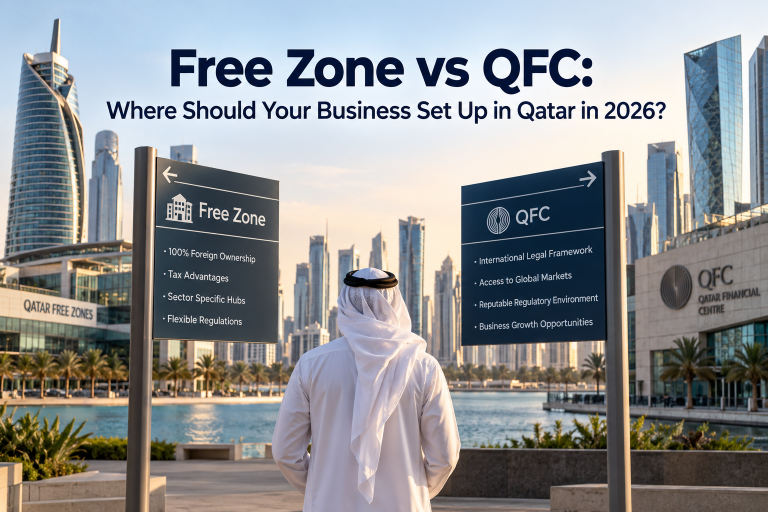
The two structures are built for entirely different purposes, and this is where most first time investors in Qatar get confused. A Qatar Free Zone is a physical location. It is administered by the Qatar Free Zones Authority (QFZA) and tied to one of two designated sites, Ras Bufontas next to Hamad International Airport or Umm Alhoul next to Hamad Port. A free zone company holds a licence to operate from within that zone and benefits from a long term tax holiday and customs relief on imported machinery and materials.
The QFC is not a physical zone at all. It is an onshore legal and regulatory jurisdiction that sits alongside Qatar’s civil law system, with its own courts, its own regulator, and its own companies registry. A QFC registered firm can operate from any approved office anywhere in Qatar, including West Bay, Lusail or Msheireb, and does not need to be located inside a designated free zone. Put simply, QFZA is about where you are based and what you trade, while the QFC is about which legal and tax framework governs a professional or financial services firm.
What Is a Qatar Free Zone and Who Is It Best For?
Qatar’s free zones are overseen by QFZA, which acts as a single authority across licensing, facilities, visa allocation and compliance. That single point of contact is one of the reasons free zone setup is often quicker than a mainland company registration. QFZA companies can be granted 100% foreign ownership, a renewable corporate tax holiday of up to 20 years, and zero customs duties on imported machinery and raw materials used in production.
The trade off is market access. A free zone company can provide services to mainland clients, but moving physical goods into the domestic Qatari market attracts standard customs duties rather than duty free treatment, and free zone entities are generally excluded from bidding on Qatar government contracts. For a business built around exporting, regional logistics, manufacturing or technology operations that do not depend on local retail footfall, this is rarely a problem. For a business that expects most of its revenue from Qatari consumers or government tenders, it usually is.
- Best suited to logistics, manufacturing, aviation support and technology companies with a regional or export focused model.
- Two zone choices, Ras Bufontas for aviation, air cargo and high tech operations, and Umm Alhoul for industrial, manufacturing and sea freight activity.
- Typical setup timeline of two to five weeks once documentation is complete.
What Is the QFC and Who Should Register There?
The Qatar Financial Centre was established under Law No. 7 of 2005 as an onshore business and financial hub for Doha, with its regulatory framework built on English common law. It has its own courts, the QFC Court and the QFC Regulatory Tribunal, and its own regulator, the QFC Regulatory Authority (QFCRA). For firms and individuals used to a common law system, that is a meaningful difference from Qatar’s civil law framework, not just a formality.
QFC licences are aimed squarely at professional and financial activity: consulting, financial services, insurance, fintech, legal practice, accounting, asset management and technology. Physical trading, retail and manufacturing fall outside the QFC’s permitted activity list, which is why a business planning to import and sell goods locally should be looking at a mainland or free zone route instead. Corporate tax within the QFC sits at 10% on Qatar sourced profits, and income sourced from outside Qatar is generally exempt, which is part of why the QFC has become popular with internationally active service businesses.
- Best suited to consulting, financial services, insurance, fintech, legal, accounting and asset management firms.
- No fixed zone location, QFC firms can operate from any approved Doha office.
- Typical setup timeline of three to six weeks for a straightforward professional services application.
How Do Free Zone and QFC Tax Rates Compare in Qatar?
The table below sets out the practical differences side by side. These are the questions we are asked most often by founders and expats comparing the two routes.
| Feature | Qatar Free Zone (QFZA) | Qatar Financial Centre (QFC) |
|---|---|---|
| Governing framework | QFZA regulations within the zone | English common law, own courts |
| Foreign ownership | Up to 100% | Up to 100% |
| Corporate tax | Tax holiday of up to 20 years | 10% on Qatar sourced profits |
| Physical location | Ras Bufontas or Umm Alhoul only | Any approved office in Qatar |
| Best for | Trading, logistics, manufacturing, tech | Consulting, finance, legal, fintech |
| Sell direct to Qatar mainland | Limited, customs duties apply | Onshore, but activity restricted |
| Government contracts | Generally not eligible | Generally not eligible |
| Typical setup time | 2 to 5 weeks | 3 to 6 weeks |
Which Structure Fits British Expats and SMEs Setting Up in Doha in 2026?
Doha’s commercial districts each attract a slightly different mix of investors. West Bay and Msheireb remain the centre of gravity for professional and financial firms, which is part of why QFC registrations cluster there. Lusail is increasingly popular for technology and consulting firms wanting a newer commercial address, while The Pearl continues to draw boutique advisory and professional practices. QFC entities are not restricted to any one of these districts, so the choice often comes down to lease terms and client proximity rather than regulation.
For British expats, the structure decision does not remove UK obligations. Leaving the UK to run a business from Doha does not automatically end UK tax residency. HMRC applies the Statutory Residence Test (SRT) to determine residency status, and many British expats remain partially or fully UK tax resident in their early years abroad, particularly if they retain UK property or visit the UK regularly. A British national running a QFC entity or a free zone company in Qatar may still need to file a UK Self Assessment return, and if they hold a UK registered company alongside their Qatar entity, that company still owes annual accounts to Companies House and a corporation tax return to HMRC regardless of where the director is based. The UK Qatar Double Taxation Agreement can help prevent the same income being taxed twice, but it has to be applied correctly, not assumed.
- Qatar SMEs selling regionally or exporting typically look first at QFZA.
- Qatar based consultancies, fintechs and financial services founders typically look first at QFC.
- British expats retaining UK income, property or a UK registered company should plan both sides of the filing calendar from day one, not after the first UK deadline is missed.
What Does Business Setup Cost and How Long Does It Take in Qatar?
Both routes typically complete within two to six weeks once documentation is complete and submitted correctly, according to guidance published by QFZA and the QFC Authority. QFZA applications for logistics and industrial activity can move faster in the early stages since they are evaluated by a single authority rather than several ministries. QFC registration for a professional services firm generally moves through in a similar window, provided the activity falls cleanly within the QFC’s permitted list.
In both cases, missing or inconsistent documentation is the most common cause of delay, not the process itself. Corporate bank account opening should be planned in parallel with registration rather than after it, since account opening for a foreign owned entity in Qatar can itself take several additional weeks once the licence is issued.
What Mistakes Do Businesses Make When Choosing Between Free Zone and QFC?
We regularly see founders in Doha choose a structure based on which one a contact used, rather than which one matches their actual revenue model. The most common issues we see include the following.
- Registering a QFZA entity and then discovering the business model depends heavily on direct sales to Qatari consumers, which the free zone structure was never designed to support.
- Registering a QFC entity for an activity that is not on the QFC’s permitted list, most often anything involving physical trading or retail.
- Choosing the wrong free zone site for the activity, for example locating a heavy industrial operation at Ras Bufontas when Umm Alhoul’s port access fits the model better.
- Assuming the structure choice replaces the need for a mainland registration, when the business also intends to bid on government tenders.
- Overlooking continuing UK tax obligations after relocating to Qatar, which can lead to unexpected HMRC penalties for British expats.
Restructuring after incorporation is rarely simple. Amending activity codes, adding a parallel mainland entity, or relocating a free zone company from one site to another all involve real time and cost. Getting the assessment right before submission is considerably cheaper than correcting it a year in.
How Can GMPA LLC Help You Choose the Right Structure in Doha?
GMPA LLC serves clients across Doha and the wider Qatar market, and supports British expats with continuing UK tax obligations alongside their Qatar business structure. We work through the activity, revenue model and ownership goals with founders before a structure is chosen, not after, and we coordinate the accounting and compliance calendar across both the UK and Qatar sides once the entity is live. If a UK company sits alongside a new QFC or free zone entity, our team keeps both sets of filings aligned so nothing falls through the gap between HMRC and Qatar’s General Tax Authority (GTA).
For businesses that go on to register within the QFC, our QFC Accounts and Compliance in Qatar service covers the ongoing annual return, financial statement and UBO filing cycle. Founders weighing up the wider financial picture before they commit to a structure often start with our Financial Advisory Services in Qatar, and businesses preparing for Qatar’s anticipated VAT framework can review our VAT Readiness and VAT Implementation guide ahead of registration.
Written by Saira Khan, Co-Founder of GMPA LLC, whose team has 15+ years of UK accounting experience advising British expats and SMEs operating across the UK and Qatar.
Updated September 2026.
Frequently Asked Questions
Is the QFC the same as a Qatar free zone?
No. The QFC is an onshore legal and regulatory jurisdiction governed by English common law, not a physical free zone. Unlike QFZA’s two designated zones at Ras Bufontas and Umm Alhoul, QFC companies can operate from any approved office location anywhere in Qatar.
Can a free zone company sell directly to customers in Qatar?
Free zone companies can provide services to mainland Qatar clients, but selling physical goods into the domestic Qatari market attracts standard customs duties. Businesses expecting most of their revenue from local Qatari consumers or government clients typically need a mainland structure alongside or instead of a free zone entity.
What types of business are best suited to QFC registration?
QFC is best suited to professional and financial services, including consulting firms, financial institutions, insurance companies, fintech businesses, legal and accounting practices, technology companies and asset managers. Physical trading, retail and manufacturing fall outside the QFC’s permitted activity list.
Can a free zone or QFC company bid on Qatar government contracts?
Generally no, not without additional mainland licensing. Government contracts in Qatar are largely awarded to mainland registered companies. Free zone and QFC entities face restrictions on government procurement, which is one of the main reasons businesses expecting to rely on government tenders choose a mainland setup instead.
I am a British expat living in Doha. Do I still need to file a UK Self Assessment return?
It depends on your residency status under HMRC’s Statutory Residence Test. Many British expats in Qatar remain obligated to file UK Self Assessment returns, particularly during transition years, if they retain UK income sources, UK property, or visit the UK frequently enough to maintain UK resident status.
How long does business setup take, Free Zone versus QFC?
Both typically complete within two to six weeks when documentation is complete and submitted correctly. QFZA setups can move faster in the initial stages since they are evaluated by a single authority. QFC registration for professional services firms generally moves through within a similar window, with missing documentation the main cause of delay in either case.
This article is intended for general guidance only and does not constitute regulated legal or tax advice. Requirements may change, always confirm current rules with the Qatar Financial Centre Authority or the Qatar Free Zones Authority before acting. Sources: Qatar Financial Centre Authority (qfc.qa), Qatar Free Zones Authority (qfz.gov.qa), General Tax Authority Qatar (GTA).