What Does Business Growth and Strategy Mean for Companies in Qatar?
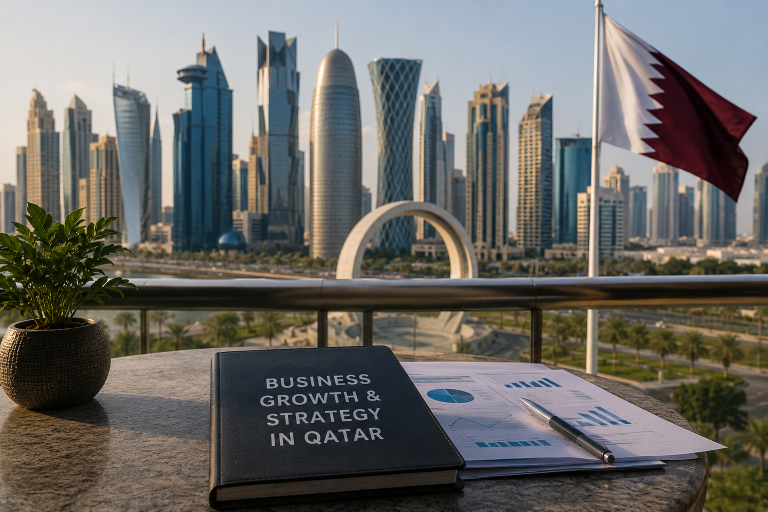
Qatar’s economy has moved well beyond its hydrocarbon roots, and that shift changes what a workable growth strategy looks like. Business growth and strategy in Qatar today means combining a locally grounded expansion plan, aligned with Qatar National Vision 2030 and government priorities, with the financial discipline needed to scale without losing control of cashflow or reporting. It is not simply a copy of a UK or European playbook. Companies expanding here need to factor in local licensing routes, sector specific regulation, and a labour market where bilingual talent and local relationships carry real weight.
For British owned SMEs and expat entrepreneurs, growth strategy also has a second dimension that many overlook, ongoing compliance with UK tax rules while the business itself is based in or trading through Qatar. A strategy that only looks at revenue targets and market entry, without a parallel plan for financial systems, KPI visibility and UK reporting, tends to stall once the business passes its first year or two of operation. The businesses that grow fastest treat strategy and financial infrastructure as one connected project rather than two separate workstreams.
Why Is 2026 a Strong Year to Plan Business Growth in Qatar?
Qatar enters 2026 with several tailwinds working in its favour. The IMF’s most recent Article IV consultation on Qatar points to real GDP growth accelerating over the medium term, supported by the ongoing LNG expansion, continued public investment and reforms guided by the Third National Development Strategy. Non oil sectors, including logistics, tourism, financial services and technology, are taking on a larger share of total output each year, which is precisely where most British owned SMEs and professional service businesses operate.
For a business owner deciding when to formalise a growth strategy, this matters because expansion plans built during a strengthening cycle tend to face fewer headwinds around financing, hiring and government support than plans built during a downturn. It also means competition for good talent, prime office space in areas like West Bay and Lusail, and public sector or GCC linked contracts will intensify through 2026, so businesses that move early on strategy, systems and financial reporting will be better positioned than those that wait.
Which Doha Business Districts Should Shape Your Growth Strategy?
Qatar’s growth opportunities are not spread evenly across Doha, and the district a business chooses to anchor itself in says as much about its strategy as its sector does. Understanding the wider GCC context matters too, since many British owned businesses use Doha as one base among several regional hubs alongside Dubai or Riyadh.
| District |
Best suited to |
Strategic note |
| West Bay |
Established SMEs, finance, corporate headquarters |
Highest concentration of banks and government offices, strong for credibility with institutional clients |
| The Pearl |
Retail, hospitality, lifestyle and consumer brands |
Affluent resident base and footfall, suited to businesses growing through direct consumer relationships |
| Lusail |
Technology, new build ventures, future facing sectors |
Newest infrastructure in Doha, positioned as a smart city hub aligned with Qatar National Vision 2030 |
| Msheireb |
Professional services, heritage adjacent and government facing business |
Downtown location close to ministries and established institutions, useful for regulatory facing growth |
What Financial Foundations Should Be in Place Before You Scale?
A growth strategy without financial infrastructure behind it is just a set of ambitions. Before scaling headcount, opening a second location, or pursuing a partnership, three foundations need to already be working properly. The first is cashflow forecasting, so the business can see, several months ahead, whether growth spending is affordable before it commits to it. The second is KPI tracking, a small set of metrics, revenue per client, cost of delivery, cash conversion cycle, reviewed on a fixed schedule rather than only at year end. The third is a proper financial health check across bookkeeping, systems and controls, which surfaces the gaps that tend to appear only once transaction volume increases.
Our guide on Why Regular Financial Reviews Are Essential for Business Growth sets out how often these reviews should happen and what they should cover. For businesses that have not had a systems review in over a year, our Business Financial Health Check & Financial Systems Review in Qatar service is usually the right starting point before any growth plan is finalised.
How Do British Expats Manage UK Tax Obligations While Growing a Business in Qatar?
Being based in Qatar does not remove UK tax obligations for British business owners and expats, and this is one of the most common blind spots in growth planning. Depending on residency status, the structure of the business, and where income actually arises, owners may still need to file UK Self Assessment returns, report overseas income, or manage director level obligations back in the UK even while running day to day operations from Doha. Growth plans that ignore this side of compliance often create costly problems later, particularly around double taxation exposure or missed UK filing deadlines while attention is focused on the Qatar side of the business.
GMPA LLC serves clients across Doha and the wider Qatar market, and supports British expats with their continuing UK tax obligations alongside their Qatar based financial planning, so growth decisions on one side of the relationship do not create compliance problems on the other.
Organic Growth or Partnership-Led Expansion: Which Strategy Fits Your Business?
Once the financial foundations are in place, most businesses in Qatar choose between two broad growth paths, and the right choice depends on how quickly market access is needed versus how much control the owner wants to keep.
| Approach |
Typical timeline |
Capital needed |
Best suited to |
| Organic growth |
12 to 24 months to material scale |
Lower upfront, funded from operating cashflow |
Owners who want full control and have a strong existing UK or expat client base |
| Partnership or joint venture led growth |
3 to 9 months to first results |
Higher upfront, often shared with the partner |
Businesses entering new sectors or targeting government linked or GCC wide contracts |
What Mistakes Commonly Stall Business Growth in Qatar?
A handful of mistakes account for most of the businesses that stall in Qatar despite operating in a genuinely favourable market. The most common is scaling headcount or marketing spend before cashflow forecasting is in place, which leaves the business reacting to cash shortages instead of planning around them. Close behind is treating KPI tracking as optional, so problems in delivery cost or client retention are only spotted once they have already damaged margin. A third mistake is importing a growth strategy from the UK or another market without adjusting for Qatar’s licensing routes, sector regulation and relationship driven business culture. Finally, many British owned businesses treat UK tax compliance as something to deal with later, once the Qatar side of the business is established, which usually means dealing with it under pressure rather than as part of a planned strategy.
How Can GMPA LLC Support Your Business Growth Strategy in Doha and Qatar?
GMPA LLC works with British expats and SMEs who need their growth strategy and their financial systems moving in the same direction. That includes cashflow forecasting and planning, KPI and CSF reporting, financial advisory, and a full financial health check for businesses that are not confident their current systems can support the next stage of growth. Because the firm operates across both the UK and Qatar, clients get one point of contact for local Doha based advisory and continuing UK tax obligations, rather than managing two disconnected advisers.
Whether a business is still shaping its first growth plan or already scaling across West Bay, The Pearl, Lusail or Msheireb, the starting point is usually the same, a clear view of the numbers before the next decision is made.
|










