










Written by Saira Khan, Co-Founder of GMPA LLC, whose team has 15+ years of UK accounting experience advising British expats and SMEs operating across the UK and Qatar.
Common Internal Fraud Risks in Small Businesses in Qatar
Small businesses in Qatar face a disproportionate risk of internal fraud. According to the ACFE Occupational Fraud 2024 Report, organisations with fewer than 100 employees suffer a median loss of $141,000 per fraud incident — often because tight teams mean weaker separation of duties and fewer oversight layers.
The most urgent risk for SMEs operating in Doha, West Bay and across the wider Qatar market is not external cybercrime — it is the trusted insider with unchecked access to your finances.
| Book a Free Consultation | View Our Services |
Definition
Internal fraud in small businesses refers to deliberate financial deception or asset theft carried out by owners, employees, or contractors within the organisation itself, exploiting weak controls, limited oversight, and trusted access to cause direct financial loss.
Key Takeaways
Asset misappropriation accounts for 89% of all occupational fraud cases globally (ACFE 2024).
Small businesses suffer the second-highest median loss per fraud case at $141,000 — often because controls are weaker.
The six most common risks for Qatar SMEs are: cash theft, payroll fraud, procurement fraud, expense abuse, financial statement manipulation, and ghost supplier schemes.
Fraud schemes typically run for around 12 months before detection — early controls cut losses dramatically.
GMPA LLC serves SMEs and British expats across Doha, West Bay, The Pearl, Lusail, and Msheireb.
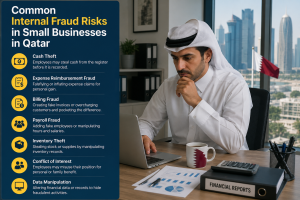
For small and medium-sized businesses operating in Qatar, internal fraud is rarely the elaborate heist depicted in films. It is far more often a quiet pattern — a trusted bookkeeper recording small overstatements, a procurement manager accepting a vendor kickback, or a payroll administrator adding a ghost employee to the system. Over months or years, these actions accumulate into losses that can threaten the viability of the entire business.
GMPA LLC works with SME owners and British expats across Doha and the wider Qatar market — from corporate offices in West Bay to retail operations in Lusail and hospitality businesses in The Pearl — to identify, prevent, and respond to internal fraud risks before they escalate. This guide covers the six most common fraud risks your business faces, along with the controls that stop them.
What is Asset Misappropriation and Why Does it Top the List for Qatar SMEs?
Asset misappropriation — the direct theft or misuse of company cash, inventory, or physical property — is the single most common category of internal fraud worldwide. According to the ACFE Occupational Fraud 2024 Report, it accounts for approximately 89% of all reported fraud cases globally.
In a Qatar SME context, this commonly takes the form of:
The primary enabler in small businesses is the absence of segregation of duties. When one person controls both recording and access to assets, opportunity is structurally built in.
How Does Payroll Fraud Affect Small Businesses in Qatar?
Payroll fraud is particularly acute in small Qatari businesses because the owner often has limited visibility into payroll processing once it has been delegated. Common schemes include:
For British-owned businesses in Qatar where the owner may spend extended periods in the UK, unsupervised payroll access poses a specific and elevated risk that standard UK-based financial oversight will fail to catch.
What Makes Procurement Fraud So Common in Doha SMEs?
Qatar’s business environment involves a high volume of vendor and contractor relationships — from IT and facilities suppliers in West Bay commercial towers to food and raw material suppliers serving Msheireb’s hospitality strip. This creates significant exposure to procurement fraud, including:
Without a three-way purchase order, delivery confirmation, and invoice match process, these schemes can run for years. Many small businesses in Qatar rely on verbal supplier agreements and informal approvals, which dramatically increase exposure.
How Do Expense Reimbursement Abuses Drain a Small Business in Qatar?
Expense fraud is the most accessible form of internal fraud — it requires no technical access, no accounting knowledge, and leaves minimal traces without a structured review process. Common abuse patterns include submitting inflated or fabricated receipts, claiming the same expense twice, coding personal costs as business expenses, and using company credit cards for non-business purchases.
The ACFE 2024 data shows expense reimbursement schemes are significantly more common in smaller organisations than in larger ones, precisely because informal culture and trust often replace formal approval workflows. For SMEs operating across Qatar with staff in multiple locations — from Lusail City developments to Pearl-Qatar retail units — expense control gaps become particularly exploitable.
Can a Small Business Owner Commit Financial Statement Fraud Against Their Own Company?
Financial statement fraud is less frequent than asset misappropriation but carries the highest median losses — around $766,000 per case according to ACFE 2024. In a small business setting, this typically involves overstating revenues to secure financing, understating liabilities to appear solvent to investors or lenders, or manipulating profit figures to reduce a co-owner’s declared share.
For British expat business owners in Qatar who also retain UK financial obligations — such as reporting overseas income and company structures to HMRC — inaccurate financial statements carry compounded risk. Misrepresented financials may trigger not only Qatari regulatory scrutiny from the Ministry of Commerce and Industry, but also HMRC compliance issues under the UK’s Requirement to Correct and offshore disclosure obligations. GMPA LLC supports British expats with both their Qatar business advisory needs and their continuing UK tax obligations.
What Are Ghost Supplier Schemes and How Do They Operate in Qatar?
A ghost supplier scheme involves an employee — usually someone with access to both the supplier master file and the payment system — creating a fictitious vendor, generating invoices for services that were never delivered, and processing payment to a bank account they personally control.
In Qatar’s business environment, where many SMEs still operate with a single finance person managing accounts payable end-to-end, ghost supplier fraud is among the easiest to execute and the hardest to detect without independent vendor verification. Regular reconciliation of the supplier master file against proof of delivery is the most effective countermeasure.
Internal Fraud Risk Comparison: Which Schemes Pose the Greatest Threat to Qatar SMEs?
The table below compares the six core internal fraud risks by frequency, typical financial impact, primary enabler, and recommended control for Qatar-based small businesses.
| Fraud Type | Frequency | Typical Loss Range | Primary Enabler | Key Control |
|---|---|---|---|---|
| Asset Misappropriation | Very High (89% of cases) | Low to Medium | No segregation of duties | Regular independent reconciliations |
| Payroll Fraud | High | Medium | Single-person payroll control | Owner sign-off on payroll reports |
| Procurement Fraud | High | Medium to High | No purchase order system | Three-way PO matching |
| Expense Abuse | Very High (small firms) | Low | Informal approval culture | Formal expense policy with receipts |
| Financial Statement Fraud | Low (5% of cases) | Very High (median $766k) | No independent review | External accountant review |
| Ghost Supplier Scheme | Medium | Medium to High | Single AP controller | Vendor master file audits |
What Are the Warning Signs of Internal Fraud in a Qatar SME?
Fraud rarely announces itself. The behaviours and operational anomalies below should trigger immediate investigation in any small business operating in Qatar:
— often a sign they fear a replacement will discover their scheme.
— a frequently cited behavioural red flag across the ACFE’s global fraud studies.
— even small regular discrepancies warrant investigation.
— a common ghost supplier indicator.
— a classic circumvention of authorisation controls.
— a clear cultural warning sign that controls need strengthening.
Which Internal Controls Provide the Best Protection Against Fraud for a Small Business in Qatar?
The ACFE 2024 Report confirms that over half of all fraud cases involve a lack of internal controls or management override of existing controls. For a Qatar SME, five foundational controls deliver the highest return on investment in fraud prevention:

1. Segregation of Duties
No single employee should control the full cycle of any financial transaction — approval, recording, and payment should always involve separate individuals. Even in a two-person finance team, structured alternation of roles significantly reduces risk. See our guide to Financial Controls Every SME in Qatar Should Implement.
2. Monthly Independent Bank Reconciliation
The owner or an external adviser should review bank statements against accounting records monthly — not annually. Discrepancies caught early reduce total loss substantially.
3. Purchase Order Controls
All purchases above a defined threshold should require a formal purchase order, a delivery confirmation, and a matching invoice before payment is released. This three-way match process is one of the most effective procurement fraud deterrents available to small businesses.
4. Anonymous Reporting Mechanism
The ACFE data shows that 52% of fraud cases are detected via internal tips. Providing a confidential channel for staff to report concerns — without fear of retaliation — dramatically increases detection rates. Even a simple anonymous email inbox designated for finance concerns is far more effective than nothing.
5. Periodic External Review
An external accountant reviewing your financial controls quarterly provides independent assurance that gaps are being identified before they are exploited. Our Internal Financial Controls and Fraud Prevention service is designed specifically for Qatar-based SMEs that need this level of independent oversight without the cost of a full-time internal audit function.
Frequently Asked Questions
External Reference
Statistics in this article are drawn from the ACFE Occupational Fraud 2024: A Report to the Nations — the world’s largest study of occupational fraud, covering 1,921 real cases across 138 countries. For Qatar-specific regulatory guidance, business owners should also refer to the Qatar Financial Centre (QFC) compliance resources.
Protect Your Business
Worried About Internal Fraud Risks in Your Qatar Business?
GMPA LLC provides independent financial controls reviews, payroll audits, and fraud prevention advisory services for SMEs and British expats across Doha, West Bay, The Pearl, Lusail, and the wider Qatar market.
| Speak to One of Our UK Accountants — Book Your Free Consultation | View Our Services |
Written and reviewed by the GMPA LLC Team | Financial Consultants and Accountants in Qatar | Serving British expats and SMEs across Doha, West Bay, The Pearl, Lusail, Msheireb, and the wider GCC. GMPA LLC also supports clients with continuing UK tax obligations including HMRC Self-Assessment, offshore disclosure, and expat tax planning.