










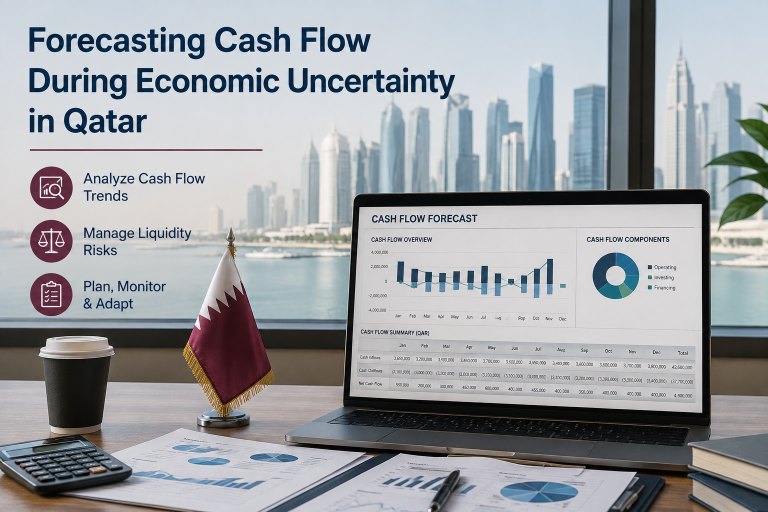
Forecasting cash flow during economic uncertainty in Qatar means building a rolling, scenario based forecast that plans for slower payments, softer demand and rising costs rather than relying on a single optimistic projection. A well built forecast gives business owners in Doha and across Qatar the lead time to protect liquidity, meet payroll and avoid emergency borrowing. This guide explains exactly how to build one.
| Key Takeaways |
| Economic uncertainty in Qatar calls for a rolling cash flow forecast, not a static annual one. Businesses should model a base case and a downside case, watch receivables closely, and revisit assumptions monthly rather than yearly. British expats running businesses in Qatar also need to factor in ongoing UK tax obligations alongside local cash planning. GMPA LLC supports both areas from one advisory relationship. |
Written by Raja Zaman, Head of Business Performance at GMPA LLC, with 10 years of experience in accounting and tax and over 10 years managing stores for Tesco and Iceland. Updated 2026.
What Does Cash Flow Forecasting Mean During Economic Uncertainty?
Cash flow forecasting is the process of projecting the money moving in and out of a business over a defined period, usually the next twelve months. During stable conditions, a forecast built on last year’s numbers is often good enough. During economic uncertainty, that approach breaks down quickly, because customer payment timing, input costs and demand can all shift at once. In Qatar specifically, businesses are navigating a period the IMF describes as one of continued but slower non hydrocarbon growth alongside global trade and geopolitical pressure, which means assumptions that held true twelve months ago may no longer apply today.
A forecast built for uncertainty does three things a standard forecast does not. It models more than one outcome, it is reviewed more often than once a year, and it treats receivables timing as a variable rather than a fixed assumption.
Why Is Qatar’s Economic Outlook Relevant to Your Cash Flow Forecast?
Qatar’s economy remains structurally strong, supported by LNG exports and continued government investment, but the near term picture carries more variability than in previous years. According to the International Monetary Fund, Qatar’s real economic growth is expected to average around four percent over the medium term, with inflation projected near two percent, though the IMF also flags risks including a global growth slowdown, tighter financial conditions and geopolitical tension as factors that could affect the pace of that growth.
For an SME or a growing business based in Doha, West Bay, The Pearl, Lusail or Msheireb, that macro picture translates into very practical questions. Will a government linked contract be paid on the agreed schedule. Will a supplier tied to global shipping costs raise prices mid contract. Will a client delay a payment because their own sector is under pressure. None of these questions can be answered with certainty, which is exactly why a forecast needs to model a range of outcomes rather than a single number.
How Should British Expats in Qatar Approach Cash Flow Differently?
British expats running or owning a business in Qatar are usually managing two financial systems at once. There is the day to day cash position of the Qatar business, and there is a continuing set of UK obligations that do not stop simply because the individual has relocated. This can include UK Self Assessment filings, UK rental property income, UK pension contributions, or a UK registered company still trading alongside the Qatar operation.
A cash flow forecast that only looks at the Qatar business misses half the picture. If a UK tax payment is due in January and the Qatar business is also facing a seasonal dip, the two obligations can collide unless they are planned for together. This is the gap most generic forecasting guidance, written for a purely domestic UAE or UK audience, simply does not address.
GMPA LLC serves clients across Doha and the wider Qatar market, and supports British expats specifically with their continuing UK tax obligations alongside their Qatar based financial planning, so both sides of the picture are managed from one relationship rather than two disconnected advisers.
What Does a Resilient Cash Flow Forecast Look Like?
The table below sets out the difference between a standard annual forecast and one built specifically to withstand economic uncertainty.
| Forecast Element | Standard Forecast | Uncertainty Adjusted Forecast |
| Review frequency | Annually or quarterly | Monthly, with a rolling twelve month view |
| Scenarios modelled | Single base case | Base case and a conservative downside case |
| Receivables assumption | Payment on agreed terms | Payment delayed by a set buffer, tested against actual client history |
| Cost assumption | Fixed at current pricing | Adjusted for supplier or shipping cost volatility |
| Cross border tax view | Not usually included | UK obligations mapped alongside Qatar cash position for British expats |
How Often Should SMEs in Doha Review Their Cash Flow Forecast?
During periods of economic uncertainty, a monthly review is the practical minimum, and some businesses in fast moving sectors, such as construction, hospitality and trading, benefit from a rolling thirteen week view sitting alongside the twelve month forecast. Monthly review does not mean rebuilding the forecast from scratch each time. It means updating the assumptions, checking actual receivables against what was projected, and adjusting the downside case if new information suggests it is needed.
Businesses across Qatar that treat forecasting as a once a year exercise tend to discover cash problems only when they are already inside them. Businesses that treat it as a living document tend to see the problem three or four months before it becomes urgent, which is enough time to renegotiate supplier terms, tighten collections, or arrange financing on reasonable rather than desperate terms.
What Mistakes Should You Avoid When Forecasting in Uncertain Conditions?
The most common mistake is forecasting revenue on contracted or agreed terms rather than on realistic payment behaviour. If clients in Qatar typically pay several weeks later than the invoice terms state, the forecast should reflect that pattern, not the paperwork. The second common mistake is ignoring seasonality, particularly around Ramadan, summer months and the government fiscal calendar, all of which can shift receivables timing noticeably.
The third mistake, specific to British expats, is treating the Qatar business and any UK obligations as entirely separate planning exercises. A UK Self Assessment payment on account, a UK rental property tax bill, or a UK company’s own reporting deadline can land at the same time as a quiet trading period in Qatar. Planning both calendars together removes an entirely avoidable source of pressure.
For a deeper walkthrough of building the base forecast itself, see our guide on
how to build a 12 month cashflow forecast,
and for the wider planning context behind these numbers, read
financial forecasting strategies for business owners.
If you are still weighing up whether this level of discipline is necessary for a smaller operation, our article on
why cashflow management is critical for SMEs in Qatar
sets out the case in full.
Frequently Asked Questions
What is cash flow forecasting during economic uncertainty?
It is the practice of projecting a business’s future cash inflows and outflows using more than one scenario, including a conservative downside case, so that leaders in Qatar can prepare for slower payments or rising costs before they happen rather than reacting after the fact.
How does Qatar’s economic outlook affect SME cash flow planning?
Qatar’s medium term growth remains supported by LNG and non hydrocarbon sectors, but global trade conditions and geopolitical risk mean payment timing and input costs can move faster than in calmer years, so forecasts need to be reviewed more frequently.
Do British expats in Qatar still need to plan around UK tax obligations?
Yes. Many British expats retain UK Self Assessment filings, rental property income, pension contributions or a UK registered company, all of which continue to create cash requirements that should be planned alongside the Qatar business rather than separately.
How often should a business in Doha update its cash flow forecast?
Monthly at a minimum during periods of economic uncertainty, with fast moving sectors such as construction, hospitality and trading benefiting from an additional rolling thirteen week short term view.
Can GMPA LLC help with cash flow forecasting for businesses across Qatar?
Yes. GMPA LLC works with SMEs and British expats across Doha and the wider Qatar market, building rolling cash flow forecasts and combining them with UK tax planning for clients who still hold obligations in the UK.
| Speak to One of Our UK Accountants, Book Your Consultation |
| View Our Services |
Source: International Monetary Fund, Qatar economic outlook and growth projections, 2026.