










Written by Saira Khan, Co-Founder of GMPA LLC, whose team has 15+ years of UK accounting experience advising British expats and SMEs operating across the UK and Qatar. Updated 2026.
Internal Audit vs Financial Health Check in Qatar: What Doha Businesses and British Expats Need to Know
An internal audit tests whether a business is following its own controls correctly, while a financial health check looks at whether those financial systems are actually built well in the first place. In Qatar, most SMEs need the health check first and the internal audit second, not the other way round.
|
Key takeaways
|
What Is an Internal Audit?
An internal audit is an independent review of whether a company is actually following the financial and operational controls it says it has in place. It is a compliance and assurance exercise. An internal auditor, whether an in house team member or an outsourced specialist, tests transactions, checks approval processes, and confirms that policies on spending, revenue recognition, and record keeping are being applied consistently.
For companies registered with the QFC, the Qatar Financial Markets Authority, or listed on the Qatar Stock Exchange, internal audit can also form part of a wider governance obligation. It answers a narrow but important question: are our existing rules being followed properly, and where are they breaking down in practice.
Internal audit tends to work best once a business already has clear financial systems and controls to test. If those systems do not exist yet or are inconsistent, an internal audit will simply confirm what most business owners in Doha already suspect, that the underlying structure needs attention first.
What Is a Financial Health Check?
A financial health check, sometimes called a financial systems review, looks at the bigger picture. Rather than testing compliance with existing rules, it asks whether the accounting systems, reporting processes, and financial controls are fit for purpose in the first place. It is a diagnostic exercise, not a compliance test.
A typical financial health check for a Qatar based SME covers bookkeeping accuracy, cash flow visibility, profitability and cost structure, the reliability of monthly reporting, and whether the accounting software in use, such as Zoho Books or QuickBooks, is configured correctly for the business. You can read more detail on this in our guide to Business Financial Health Check and Financial Systems Review in Qatar.
Most growing businesses in Qatar benefit from a financial health check well before they need a full internal audit function, particularly if they are still relying on manual processes or have never had their systems reviewed by an external adviser.
How Do Internal Audits and Financial Health Checks Differ?
The table below sets out the practical differences side by side.
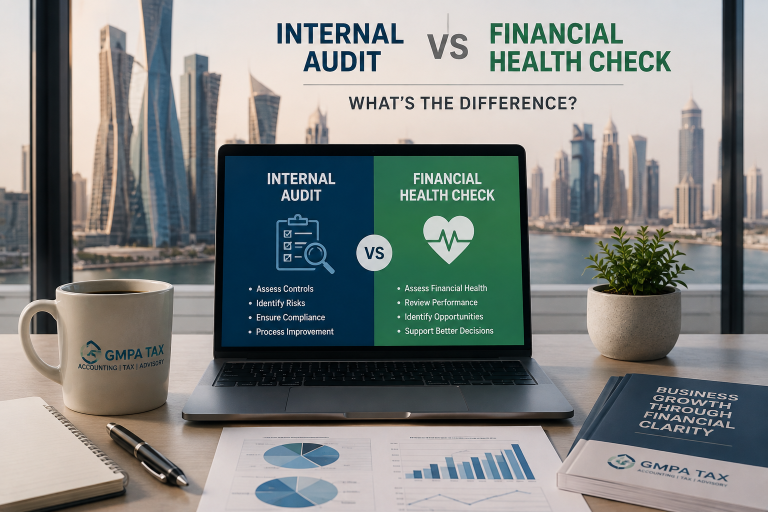
| Factor | Internal Audit | Financial Health Check |
| Main purpose | Tests compliance with existing controls | Assesses whether systems and controls are sound |
| Typical trigger | Governance requirement, QFC or QSE obligation, board request | Rapid growth, unclear reporting, first review in years |
| Frequency | Ongoing or annual cycle | One off or periodic, often before an audit or investment round |
| Output | Findings report on control weaknesses and exceptions | Diagnostic report with recommended fixes to systems and processes |
| Best suited to | Established businesses with existing controls | Growing SMEs, new QFC entities, businesses without a recent review |
Which One Does Your Business in Qatar Need?
If your business in Doha has never had its accounting systems formally reviewed, a financial health check is almost always the right starting point. It identifies where bookkeeping, reporting, or cash flow visibility is weak, so that any controls you introduce afterwards are built on solid ground.
If your business already has documented financial controls, whether because of a QFC licence condition, an investor requirement, or board level governance policy, an internal audit becomes the more relevant next step. It tells you whether those controls are actually working day to day.
Many SMEs across Qatar benefit from doing both in sequence: a financial health check to fix the foundations, followed by a lighter touch internal audit function once systems are stable. Our related guide on Audit Readiness and Auditor Liaison in Qatar covers how to prepare once you reach that stage.
Do QFC and MoCI Rules Require Either of These in Qatar?
Companies registered with the Ministry of Commerce and Industry or licensed under the Qatar Financial Centre are generally required to submit audited financial statements annually. This is an external audit obligation, separate from internal audit, but it is directly affected by the quality of your underlying financial systems. A QFC firm heading into its first statutory audit with weak bookkeeping will face a longer, more expensive process than one that has already had a financial health check. We cover the practical preparation steps in How to Prepare Your QFC Firm for Its First Audit.
For up to date detail on QFC regulatory requirements, the Qatar Financial Centre Authority publishes current guidance directly for registered firms, and this is worth checking alongside advice from your accountant.
What Does This Mean for British Expats in Qatar?
British expats running SMEs or consultancy businesses in Doha, West Bay, The Pearl, Lusail or Msheireb often carry financial reporting obligations on two fronts at once. Locally, Qatar’s MoCI and QFC rules apply to the business itself. Separately, many British expats retain UK tax obligations, whether through continuing UK income, property, pensions, or a UK registered entity connected to their Qatar operations.
A financial health check that only looks at the Qatar side of the business can miss how local reporting decisions affect UK tax filings back home. GMPA LLC serves clients across Doha and the wider Qatar market and supports British expats with continuing UK tax obligations, so financial reviews are structured to hold up under scrutiny on both sides.
What Does the Process Look Like With GMPA LLC?
Our approach typically follows four stages: an initial review of current bookkeeping and reporting, a diagnostic assessment against best practice for your sector, a written report setting out specific weaknesses and fixes, and where relevant, a follow up internal audit or audit readiness phase once systems are stable. The process is scaled to the size of the business, from single director consultancies to multi entity SMEs operating across the GCC.
Conclusion
Internal audit and financial health check solve different problems. One confirms your controls are being followed, the other confirms your controls are worth following in the first place. For most SMEs and British expat businesses in Doha, the financial health check comes first, and it makes every audit that follows faster, cheaper, and less stressful.
| Speak to One of Our UK Accountants — Book Your Free Consultation |
| View Our Services |
Frequently Asked Questions
| Is a financial health check the same as an internal audit? |
| No. A financial health check assesses whether your financial systems and controls are well designed. An internal audit tests whether existing controls are actually being followed. Businesses often need a health check before an internal audit is useful. |
| Does a QFC registered firm need both? |
| Not automatically. QFC firms are generally required to submit audited annual financial statements, which is a separate external audit obligation. A financial health check and internal audit are additional steps that many firms choose in order to prepare properly and reduce audit costs. |
| How often should a business in Qatar run a financial health check? |
| Most SMEs benefit from a review annually, or whenever there is rapid growth, a change in accounting software, or preparation underway for an external audit or investment round. |
| Can GMPA LLC carry out both services together? |
| Yes. GMPA LLC runs financial health checks and audit readiness reviews for clients across Doha and the wider Qatar market, including British expats with continuing UK tax obligations, and can sequence both services as part of one engagement. |