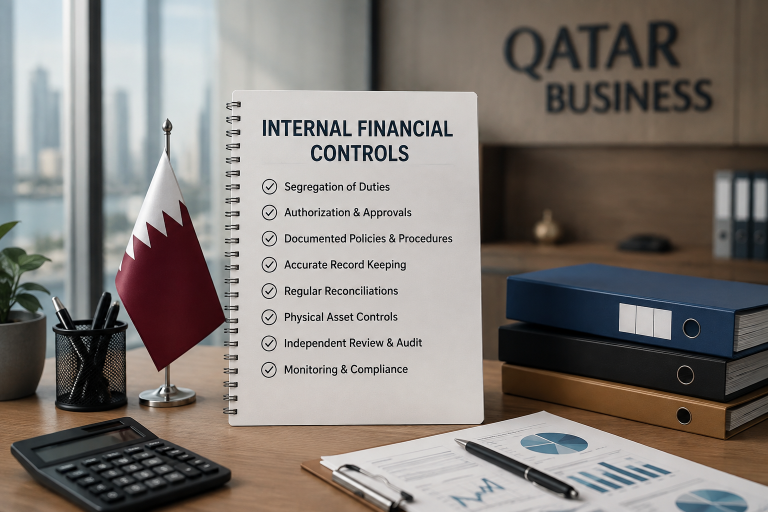
Internal Financial Controls Every Qatar Business Should Have in 2026A practical guide for business owners in Doha, The Pearl, West Bay, and British expats managing companies across Qatar |
||||||||||||||||||||||||||||||||||||||||||||||||||||||||||||||||||||||
|
Every Qatar business, from a small trading company in Doha to a growing SME with offices in West Bay, needs at least four core financial controls in place: segregation of duties, a documented approval process, monthly bank reconciliation, and regular financial reporting review. Without these, even profitable businesses face a real risk of fraud, errors, and compliance issues that surface too late to fix cheaply.
What Are Internal Financial Controls and Why Do Qatar Businesses Need Them?Internal financial controls are the day to day procedures a business uses to protect its money, its records, and its decision making. They cover who can approve a payment, how invoices are checked before they are paid, how cash and bank balances are reconciled, and how financial reports are reviewed before they reach the owner or board. As Qatar’s business environment continues to move toward greater transparency, automation, and stronger audit requirements, companies that treat financial controls as a year end task rather than an ongoing discipline are the ones most exposed to fraud, penalties, and reporting errors in 2026. For a growing business in Doha, weak controls rarely show themselves early. A missing approval step, an untracked petty cash float, or a single person handling both invoicing and payments can run quietly for months before a shortfall, a duplicate payment, or an inaccurate VAT position appears. By that stage, the fix is far more expensive than the prevention would have been. Which Internal Controls Should Every Business in Doha Implement First?Not every control needs to be introduced on day one. Businesses across Doha, the Pearl, and Lusail typically see the fastest reduction in risk from the following four areas, applied in this order.
How Do Internal Controls Differ Between a Small SME and a Larger Qatari Company?A control framework should scale with the size of the business. The table below compares what is realistic and appropriate at each stage of growth.
What Do Regulators in Qatar Expect From a Business’s Financial Controls?Companies operating in Qatar, including those registered with the Qatar Financial Centre, are expected to maintain proper books of accounts and, in many cases, undergo statutory audits as part of their regulatory and tax obligations. The International Monetary Fund has similarly noted that sound risk management and internal control practices are a fundamental pillar of financial stability for any economy, a principle that applies equally at the level of an individual business (source: IMF Financial Sector Assessment Program). For businesses registered with the QFC, the General Tax Authority, or the Qatar Central Bank, having documented controls in place also makes tax assessments and periodic reviews considerably smoother, since supporting records and approval trails are already organised rather than reconstructed under time pressure. How Do British Expat Owners in Qatar Manage Controls Across Two Tax Systems?British expats running businesses in Doha, West Bay, or Msheireb often carry a dual reporting burden that local competitors rarely mention. Alongside meeting Qatari expectations, many expat owners retain ongoing UK tax obligations, including reporting worldwide income or maintaining UK company filings if a business has cross border structure. Strong internal controls make this considerably easier, since clean, well reconciled Qatari records translate directly into accurate figures for UK reporting, rather than requiring a separate reconstruction exercise each year. GMPA LLC supports clients across Doha and the wider Qatar market with this exact combination, helping British expat owners maintain financial systems that satisfy Qatari requirements while keeping their UK tax position current and defensible. What Are the Warning Signs That Your Financial Controls Are Too Weak?
If any of these apply, a financial health check for your business in Qatar is a practical first step, since it identifies exactly which controls are missing before deciding what to fix first. What Does Weak Financial Control Actually Cost a Qatar Business?The cost of weak controls rarely shows up as a single dramatic loss. More often it appears as a slow accumulation of small problems, a duplicate supplier payment that goes unnoticed for months, VAT or corporate tax figures that need reworking because expense records were incomplete, or a bank reconciliation that takes days instead of hours because transactions were never matched as they occurred. Businesses expanding into Lusail or opening a second location in Doha are particularly exposed during that growth phase, since the informal, owner led approval process that worked at a small scale rarely scales cleanly once a second manager, a second bank account, or a second country is added to the picture. The businesses that avoid these problems are almost always the ones that treated controls as infrastructure to be built early, rather than a fix applied after something has already gone wrong. There is also a credibility cost. Investors, banks, and joint venture partners across the GCC increasingly expect to see documented controls before extending funding or entering a partnership. A business that can produce a clear approval matrix, reconciled accounts, and a consistent monthly reporting pack is simply easier to trust with capital than one that cannot. Does Your Accounting Software Support Strong Internal Controls?Software alone does not create good controls, but the right system makes them far easier to enforce consistently. Cloud accounting platforms allow a business to set user permissions so staff can raise a bill without also being able to approve or pay it, to build automated approval workflows above a chosen value, and to keep a permanent audit trail of who created, edited, or approved each transaction. A spreadsheet or a basic desktop package rarely offers any of this, which is one reason many businesses in Doha and Msheireb choose to migrate to a proper cloud system as part of their wider control upgrade, rather than trying to run tighter processes on top of software that cannot support them. How Should a Business in Qatar Go About Implementing Stronger Controls?Implementation works best as a staged process rather than an overnight overhaul. Most businesses in Qatar start with a review of their financial systems for better business performance, which highlights the gaps between current practice and a workable control framework. From there, the common next steps are agreeing an approval matrix with the owner or board, setting up a monthly reconciliation routine within the accounting system, and training staff on the new approval process so it becomes habit rather than an occasional exercise. Many Qatari SMEs share the same handful of weaknesses, covered in more detail in our guide to common financial system weaknesses found in Qatar SMEs, and businesses looking to reduce manual error further can also explore financial process automation for businesses in Qatar once the manual controls are working reliably. A wider view of how controls fit into overall financial health is available in our guide to a business financial health check and financial systems review in Qatar, which walks through the full assessment process step by step. Realistically, a small business can have the first four controls in place within a few weeks, since they mainly require agreeing a process and communicating it clearly rather than buying new software. A growing SME moving to a tiered approval matrix and a cloud accounting system with proper permissions should plan for four to eight weeks, allowing time to migrate historical data and train staff on the new workflow. Larger or QFC registered businesses preparing for statutory audit typically need a longer runway, often two to three months, to document policies formally, test that controls are operating as designed, and address any gaps an external auditor might raise. In every case, the sequence matters more than the speed, since controls introduced without proper staff buy in tend to be bypassed within a few months, undoing the benefit of the exercise entirely. Frequently Asked Questions
|