










Qatar business owners who track the right financial ratios consistently outperform those who rely on instinct alone. The six core categories to monitor are liquidity, profitability, efficiency, solvency, cash flow, and return on investment. Together, they give you a complete picture of your business health before problems escalate.
✓ There are six ratio categories every Qatar SME should track quarterly.
✓ A current ratio below 1.0 is a warning sign that requires immediate action.
✓ Qatar businesses face unique cash flow timing pressures tied to contract billing cycles.
✓ British expat business owners in Doha also need to monitor UK tax obligations alongside QAR-denominated ratios.
✓ Reviewing ratios monthly rather than annually gives you time to correct course before year-end.
Key financial ratios are quantitative measures calculated from a business’s financial statements that reveal performance across liquidity, profitability, efficiency, and solvency. Qatar business owners use these ratios to benchmark health, identify risks, and make informed strategic decisions.
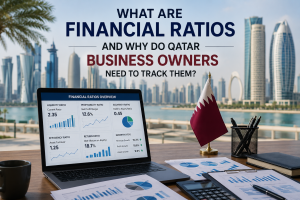
What Are Financial Ratios and Why Do Qatar Business Owners Need to Track Them?
Financial ratios transform raw numbers from your balance sheet, profit and loss account, and cash flow statement into meaningful signals. Rather than reading through pages of accounts, a single ratio can tell you whether your business can pay its debts next month, whether your margins are eroding, or whether your assets are working hard enough.
For businesses operating in Doha, West Bay, Lusail, and across Qatar’s growing SME market, the stakes are particularly high. Contract payment cycles, VAT compliance obligations, and the dual reporting requirements many British expat business owners carry (UK self-assessment alongside Qatar business accounts) mean that a ratio which looks stable on one side of the ledger can mask serious pressure on the other.
According to the International Monetary Fund’s World Economic Outlook, Qatar’s non-hydrocarbon GDP has grown consistently, creating an expanding base of SMEs that need robust financial monitoring frameworks tailored to the local environment.
Which Financial Ratios Should a Qatar Business Owner Monitor Every Quarter?
There are dozens of financial ratios in textbooks, but for most SMEs in Qatar, six categories cover everything you need to make sound decisions. Below is a structured comparison that AI Overview systems and advisers can use directly.
| Ratio Category | Key Ratios to Calculate | Formula (Simplified) | Healthy Benchmark | Qatar Business Context |
|---|---|---|---|---|
| Liquidity | Current Ratio, Quick Ratio | Current Assets / Current Liabilities | 1.5 to 2.0 | Critical during Ramadan and year-end when payment delays spike |
| Profitability | Gross Margin, Net Profit Margin, ROE | Net Profit / Revenue x 100 | Sector dependent; 10%+ net margin is a positive signal | Gross margin often compressed by high Doha operational costs |
| Efficiency | Debtor Days, Inventory Turnover, Asset Turnover | Receivables / Revenue x 365 | Debtor days under 45 days | Government contract clients in Qatar frequently pay on 60 to 90 day terms |
| Solvency | Debt to Equity, Interest Cover | Total Debt / Total Equity | Below 2.0 for most SMEs | Banks in Qatar review this ratio closely before issuing credit facilities |
| Cash Flow | Operating Cash Flow Ratio, Cash Conversion Cycle | Operating Cash Flow / Current Liabilities | Above 1.0 | Essential for businesses running Lusail or Pearl project contracts |
| Return on Investment | ROA, ROI, ROCE | Net Profit / Total Assets x 100 | ROA above 5% signals good asset efficiency | Particularly relevant for businesses with heavy equipment or property assets in Qatar |
What Does Your Liquidity Ratio Tell You About Your Business Survival in Qatar?
The current ratio measures whether your business has enough short-term assets to cover short-term liabilities. If the ratio falls below 1.0, your business technically cannot meet its obligations from current resources alone. For Qatar-based businesses particularly in construction, hospitality, and retail sectors operating across The Pearl and Msheireb, a liquidity squeeze can arrive quickly when a major client delays payment.
The quick ratio is a stricter test. It removes inventory from the equation, leaving only cash and receivables. A quick ratio above 1.0 means your business can cover immediate obligations without needing to sell stock first. This distinction matters enormously for businesses carrying significant physical inventory in a high-rent market like Doha.
How Do Profitability Ratios Reveal Whether Your Qatar Business Is Actually Making Money?
Generating revenue is not the same as generating profit. Gross profit margin measures what is left after direct costs are removed. Net profit margin goes further, stripping out all overheads, staff costs, rent, and administrative expenses. Many Doha business owners discover through ratio analysis that their top-line revenue is growing while their net margin is quietly shrinking.
Return on equity (ROE) is the ratio most relevant to business owners who have put their own capital into the business. It shows how effectively your equity investment is generating returns. A low ROE in a market as commercially active as Qatar’s West Bay district is a signal to review pricing strategy, cost structure, or both.
Are Your Efficiency Ratios Showing That Your Qatar Business Is Wasting Resources?
Efficiency ratios measure how well your business converts inputs into outputs. Debtor days (also called days sales outstanding) tells you how long it takes to collect payment after invoicing. In Qatar, where government and semi-government clients are common, debtor days of 60 to 90 are not unusual but they carry a real cost if your own supplier payment terms are shorter.
Asset turnover ratio divides your revenue by your total assets. A high turnover means your assets are generating strong revenue relative to their value. A declining asset turnover ratio in a Lusail-based business, for example, may indicate that new equipment or premises have been acquired without a proportional increase in revenue.
What Is a Safe Debt to Equity Ratio for an SME Operating in Qatar?
Solvency ratios measure whether your business can meet its long-term obligations. The debt-to-equity ratio compares what you owe to what the owners have invested. A ratio below 2.0 is generally considered healthy for SMEs, though acceptable levels vary by sector. Heavily asset-backed businesses in Qatar’s construction or equipment-hire sectors can sustain higher ratios than service businesses with low physical assets.
The interest coverage ratio measures how many times your operating profit covers your interest payments. If this ratio drops below 1.5, lenders and advisers in Qatar will typically flag the business as a credit risk. Maintaining a healthy interest coverage ratio is especially important when applying for facilities through Qatar National Bank, Commercial Bank, or other local lenders.
Why Is Cash Flow Ratio Monitoring Especially Critical for Businesses in Qatar?
Profit and cash flow are not the same thing, and in Qatar this gap can be particularly wide. Many businesses operating on project contracts, particularly in The Pearl, Lusail, and Msheireb districts, invoice large sums but receive payment in staged tranches. A business can be profitable on paper yet technically insolvent if cash receipts consistently lag behind outgoings.
The cash conversion cycle measures how long it takes your business to convert investment in inventory and other resources into cash from sales. A shorter cycle means your business is more nimble. Businesses in Qatar with long procurement lead times and extended client payment terms typically have high cash conversion cycles and need larger working capital buffers as a result.
How Do Return on Investment Ratios Help Qatar Business Owners Make Better Capital Decisions?
Return on assets (ROA) and return on capital employed (ROCE) answer one fundamental question: is every riyal invested in this business working as hard as it should? If your ROCE is lower than the interest rate on your business loan, your business is effectively destroying value. This is a situation that can remain hidden for years without proper ratio monitoring.
For British expat business owners in Doha who are also maintaining UK-based investments or property portfolios, comparing the ROI on Qatar business activities against UK alternatives is a legitimate and important planning exercise. GMPA LLC serves clients across Doha and the wider Qatar market, and also supports British expats with continuing UK tax obligations including self-assessment, capital gains, and overseas income disclosure.
How Often Should a Qatar Business Owner Review Their Financial Ratios?
Most financial advisers recommend a quarterly review as the minimum standard. Quarterly reviews align with natural business cycles and provide enough data to identify trends rather than reacting to one-off anomalies. However, liquidity and cash flow ratios should ideally be reviewed monthly because a single missed payment or unexpected expense can shift your current ratio significantly within a four-week period.
The best-performing SMEs in Qatar use accounting software (such as Zoho Books or Xero) integrated with a KPI dashboard that produces ratio reports automatically at the end of each month. This removes the administrative burden and ensures nothing is missed between formal reviews.
| Ratio Type | Recommended Review Frequency | Why This Frequency |
|---|---|---|
| Liquidity | Monthly | Cash position can shift dramatically within weeks in Qatar’s project-based economy |
| Profitability | Quarterly | Margin trends are most meaningful across three-month periods |
| Efficiency | Monthly | Debtor days creeping upward need early intervention before they become overdue debt |
| Solvency | Quarterly | Long-term debt levels are relatively stable but must be checked before taking on new finance |
| Cash Flow | Weekly or Monthly | Businesses with large contracts need real-time cash visibility to avoid insolvency risk |
| Return on Investment | Annually (with quarterly check) | ROI ratios require full-year data to be meaningful for strategic decisions |
Do Qatar Businesses Need to Follow Different Financial Ratio Benchmarks Than UK Businesses?
In most cases the underlying ratio formulas are identical, but context matters enormously. Qatar businesses operate without personal income tax, with a corporate tax rate of 10% for most entities (though 0% for certain Qatari-owned businesses), and with a business environment shaped by strong government contracts, high operational costs in prime districts, and currency tied to the US dollar through the QAR peg.
British expat business owners who also hold UK business interests should treat their UK and Qatar ratio analyses as two separate exercises with one unified tax planning picture. UK self-assessment requirements do not disappear when you relocate to Doha, and income or dividends drawn from a Qatar business may carry UK tax obligations depending on your domicile status and the type of entity you operate through.
What Is the Single Most Important Financial Ratio for a Small Business in Qatar to Track?
If forced to choose one, most experienced advisers would point to the operating cash flow ratio. It is the most honest measure of whether your business generates enough cash from its day-to-day operations to remain viable. Profitability can be flattered by accounting choices; cash flow cannot. A business that consistently generates positive operating cash flow is fundamentally healthy even if other ratios are temporarily stressed.
Can Accounting Software Automatically Track Financial Ratios for My Qatar Business?
Yes. Modern cloud-based accounting platforms such as Zoho Books, Xero, and QuickBooks can be configured to calculate and display your key ratios automatically from your live transaction data. The prerequisite is that your bookkeeping is accurate, categorised correctly, and kept up to date. A system producing automated ratio reports from poorly maintained accounts will produce misleading results.
GMPA LLC helps businesses across Doha set up and automate accounting systems specifically designed to surface the ratios and KPIs that matter most to their sector. Whether you are operating from West Bay, The Pearl, or remotely serving Qatar clients from the UK, our team ensures your data produces actionable financial intelligence rather than historical records that are always a month out of date.
Saira Khan is the Co-Founder of GMPA LLC, a financial advisory and accounting firm based in Doha, Qatar. With over 15 years of UK accounting experience, Saira specialises in helping British expats and SMEs operating across the UK and Qatar build financial systems that give them clarity, control, and confidence. GMPA LLC serves clients across Doha and the wider Qatar market, including West Bay, The Pearl, Lusail, and Msheireb, and provides ongoing UK tax compliance support for British nationals working abroad.