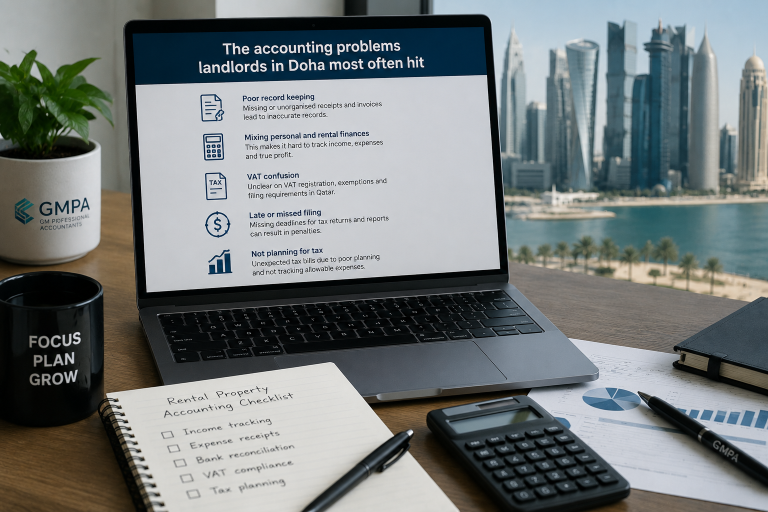
Landlord Accounting Qatar: The Accounting Problems British Landlords in Doha Most Often Hit (2026 Guide)British landlords living in Doha most often hit trouble because they treat their UK rental income as a UK only matter and forget it must be reported under two systems at once. The three problems we see every week are missed Self Assessment deadlines, poor rent and deposit record keeping, and confusion over Making Tax Digital thresholds. Fixing these early protects both your UK compliance and your peace of mind in Qatar.
Why do landlords in Doha get UK rental income reporting wrongMost landlords in Doha assume that because their rent is generated from a UK property and paid into a UK bank account, it falls outside Qatar’s tax free personal environment entirely and can be dealt with once a year without much thought. In practice HMRC still requires non resident landlords to register and file a Self Assessment tax return covering the UK tax year running from 6 April to 5 April, whether or not any tax is ultimately due. Missing this deadline while settled in Doha, Lusail, or Msheireb triggers the same UK late filing penalties as for a resident landlord, and those penalties escalate quickly the longer a return remains outstanding. How does Making Tax Digital affect landlords living in QatarMaking Tax Digital for Income Tax changes how UK rental income is reported, and the rollout affects British landlords in Qatar exactly as it affects those in the UK. From 6 April 2026, landlords with gross rental income above 50000 pounds must keep digital records and submit quarterly updates rather than a single annual return. The threshold drops to 30000 pounds from April 2027, then to 20000 pounds from April 2028. For a landlord managing a UK portfolio from an apartment in West Bay or The Pearl, this means quarterly digital submissions become part of the routine, not an annual afterthought.
What bookkeeping mistakes do Doha based landlords make with rent and depositsThe most common error is mixing personal and rental funds in a single account, which makes it almost impossible to reconstruct an accurate profit figure at year end. Landlords also frequently fail to log letting agent fees, mortgage interest restrictions, and repair costs separately, all of which affect the final taxable profit differently under current HMRC rules. We cover the mechanics of this in detail in our guide on tracking rent, deposits, and service charges for property managers in Qatar, which is worth reading alongside this page if you manage more than one unit. Should landlords in Qatar use a UK limited company or personal ownershipThere is no single correct answer, and the right structure depends on portfolio size, mortgage finance, and long term plans for the property. The table below sets out the main factors we walk clients through during an initial review.
How does the UK Qatar tax treaty affect rental incomeThe United Kingdom and Qatar have a double taxation agreement, which is designed to stop the same rental profit being taxed twice when a landlord is resident in one country and earning income sourced in the other. In most cases UK rental profit is taxed first in the UK, and any relief due in Qatar is applied against that liability rather than as a separate charge, since Qatar does not levy personal income tax on individuals. Understanding how this interacts with your residency status matters, and according to the International Monetary Fund’s Qatar country data, Qatar’s tax environment for individuals remains distinct from most jurisdictions, which is precisely why UK reporting obligations are so easy to overlook while living there. What records do landlords in West Bay, The Pearl, Lusail, and Msheireb need to keepWherever you are based across Doha, whether in West Bay, The Pearl, Lusail, or Msheireb, the underlying UK record keeping requirement does not change. You need dated evidence of rent received, letting agent statements, mortgage interest certificates, and receipts for allowable repairs, kept for at least five years after the relevant filing deadline. For landlords managing several units through a property manager, our page on accounting and bookkeeping for property management and landlords in Qatar sets out a fuller monthly record keeping routine. How can one of our UK accountants helpGMPA LLC supports clients across Doha and the wider Qatar market, helping British expats manage continuing UK tax obligations alongside their day to day life in Qatar. Working with an accountant who understands both HMRC rules and the practical realities of living in the GCC means deadlines are tracked in the correct time zone, records are organised proactively rather than reconstructed under pressure, and structuring decisions are made with full sight of both UK and Qatar circumstances. Frequently asked questionsDo I still pay UK tax on rental income if I live in Qatar full time Yes. UK rental income remains taxable in the UK regardless of where the landlord lives, and non resident landlords must still register and file with HMRC. When does Making Tax Digital start for landlords in Qatar Landlords with gross rental income above 50000 pounds must comply from 6 April 2026, with lower thresholds phasing in during 2027 and 2028. Is it better to hold UK property personally or through a limited company while living in Qatar It depends on portfolio size and mortgage finance. Personal ownership suits smaller portfolios, while a limited company often benefits growing portfolios due to full mortgage interest deduction. Can the UK Qatar tax treaty stop me being taxed twice on rental profit The treaty is designed to prevent double taxation, though relief must be claimed correctly and depends on individual residency status.
|