










| Yes, the UK and Qatar have a full double taxation agreement, in force since 15 October 2010, that stops the same income being taxed twice for expat directors moving between London and Doha. It sets out which country taxes your director’s fees, UK dividends, UK pensions and UK rental income, and in most cases you will still need to file a UK Self Assessment return even though Qatar itself charges no personal income tax on individuals. |
|
Key Takeaways 1. The UK Qatar Double Taxation Agreement has been in force since 15 October 2010, effective for UK income tax and Capital Gains Tax from 6 April 2011 and in Qatar from 1 January 2011. 2. Qatar charges no personal income tax on individuals, but that does not remove your UK tax obligations on UK-source income such as director’s fees, dividends or rental profits. 3. Director’s fees are generally taxed in the country where the paying company is resident, which means UK company directors living in Doha usually stay within the UK tax net on that income. 4. Most British directors in Qatar still need to file a UK Self Assessment return (SA100) even where the DTA relieves them from paying tax twice. 5. GMPA LLC supports expat directors across Doha, West Bay, The Pearl, Lusail and Msheireb with UK Self Assessment filing and Qatar-side QFC obligations, side by side. |
| The UK Qatar Double Taxation Agreement is a bilateral tax treaty, in force since 2010, allocating taxing rights between the UK and Qatar so a British expat director in Doha is not taxed twice on the same director’s fees, dividends or pension income. |
What Is the UK Qatar Double Taxation Agreement?
The UK Qatar Double Taxation Agreement is the treaty that allocates taxing rights between the two countries so that income is not taxed twice on the same profit. It was signed by the two governments in 2009 and covers taxes on income and on capital gains, including employment income, director’s fees, business profits, dividends, interest, royalties and pensions. The full text is published by Qatar’s General Tax Authority, which lists the agreement alongside Qatar’s other bilateral tax treaties.
For a British expat director running or sitting on the board of a UK-registered company while based in Doha, the UK Qatar DTA is the mechanism that decides whether HMRC, the Qatar General Tax Authority (GTA), or both, have a right to tax a given piece of income. It does not exempt you from UK tax altogether. Instead, it tells you which country taxes what, and how relief is given where both countries would otherwise have a claim.
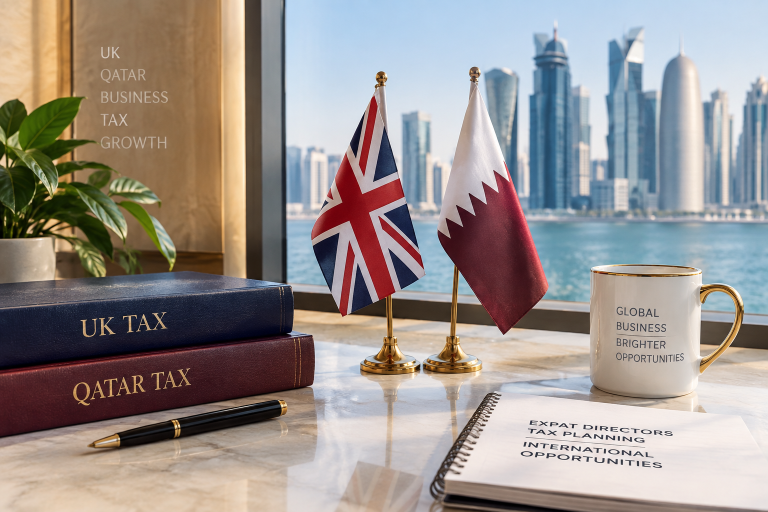
When Did the UK Qatar DTA Come Into Force?
According to HMRC’s Double Taxation Relief Manual, the agreement (SI 2010/241) entered into force on 15 October 2010. It has different effective dates in each country and for each type of tax. In the UK, it applies from 1 January 2011 for tax withheld at source, from 1 April 2011 for corporation tax, and from 6 April 2011 for income tax and Capital Gains Tax. In Qatar, it applies from 1 January 2011. The agreement was later modified by an amending protocol (SI 2011/1684), also effective from 1 January 2011.
These dates matter because they set the point from which a director moving between the UK and Doha can rely on the treaty’s relief provisions rather than domestic law alone.
How Are a UK Director’s Fees Taxed Under the DTA?
This is the question we are asked most often by expat directors in Doha, and it catches a lot of people out. Under the director’s fees article of the UK Qatar DTA, fees and similar payments received by a person as a member of the board of a company are generally taxable in the state where that company is resident, not the state where the director happens to live. In practice, this means a UK company director based in West Bay or Lusail usually remains taxable in the UK on director’s fees, even though they are living and working day to day in Qatar.
We regularly see British expat directors in Doha assume that moving abroad automatically moves their director income out of UK tax. It does not, and getting this wrong creates an unexpected UK tax bill, sometimes years after the fees were paid, once HMRC catches up on a missed Self Assessment return.
Does Qatar Tax Expat Directors’ Income at All?
Qatar does not levy personal income tax on individuals, whether that income comes from employment, director’s fees, investments or pensions. This is one of the main reasons British professionals relocate to Doha in the first place. However, if you own or direct a company registered with the Qatar Financial Centre (QFC), that entity itself is subject to a flat 10 per cent corporate tax on Qatar-sourced profits, filed through the GTA’s Dhareeba portal.
This creates a two-layer position for many expat directors: the company may owe QFC corporate tax on its Qatar profits, while the director personally may still owe UK tax on fees, dividends or salary drawn from a UK entity. GMPA LLC serves clients across Doha and the wider Qatar market, and supports British expats with continuing UK tax obligations alongside their Qatar-side compliance duties, so nothing falls through the gap between the two systems.
The same picture applies across the wider GCC region, not only Qatar. Neighbouring jurisdictions such as the UAE and Saudi Arabia have their own tax regimes and their own treaties with the UK, so a director splitting time between Doha and another Gulf city needs to check each treaty separately rather than assuming Qatar’s rules apply throughout the region. For directors based specifically in Doha, GMPA LLC works with clients across West Bay, The Pearl, Lusail and Msheireb, and understands the practical realities of running a UK company from a Qatar base, including time zone differences for board meetings and the paperwork QFC-registered entities need to keep both authorities satisfied.
What Income Types Does the UK Qatar DTA Cover?
The table below summarises how the main income types relevant to expat directors are generally treated under the DTA. Treaty treatment depends on the specific facts, so always confirm your position with an adviser before relying on it.
| Income Type | Generally Taxed In | Action for a Director in Doha |
| Director’s fees from a UK company | UK, where the company is resident | Report on UK Self Assessment |
| Employment income from a Qatar employer | Qatar, no personal tax due | Confirm UK residence status under the SRT |
| UK dividends | UK, treaty may reduce withholding | Declare on SA100 with dividend supplementary pages |
| UK rental income | UK, Non-Resident Landlord Scheme applies | Register under NRLS, file SA105 |
| Private UK pension income | Usually residence country (Qatar) | Check treaty article applying to your pension type |
| Capital gains on UK residential property | UK, 60 day reporting rule applies | Report and pay within 60 days of completion |
How Does the Statutory Residence Test Affect Directors Using the DTA?
Before the DTA’s relief provisions become relevant, you first need to establish your UK tax residence position under HMRC’s Statutory Residence Test (SRT). The SRT works through automatic overseas tests, automatic UK tests, and, where neither applies, a sufficient ties test that weighs factors such as family, accommodation and days spent in the UK. Many British directors who have recently relocated to Doha remain UK tax resident for part or all of a transition year, particularly if they retain a UK home or return frequently for board meetings.
If you end up tax resident in both the UK and Qatar under each country’s own rules, which is uncommon given Qatar has no domestic residence-based tax, the DTA’s tie-breaker provisions determine which country is treated as your country of residence for treaty purposes. Split year treatment may also apply in the year you actually move, which can reduce the UK income assessed to the part of the year you were UK resident.
This is an area where a small factual detail can change the outcome. A director who keeps a UK home available for their own use, or who returns to the UK for more than the permitted number of days in a tax year, can find themselves still counted as UK resident under the sufficient ties test long after they believed their move to Doha had settled the question. We regularly see this catch out newly relocated directors in their first two tax years, which is exactly the period when split year treatment and careful day counting matter most.
Do Expat Directors in Doha Still Need to File a UK Self Assessment Return?
In most cases, yes. If you continue to receive director’s fees from a UK company, UK dividends, UK rental income or UK pension income, HMRC will normally expect a Self Assessment return (SA100), with SA105 property pages if you retain a UK rental property. The online filing deadline is 31 January following the end of the tax year, with payment normally due on the same date. Missing this deadline while abroad is one of the most common and most avoidable UK tax problems we see among directors in Doha.
Looking ahead, Making Tax Digital for Income Tax (MTD ITSA) continues its phased rollout through 2026 and 2027 for sole traders and landlords above the relevant income thresholds. If you have UK rental income alongside your director’s fees, this is worth reviewing now with your adviser rather than waiting for the requirement to apply to you.
How Does GMPA LLC Support Expat Directors Across Doha and Qatar?
GMPA LLC was set up specifically for the dual-jurisdiction position that British directors in Qatar face. We advise clients across Doha, West Bay, The Pearl, Lusail and Msheireb, as well as the wider GCC, on how the UK Qatar DTA applies to their director’s fees, dividends, pensions and property income, and we prepare and file UK Self Assessment returns alongside any Qatar-side QFC obligations. If your company also needs ongoing financial leadership rather than a one-off filing, our Virtual CFO and outsourced financial controller service gives growing Qatar businesses that structure without the cost of a full-time hire.
Keeping clean, dual-currency records is the foundation of getting any of this right. If you are still reconciling UK and Qatar books manually, our guide to the best accounting software for Qatar businesses in 2026 covers the platforms that make dual reporting straightforward. GMPA LLC serves clients across Doha and the wider Qatar market, and supports British expats with continuing UK tax obligations, so your director’s fees, dividends and pension income are reported correctly on both sides of the treaty.
Frequently Asked Questions
| Does the UK have a double taxation agreement with Qatar? |
| Yes. The UK Qatar Double Taxation Agreement has been in force since 15 October 2010 and covers income tax, corporation tax, Capital Gains Tax and Qatar taxes on income and capital gains, including director’s fees, dividends, interest, royalties and pensions. |
| How are a UK director’s fees taxed if the director lives in Doha? |
| Director’s fees are generally taxed in the country where the paying company is resident under the DTA’s director’s fees article. For a UK company, this usually means the fees remain taxable in the UK even though the director lives in Qatar. |
| Do I still need to file a UK Self Assessment return if I live in Doha? |
| In most cases yes, if you receive UK director’s fees, UK dividends, UK rental income or UK pension income. The online filing deadline is 31 January following the end of the tax year. |
| Does Qatar tax my UK dividends or UK pension income? |
| No. Qatar does not levy personal income tax on individuals, so it does not tax UK dividends or pension income received while you are resident in Qatar. UK tax treatment of that income still depends on the DTA and your UK residence position. |
| What is the Statutory Residence Test and how does it affect the DTA? |
| The Statutory Residence Test is HMRC’s framework for deciding whether you are UK tax resident in a given tax year. Only where you are resident in both the UK and Qatar under each country’s own rules do the DTA’s tie-breaker provisions come into play to determine your treaty residence. |
| Can I claim relief if I am taxed in both the UK and Qatar on the same income? |
| The DTA is designed to prevent this happening in the first place by allocating taxing rights to one country for each type of income. Where relief is still needed, it is normally claimed through your UK Self Assessment return, with the specific mechanism depending on the income type. |
|
Speak to one of our UK accountants about your director’s fees, dividends and UK Self Assessment position.
|
|
Written by Saira Khan, Co-Founder of GMPA LLC, whose team has 15+ years of UK accounting experience advising British expats and SMEs operating across the UK and Qatar. Updated September 2026. This article is for general guidance only and does not constitute regulated legal or tax advice. Treaty interpretations and HMRC guidance can change; always confirm your specific position with a qualified adviser before relying on it. |