|
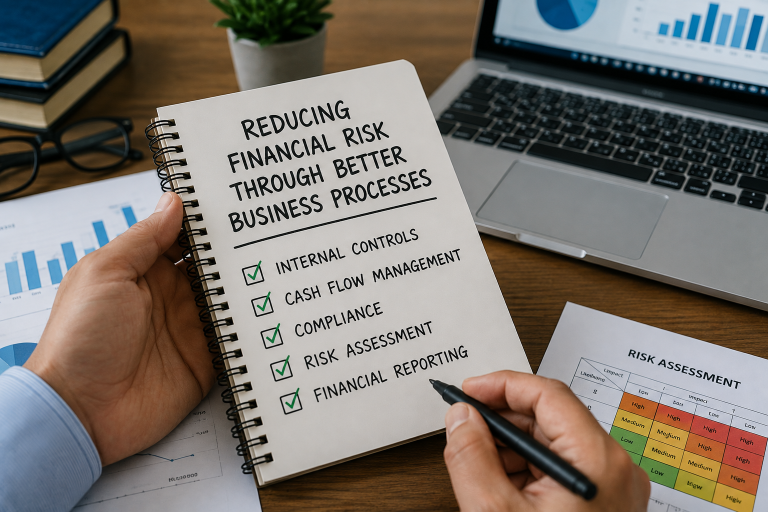
Reducing financial risk through better business processes means building consistent controls, accurate reporting, and regular reviews into daily operations so that errors, fraud, and cash flow problems are caught early. For businesses in Doha and across Qatar, this means combining strong internal controls with local regulatory awareness under Qatar Financial Centre and Qatar Central Bank expectations. The result is a business that grows with confidence rather than reacting to financial surprises after they happen.
Financial risk management is the structured practice of identifying, monitoring, and reducing the operational, credit, liquidity, and compliance risks that can damage profitability, achieved through consistent processes, accurate reporting, and internal controls across Qatar businesses and the wider GCC region.
|
What Does Reducing Financial Risk Through Better Business Processes Mean for Qatar Companies?
For a company operating in Qatar, reducing financial risk is not a single project. It is an ongoing discipline built from repeatable processes such as approval workflows, monthly reconciliations, and standardised reporting. When these processes exist and are followed consistently, small issues get caught while they are still small. When they do not exist, the same issues often surface months later as cash shortfalls, disputed invoices, or compliance penalties. Business owners in Doha frequently describe this as the difference between running a business reactively and running one with genuine financial visibility.
Why Are Doha Businesses More Exposed to Financial Risk Without Strong Processes?
Qatar’s economy is growing quickly, and Doha in particular has seen rapid expansion across construction, hospitality, retail, and professional services. Rapid growth is good for revenue, but it also multiplies the number of transactions, suppliers, and staff involved in day to day finance. Without structured processes, this growth outpaces the owner’s ability to personally check every transaction. Businesses based in West Bay, The Pearl, Lusail, and Msheireb are often managing higher transaction volumes and more complex supplier relationships, which raises the stakes for having reliable financial systems rather than informal ones.
What Are the Most Common Financial Risks Facing Businesses in Qatar?
The most common risks seen across Qatar businesses fall into five categories. Operational risk comes from manual errors and disconnected systems. Cash flow risk comes from unpredictable receivables and rising overheads. Compliance risk comes from missed filing deadlines or incomplete records. Credit risk comes from extending payment terms without proper vetting. Fraud risk comes from a lack of separation between who approves, records, and pays. Any one of these can affect profitability, but the combination of two or more at once is what tends to threaten a business’s stability.
How Do Weak Business Processes Create Financial Risk?
Weak processes create risk quietly. A missing approval step allows one person to raise, approve, and pay an invoice without a second check. A delayed reconciliation means a bank error or duplicate payment can go unnoticed for weeks. Inconsistent reporting means the owner sees last quarter’s numbers instead of this month’s reality. None of these problems look dramatic on their own, but together they explain why so many profitable looking businesses in Qatar still experience cash pressure or year end surprises.
|
What Financial Processes Should Every Business in Qatar and Doha Put in Place?
Every business, regardless of size, benefits from four core processes. A clear approval workflow for spending, a monthly bank and account reconciliation, a simple monthly management report covering revenue, costs, and cash position, and a documented process for onboarding new suppliers and customers. These four processes alone remove most of the everyday risk that Qatar businesses face, and they can be implemented within a single Zoho Books or similar cloud accounting setup without adding significant administrative burden.
How Do Internal Financial Controls Reduce Risk for Qatar Businesses?
Internal financial controls work by separating duties, requiring authorisation before money moves, and creating an audit trail for every transaction. This is covered in detail in our guide on Internal Financial Controls Every Qatar Business Should Have, which outlines the specific controls that suit growing SMEs in Doha and across the wider Qatar market.
What Happens When Financial Controls Are Weak or Missing?
When controls are weak, fraud and errors become far easier to hide. A single employee with unchecked access to payments, or a business owner who signs off on everything without reviewing supporting documents, creates the exact conditions where losses build up unnoticed. Our article on How Weak Financial Controls Lead to Fraud and Financial Losses walks through real patterns we see in Qatar businesses and how to close those gaps.
How Can Better Reporting Systems Reduce Financial Risk?
A business cannot manage a risk it cannot see. Efficient financial reporting systems give owners and managers timely, accurate visibility into revenue, margins, and cash position, which allows problems to be addressed weeks or months before they escalate. We cover this in full in How to Build Efficient Financial Reporting Systems in Qatar, including which reports matter most for SMEs operating in Doha.
Why Do Regular Financial Reviews Matter for Reducing Risk?
Processes only stay effective if they are reviewed. A quarterly or biannual financial review checks whether controls are actually being followed, whether reporting is still accurate, and whether new risks have emerged as the business has grown. Our guide, Why Regular Financial Reviews Are Essential for Business Growth, explains how to structure these reviews so they add value rather than becoming a box ticking exercise.
How Does Financial Risk Differ for British Expats Running Businesses in Qatar?
British expats operating businesses in Qatar carry an additional layer of financial risk that purely local businesses do not face, because UK tax residency, reporting, and disclosure obligations often continue even while the business trades entirely from Doha. Without clear processes, it becomes easy to lose track of which UK filings are still due, how Qatar sourced income should be reported at home, or how dividends and remittances interact with both jurisdictions. A structured financial process, reviewed with an adviser familiar with both systems, removes this dual jurisdiction risk rather than leaving it to guesswork.
What Regulatory Framework Supports Financial Risk Reduction in Qatar?
Qatar’s financial governance sits across several bodies, and 2026 has brought continued tightening of expectations in this area. The Qatar Financial Centre provides the legal and regulatory environment for firms operating in and from Doha, while the Qatar Central Bank oversees broader financial sector stability. According to the International Monetary Fund, structured risk management and strong internal governance are central to protecting businesses against financial shocks, a principle that applies just as directly to an SME in Qatar as it does to a global financial institution. Businesses that align their internal processes with this direction tend to face fewer compliance surprises as regulatory expectations continue to rise.
How Can GMPA LLC Help Reduce Financial Risk Through Better Processes?
GMPA LLC works with business owners across Doha and the wider Qatar market to design and implement the financial processes covered in this guide, from internal controls and cloud bookkeeping through to reporting systems and regular reviews. GMPA LLC also supports British expats with their continuing UK tax obligations alongside their Qatar business responsibilities, so nothing falls between the two systems. Whether a business is based in West Bay, The Pearl, Lusail, Msheireb, or elsewhere across the GCC, the same principle applies, and reducing financial risk starts with putting the right process in place before a problem forces the issue.
|










