










How Weak Financial Controls Lead to Fraud and Financial Losses in Qatar
A practical guide for business owners in Doha, West Bay, The Pearl and British expats managing companies across Qatar
| Weak financial controls lead to fraud because they remove the checks that would normally stop a single employee from initiating, approving and recording a transaction alone. In Qatar, this gap most often shows up as invoice fraud, payroll manipulation or petty cash abuse, and it is almost always avoidable with basic segregation of duties. |
|
Definition Weak financial controls are gaps in the approval, recording and review process of a business, such as one person handling payments alone, that create the opportunity for employee fraud, undetected errors and direct financial loss across a Qatari or UK connected company. |
Key Takeaways
| Weak controls are consistently identified as the leading cause of fraud in small and medium businesses, in Qatar and globally. |
| A single person raising, approving and paying an invoice is the single most common fraud gap found in Doha SMEs. |
| Fraud from weak controls is rarely a single large loss. It is usually a slow accumulation of small, undetected transactions. |
| British expats in Qatar face an added layer of risk, since poor records affect both Qatari reporting and ongoing UK tax obligations. |
| GMPA LLC serves clients across Doha and the wider Qatar market and supports British expats with their continuing UK tax obligations. |
| 42%of small business fraud is caused by lack of controls, against 25% in larger firms (ACFE) | 12 monthsaverage time small business fraud runs before it is detected (ACFE) | 15+ yearsof UK accounting experience behind GMPA LLC advisory services in Qatar |
What Is the Direct Link Between Weak Financial Controls and Fraud in Qatar?
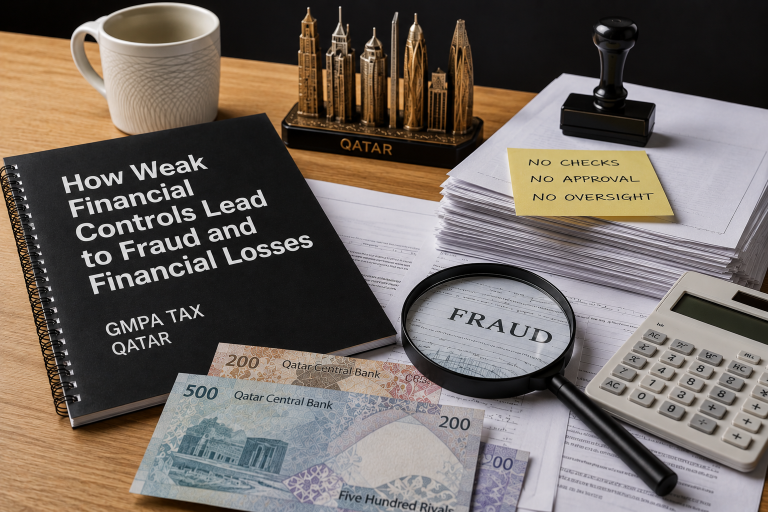
Fraud rarely begins with a criminal mastermind. It begins with an opportunity, and weak financial controls are what create that opportunity. When one person in a Doha business can raise a purchase, approve it and process the payment without a second check, the business has removed the exact barrier that would normally catch a fraudulent or fictitious transaction. This pattern, often called the fraud triangle of pressure, opportunity and rationalisation, is well documented internationally, and the opportunity element is almost entirely a function of how strong or weak the company’s financial controls are.
In Qatar’s fast growing SME market, this gap tends to appear during periods of rapid expansion. A business that starts with one owner managing every payment personally often keeps that same informal structure long after it has hired staff, opened a second bank account, or expanded into West Bay or Lusail. The informal approach that worked at a small scale becomes the exact weakness that a dishonest employee, or simple human error, can exploit once the business is too large for one person to monitor everything alone.
Which Financial Control Weaknesses Create the Highest Fraud Risk for Businesses in Doha?
Certain gaps consistently appear across the businesses GMPA LLC reviews in Doha, The Pearl and Msheireb. Understanding which weakness leads to which risk helps a business owner prioritise fixes correctly rather than guessing.
| 1 | One person handling invoicing, approval and payment together, with no second signoff at any stage |
| 2 | Bank accounts reconciled only once a year instead of monthly, allowing errors or theft to sit undetected |
| 3 | No written approval matrix, meaning any staff member can authorise a payment of any size |
| 4 | Petty cash with no float limit and no receipt requirement |
| 5 | Payroll prepared and authorised by the same individual, with no cross check against HR records |
How Does Weak Financial Control Fraud Actually Happen in a Qatar SME?
The table below maps the most common Qatar SME fraud types directly to the control gap that enables them. This is the part most guides skip, yet it is the single most useful thing a business owner in Doha can understand about their own exposure.
| Fraud Type | Control Gap That Enables It | Typical Warning Sign |
| Fictitious supplier invoices | No supplier onboarding checks or three way match between order, delivery and invoice | New supplier appears with no contract or trading history |
| Ghost employees or payroll inflation | Payroll prepared and approved by one person, no HR cross check | Employee count on payroll does not match HR headcount |
| Petty cash and expense abuse | No float limit, no receipt requirement, no line manager approval | Recurring round number cash claims with missing receipts |
| Unauthorised bank transfers | Monthly reconciliation skipped or delayed to year end | Bank balance does not match accounting records for several months |
| Skimming of cash sales | No daily cash count or cash to sales reconciliation | Cash sales trending down while footfall stays consistent |
| Source: GMPA LLC advisory framework, informed by ACFE small business fraud research and KPMG Middle East fraud profiling. | ||
What Does Fraud From Weak Controls Really Cost a Business in Qatar?
The cost of weak controls is almost never a single dramatic event. It is a slow accumulation, a duplicate supplier payment missed for months, a petty cash float that quietly shrinks, a VAT or corporate tax position that needs reworking because the underlying records were incomplete. Small businesses globally report a considerably higher median fraud loss than large organisations, precisely because they lack the layered checks that bigger companies can afford to build. For a growing company in Doha, the real cost extends beyond the direct loss to the time spent reconstructing records, the reputational damage with banks and investors, and the delay to raising finance while a fraud investigation or cleanup is underway.
There is also a credibility cost that is easy to underestimate. Banks, investors and joint venture partners across the wider GCC increasingly expect to see documented controls before extending finance or entering a partnership. A business that can show reconciled accounts and a clear approval trail is simply easier to trust with capital than one that cannot, and the International Monetary Fund has noted that limited access to finance for SMEs in Qatar is linked directly to weak governance and unreliable financial records, a structural point that applies at the level of an individual company just as much as the wider economy. Read the IMF’s 2024 Article IV Consultation on Qatar.
How Do British Expats in Qatar Face Extra Fraud and Compliance Risk?
British expats running businesses in Doha, West Bay or Msheireb carry a dual reporting burden that most local competitors never have to consider. Alongside satisfying Qatari expectations, many expat owners retain ongoing UK tax obligations, including reporting worldwide income to HMRC and, in some structures, maintaining UK company filings. If weak controls have allowed inaccurate or incomplete records to build up on the Qatari side, that same weakness flows straight through into the UK reporting position, turning a local control gap into a cross border compliance problem.
GMPA LLC serves clients across Doha and the wider Qatar market, and directly supports British expats with their continuing UK tax obligations, ensuring that the same financial records used to satisfy Qatari requirements are also fit for purpose under HMRC scrutiny. This dual jurisdiction lens is rarely offered by local Qatari audit firms and is one of the clearest reasons expat business owners choose an advisor who understands both systems.
How Can a Business in Qatar Fix Weak Financial Controls Before Fraud Happens?
Fixing weak controls does not require a full finance department. It requires the right things fixed in the right order. Start by mapping who currently raises, approves and pays every transaction in your business, since this alone will usually reveal your biggest single point of exposure. From there, most businesses in Qatar benefit from a structured review such as our guide to common financial system weaknesses found in Qatar SMEs, which identifies the specific gaps before deciding what to fix first.
Many businesses running manual processes also benefit from comparing their current setup against a digital alternative, covered in our guide to manual versus automated financial processes for businesses in Qatar. Once the immediate gaps are addressed, the next step is usually building a proper reporting structure, which our guide to building efficient financial reporting systems in Qatar walks through in detail, alongside the wider case for financial process automation for businesses in Qatar to reduce manual error further.
For a full breakdown of which specific controls to put in place first, see our companion guide to financial controls every SME in Qatar should implement, and our related piece on internal financial controls every Qatar business should have, which sets out the four controls most businesses in Doha should prioritise first.
Frequently Asked Questions: Weak Financial Controls and Fraud in Qatar
| How quickly does fraud usually get discovered when controls are weak? |
| Small business fraud linked to weak controls often runs for around a year before it is discovered, since there is no second person reviewing transactions closely enough to notice a pattern. The longer it runs, the larger the eventual loss and the harder the records are to reconstruct. |
| Is fraud from weak controls usually external or internal in Qatar? |
| The overwhelming majority of fraud enabled by weak controls is an insider risk, carried out by an employee or, in a notable proportion of small business cases, an owner or senior manager rather than an outside attacker. |
| Can a small business in Doha realistically prevent fraud without hiring a finance team? |
| Yes. Segregation of duties, monthly bank reconciliation and a simple written approval limit can be introduced within weeks and require no new hires, only a change in process and clear communication to staff. |
| Do British expat business owners in Qatar face different fraud risks to local businesses? |
| The fraud mechanisms are the same, but the consequences are wider, since inaccurate Qatari records caused by weak controls can also undermine a British expat’s UK tax reporting position, creating a compliance issue on two fronts instead of one. |
| Does GMPA LLC help businesses recover from fraud as well as prevent it? |
| Yes. GMPA LLC supports businesses across Doha and the wider Qatar market both in building stronger financial controls to prevent fraud and in reconstructing records and reporting positions after a control failure has already occurred. |
| Written by Saira Khan, 2026, Co-Founder of GMPA LLC, whose team has 15+ years of UK accounting experience advising British expats and SMEs operating across the UK and Qatar. |
| Speak to One of Our UK Accountants, Book Your Free Consultation | View Our Services |