










|
Financial Governance in Qatar Financial Governance Best Practices in Qatar: A 2026 Guide for Doha Businesses and British ExpatsA practical guide for business owners in Doha, West Bay, The Pearl, and Lusail, and for British expats governing companies across Qatar in 2026. |
|
Strong financial governance in Qatar means a business has clear board or ownership oversight, documented approval processes, accurate and timely reporting, and controls that satisfy both Qatari regulators and, for British expat owners, ongoing UK obligations. Businesses that treat governance as a live discipline rather than a once a year exercise are consistently the ones that pass audits smoothly, attract investment faster, and avoid the compliance penalties that catch out less prepared competitors. |
|
Definition Financial governance is the framework of policies, oversight roles, reporting standards, and controls a business uses to manage its finances responsibly, satisfy regulators such as the QCB, QFMA, and QFC, and protect owners, investors, and stakeholders from risk. |
Key Takeaways |
|
| 1 | Financial governance covers oversight, reporting, and controls together, not any single practice on its own. |
| 2 | Qatar’s 2026 regulatory updates raise expectations around board accountability and disclosure for QFC registered and foreign owned businesses. |
| 3 | British expat owners in Qatar need governance that satisfies Qatari reporting and ongoing UK obligations at the same time. |
| 4 | Governance requirements scale with company size, from an owner led approval process through to formal delegation of authority. |
What Is Financial Governance and Why Does It Matter for a Business in Qatar?
Financial governance is the structure a business puts around how money is managed, reported, and controlled. It sits above day to day bookkeeping and covers who is accountable for financial decisions, how those decisions are reviewed, and how the business proves to regulators, investors, and partners that its numbers can be trusted. In Qatar, this matters more than ever in 2026. Regulators including the Qatar Central Bank, the Qatar Financial Markets Authority, and the Qatar Financial Centre Regulatory Authority have all tightened expectations around board accountability, disclosure, and internal controls, part of Qatar’s wider push toward transparency and investor confidence under Qatar National Vision 2030.
For a growing SME in Doha, weak governance rarely announces itself. It shows up quietly, a delayed board decision, a set of accounts nobody reviewed properly before year end, or a compliance requirement that surfaces only once a regulator or investor asks a question the business cannot answer cleanly.
What Are the Core Pillars of Strong Financial Governance in Qatar?
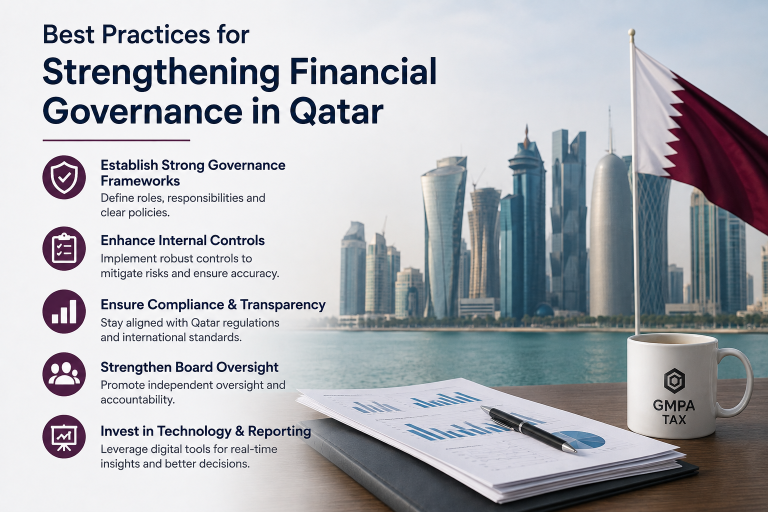
Most businesses across Doha, West Bay, and Lusail build strong governance around five practical pillars, applied in this order for the fastest reduction in risk.
| 1 | Clear ownership of financial decisions. A named individual or board is accountable for approvals, not an informal understanding among staff. |
| 2 | Documented policies and approval limits. Spending authority and sign off levels are written down, not remembered. |
| 3 | Timely, accurate reporting. Management sees a monthly financial picture rather than a reconstruction at year end. |
| 4 | Independent review. Someone outside the day to day transaction flow checks the numbers, whether that is an external accountant, an auditor, or a non executive advisor. |
| 5 | Regulatory alignment. Policies map directly to what Qatari regulators and, where relevant, UK tax authorities expect to see. |
These pillars work together. A written approval policy without independent review still leaves a business exposed, and accurate reporting means little if nobody with real authority reviews it monthly. Businesses that already have internal controls in place, covered in detail in our guide to internal financial controls every Qatar business should have, already have the operational foundation governance is built on.
Which Regulatory Bodies Shape Financial Governance Requirements in Qatar?
Three regulators shape most governance expectations in Qatar. The Qatar Central Bank sets governance instructions for banks and financial institutions, aligned with international Basel Committee principles. The Qatar Financial Markets Authority issues the Code of Governance for listed companies, covering board accountability, disclosure, and shareholder rights. The Qatar Financial Centre Regulatory Authority applies its own Governance and Controlled Functions Rules to firms registered within the QFC, with a framework proportionate to the size and complexity of each entity’s operations. The QFCRA states plainly that good corporate governance in QFC firms supports transparency and integrity across the financial sector, minimises reputational risk, and strengthens protection for clients, customers, investors, and shareholders (source: QFC Regulatory Authority, Corporate Governance).
For a business outside the QFC, these frameworks still matter as a benchmark, since the Ministry of Commerce and Industry, the General Tax Authority, and increasingly investors and banks all expect governance practices that broadly mirror them, even where formal compliance is not mandatory.
How Does Financial Governance Differ Between a Small Business and a Larger Qatari Company?
Governance should scale with the size and complexity of the business rather than applying a single standard everywhere. The table below compares what is realistic and expected at each stage.
| Governance Area | Small Business or Start Up | Growing SME | Larger or QFC Registered Company |
| Oversight | Owner reviews all decisions personally | Small leadership team with defined roles | Formal board or committee oversight |
| Reporting | Quarterly, often reactive | Monthly management reporting | Monthly reporting plus quarterly board packs |
| External Assurance | Not usually required | Annual review recommended | Statutory audit typically required |
| Policy Documentation | Informal or verbal | Written approval matrix | Formal delegation of authority policy |
How Should British Expat Owners in Qatar Align Governance With UK Obligations?
British expat owners running businesses from Doha, West Bay, or Msheireb often carry a dual governance burden that local competitors rarely address. Alongside meeting Qatari expectations around reporting and oversight, many still hold ongoing UK obligations, including reporting worldwide income to HMRC or maintaining UK company filings where a business has a cross border structure. Governance built to satisfy only one jurisdiction tends to create duplicate work later, since Qatari records that were never structured with UK reporting in mind often need reconstructing from scratch each year.
GMPA LLC supports clients across Doha and the wider Qatar market with this exact combination, helping British expat owners build governance frameworks that satisfy Qatari regulators while keeping their UK tax position current and defensible. Businesses wanting to understand where their current systems fall short can start with our guide to how to identify financial risks before they become problems.
What Are the Warning Signs of Weak Financial Governance in a Qatar Business?
| 1 | No single person is clearly accountable for financial decisions above a certain value. |
| 2 | Management only sees financial performance once a year rather than monthly. |
| 3 | Approval limits exist only informally and are not written down anywhere. |
| 4 | No independent party reviews the accounts before they reach investors, banks, or regulators. |
Left unaddressed, these gaps are a leading cause of the losses described in our guide to how weak financial controls lead to fraud and financial losses, and they compound quickly once a business adds a second location, a second bank account, or expands into Lusail or the wider GCC.
How Can a Business in Doha Start Strengthening Its Financial Governance?
Governance improvements work best as a staged process rather than an overnight overhaul. Most businesses in Doha start by mapping current decision making against the five pillars above, identifying where accountability is unclear or undocumented. From there, the typical next steps are agreeing a written approval matrix with the owner or board, introducing a monthly reporting rhythm, and bringing in independent review, whether through an external accountant or a periodic audit. Our guide to reducing financial risk through better business processes walks through this staging in more detail.
A small business can typically put the core governance foundations in place within a few weeks, since it mainly requires agreeing a process and writing it down. A growing SME introducing tiered approval limits and monthly reporting should plan for four to eight weeks. Larger or QFC registered businesses preparing for statutory audit usually need two to three months to document policies formally and test that they operate as designed. In every case, the businesses that succeed are the ones that build governance in early rather than reacting to a regulator, investor, or bank asking for it later.
Frequently Asked Questions
| What is financial governance? |
| Financial governance is the combination of policies, oversight roles, reporting standards, and controls a business uses to manage its finances responsibly and satisfy regulators, investors, and stakeholders that its numbers can be trusted. |
| Which regulators oversee financial governance in Qatar? |
| The Qatar Central Bank, the Qatar Financial Markets Authority, and the Qatar Financial Centre Regulatory Authority all shape governance requirements, alongside the Ministry of Commerce and Industry for general business compliance. |
| Does financial governance matter for a small business, or only larger companies? |
| Yes. Governance should scale with the business rather than apply only above a certain size. A small business benefits from clear ownership of decisions and basic reporting just as a larger company benefits from board oversight and statutory audit. |
| How does financial governance affect British expat owners in Qatar? |
| British expat owners often need governance that satisfies both Qatari reporting expectations and ongoing UK obligations, such as reporting worldwide income to HMRC. Structuring governance for both jurisdictions from the start avoids duplicate work later. |
| Can an outsourced advisory firm help strengthen financial governance in Qatar? |
| Yes. An outsourced financial advisory partner such as GMPA LLC can design an approval matrix, set up independent review, and align reporting with both Qatari and UK requirements, without the cost of building a full internal finance function. |
| Written by Saira Khan, 2026, Co-Founder of GMPA LLC, whose team has 15+ years of UK accounting experience advising British expats and SMEs operating across the UK and Qatar. |
| Speak to One of Our UK Accountants, Book Your Free Consultation | View Our Services |