










| Written by Saira Khan, Co-Founder of GMPA LLC, whose team has 15+ years of UK accounting experience advising British expats and SMEs operating across the UK and Qatar. Updated for 2026. |
A 3 year financial plan sets clear revenue, cost and cash targets across three consecutive years, giving a growing limited company in Qatar a structured route to expansion, funding decisions and UK reporting, rather than reacting one quarter at a time.
| Key Takeaways |
| A 3 year financial plan links your annual budget and rolling forecast into one growth story your bank, board or UK parent company can follow. |
| Qatar Financial Centre data shows 813 new firms joined the platform in Q1 2026 alone, a 57 percent increase year on year, which changes the competitive and hiring assumptions behind Year 2 and Year 3. |
| British expat directors need a plan that tracks UK dividend timing and residual UK corporation tax exposure alongside Qatar trading figures. |
| Year 1 should be built bottom up from real numbers, Year 2 and Year 3 should be built top down from market and sector assumptions. |
| GMPA LLC serves clients across Doha and the wider Qatar market and supports British expats with continuing UK tax obligations while building these plans. |
What Is a 3 Year Financial Plan and Why Does a Growing Limited Company Need One?
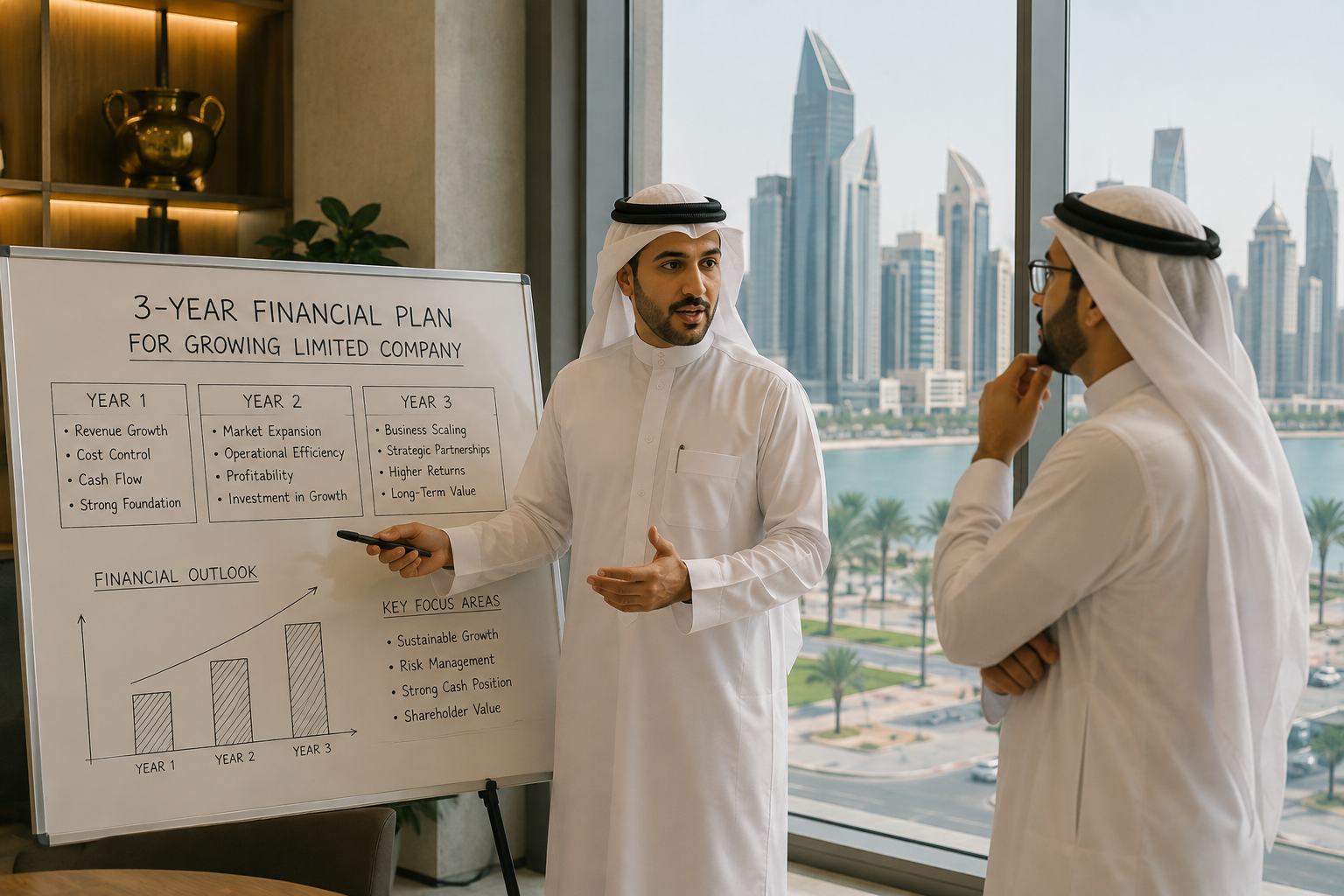
A 3 year financial plan is a structured projection of revenue, costs, cash flow and profitability across three consecutive financial years, built to support decisions that a single annual budget cannot answer on its own. Where an annual budget sets one year of targets and a rolling forecast keeps a moving twelve month view current, a 3 year plan answers a longer question, whether the business can fund a second office, take on a new sector, or justify a bank facility. For limited companies trading out of Doha, the plan also has to hold two realities at once, the pace of Qatar’s non hydrocarbon economy and the UK compliance calendar that many British expat directors are still tied to through a UK entity, UK dividends or UK property income left behind.
What Should Be Included in a 3 Year Financial Plan for a Qatar Based Limited Company?
Every credible 3 year plan covers the same core sections, but the weighting shifts for a company trading between the UK and Qatar. Revenue projections should be broken down by service line or client segment, with separate assumptions for Doha based clients and any UK or international revenue. Cost projections need to separate fixed costs, such as office space in West Bay, The Pearl, Lusail or Msheireb, from variable costs like staffing, freelance support and QFC or Ministry of Commerce licence renewals. Cash flow projections should be modelled monthly for Year 1 and quarterly for Year 2 and Year 3. Profitability targets should be stated as both a percentage margin and an absolute figure, since a growing company often sees margin compress in Year 2 as headcount is added ahead of revenue catching up. A funding and capital section should record whether growth is self funded, financed through a Qatar bank facility, or supported by a UK parent company, since each route carries different reporting obligations.
How Do You Build Year One of Your 3 Year Financial Plan?
Year 1 should always be built bottom up, using your actual trading history, current contracts and known cost base rather than market averages. Start with confirmed and highly probable revenue, add a conservative estimate for pipeline you have not yet closed, and separate the two clearly so the board or bank can see which figure is guaranteed and which is an assumption. Cost projections for Year 1 should be built from your existing payroll, rent and supplier commitments, adjusted only for changes you have already agreed, a new hire starting in month four, a lease renewal at a known rate, a licence fee increase already announced by the QFC or Ministry of Commerce. A Year 1 plan that is more than 10 to 15 percent optimistic against the prior twelve months of actual trading is usually a sign the assumptions need revisiting before the plan goes to the board.
How Should Year Two and Year Three Assumptions Differ From Year One?
Year 2 and Year 3 cannot be built with the same precision as Year 1, and trying to force that level of detail usually produces a plan nobody trusts by month three. Instead, Year 2 should be built top down from sector growth rates, hiring plans and known market shifts, and Year 3 should be treated as a directional target rather than a fixed number, revisited properly once Year 2 actuals are in. A useful discipline is to build three scenarios for Year 2 and Year 3, a base case using current trajectory, a growth case assuming a new district office or sector expansion succeeds, and a conservative case assuming Qatar’s hydrocarbon linked spending slows. Presenting all three to a bank or UK parent company is usually better received than presenting a single confident number that later proves wrong.
How Does Qatar’s Economic Outlook Affect a 3 Year Plan in 2026?
According to the IMF’s 2026 Article IV mission to Qatar, growth strengthened through 2025 and is expected to average around 4 percent in the medium term, supported by expanding LNG production and continued non hydrocarbon reform under the Third National Development Strategy. Separately, Qatar Financial Centre data shows 813 new firms joined its platform in the first quarter of 2026 alone, a 57 percent increase year on year, which signals faster competition for office space, staff and clients across West Bay, Lusail and the wider Doha market than most Year 2 and Year 3 plans currently assume. A plan built in early 2026 without adjusting for that pace of new market entry is likely to understate both the opportunity and the cost pressure a growing company will face by Year 3.
What Is the Difference Between a 3 Year Financial Plan, an Annual Budget and a Rolling Forecast?
These three tools work together rather than replacing one another, and confusing them is one of the most common planning mistakes we see among growing limited companies in Doha. The table below sets out how each one is used.
| Feature | 3 Year Financial Plan | Annual Budget | Rolling Forecast |
| Time horizon | Three financial years | Fixed financial year | Fixed months ahead, always moving forward |
| Update frequency | Reviewed annually, revised after each year end | Once a year | Monthly or quarterly |
| Main purpose | Strategic growth, funding decisions, board direction | Accountability, UK reporting, target setting | Agility, early warning, operational decisions |
| Best suited to | Companies planning expansion, hiring or new funding | UK statutory reporting, investor and board packs | Companies exposed to Qatar market volatility |
| Precision | High in Year 1, directional in Year 2 and Year 3 | High across the full year | High, updated continuously |
How Do UK Tax Obligations Fit Into a 3 Year Plan for British Expat Directors?
Many GMPA LLC clients running a Qatar limited company still hold UK obligations, whether that is a UK trading entity, a holding structure, residual UK property income, or simply dividend planning that needs to work around the UK Statutory Residence Test. A 3 year plan built purely around Qatar cash flow misses these triggers entirely, and directors are often surprised in Year 2 or Year 3 by a UK filing deadline or corporation tax position their local numbers never flagged. Building UK dividend timing, GBP to QAR currency exposure and any UK entity obligations into the same plan as your Doha trading figures means fewer surprises when the two jurisdictions’ deadlines land in the same quarter. If your UK company is scaling alongside your Qatar operation, our guidance on advisory support for scaling limited companies in the UK sets out the compliance side that should feed directly into this plan.
What Mistakes Do Growing Companies Make When Building a 3 Year Financial Plan?
The most common mistake is building all three years with the same false precision, which usually means the plan is quietly abandoned by month six once Year 1 actuals diverge from Year 2 and Year 3 guesses dressed up as detail. A second common mistake is ignoring scenario planning entirely, presenting one confident number instead of a base, growth and conservative case, which leaves a board or bank with no way to judge how much risk sits behind the figure. A third is treating the plan as a UK only or Qatar only exercise rather than combining both, which is a particular risk for British expat directors who assume their accountant on one side of the relationship is tracking the other. If you want to pressure test your assumptions before finalising a plan, our guide on scenario planning for limited companies covers how to stress test a plan before you commit to it, and our article on 5 financial planning mistakes SMEs make in the Middle East sets out the wider pitfalls we see most often.
How Can GMPA LLC Help You Build a 3 Year Financial Plan in Doha?
GMPA LLC serves clients across Doha and the wider Qatar market, and supports British expats with continuing UK tax obligations alongside their local reporting needs. We build 3 year plans that start with a properly built annual budget for Year 1, layer scenario based projections for Year 2 and Year 3, and connect the whole plan to any UK entity, dividend or residency position you are still managing. If you have not yet built your first annual budget, our step by step guide on how to build an annual budget for your limited company in Qatar is the right starting point, and once that is in place our guide comparing rolling forecasts against annual budgets shows how to keep the plan current between annual reviews.
Frequently Asked Questions
| How often should a 3 year plan be rebuilt? |
| Most growing companies rebuild the full 3 year plan once a year, ideally straight after Year 1 actuals are confirmed, so Year 2 becomes the new Year 1 and Year 3 becomes the new Year 2. |
| Do I need a 3 year plan if I already have an annual budget and rolling forecast? |
| Yes, in most cases. An annual budget and rolling forecast manage the current year, while a 3 year plan is the tool a bank, board or UK parent company uses to judge whether longer term growth or funding decisions make sense. |
| How accurate should Year 3 figures be? |
| Year 3 should be treated as directional, not precise. Its value is in testing whether a growth ambition is broadly realistic, not in matching actual results to the pound or riyal. |
| Does a 3 year plan need to include UK figures if my company only trades in Qatar? |
| If you are a British expat director with any residual UK entity, property income or dividend planning, yes. Leaving UK obligations out of the plan is one of the most common gaps we see when reviewing plans built without local expat experience. |
| What is the biggest risk to a 3 year plan in Qatar right now? |
| The pace of new market entry. With QFC reporting a 57 percent year on year rise in new firms joining its platform in Q1 2026, plans that assume slow, steady competition may understate both hiring costs and pricing pressure by Year 3. |
| Speak to One of Our UK Accountants, Book Your Free Consultation |
| View Our Services |