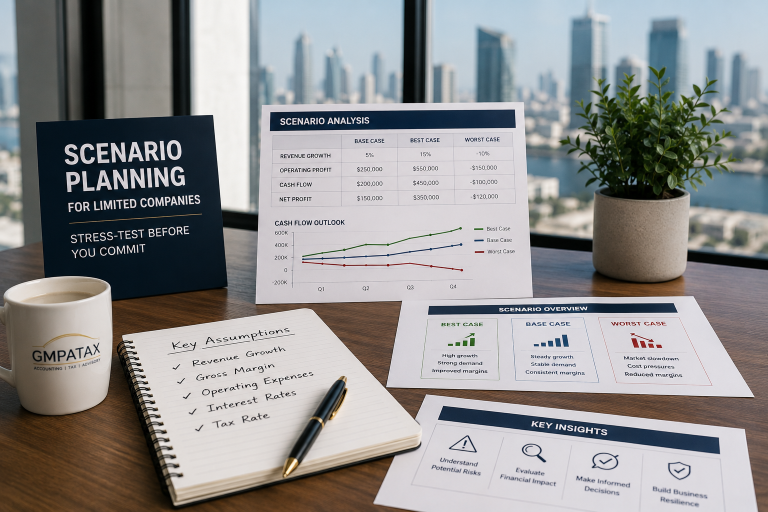
Scenario Planning for Limited Companies in Qatar: Stress Test Before You Commit
Yes, scenario planning is essential for limited companies in Qatar because it shows how your business would perform under a best case, base case and worst case outcome before you sign a lease, hire staff or expand into a new GCC market. Rather than relying on one forecast, you build two or three plausible futures using your actual financial data and test each one against your cash position. Most Doha based directors find this reveals risks, such as sponsorship cost increases or delayed receivables, that a standard annual budget alone would miss. Scenario planning is the process of modelling how a limited company’s revenue, costs and cash position would change under different future conditions, such as a client loss or a currency shift, so directors in Doha and across Qatar can stress test decisions before committing resources.
What Is Scenario Planning for a Limited Company?Scenario planning is a structured way of asking “what happens to my company if” before it happens, rather than after. Instead of producing one annual budget and hoping it holds, you build a small number of alternative versions of your financial year, typically a best case, a base case and a worst case, each built on a different set of assumptions about revenue, costs and timing. A limited company in Qatar might model what happens if a major client contract is delayed by three months, if sponsorship and visa costs rise, or if a new GCC competitor enters the market. The output is not a prediction. It is a set of decisions you have already thought through, so that when conditions change you are adjusting a plan rather than reacting from a standing start.
Why Should Qatar Based Limited Companies Stress Test Before Committing?Committing to a lease in West Bay, hiring your first sales team, or opening a second entity through the Qatar Financial Centre are decisions that are expensive to reverse once signed. Stress testing these decisions against a downside scenario, not only your expected case, shows you the minimum revenue you need to cover the new cost, and how many months of reserve you would have if that revenue arrives late. This matters more in Qatar than in many markets because a meaningful share of your cost base, such as sponsorship fees, end of service gratuity and commercial lease terms, is fixed once agreed and difficult to unwind mid year. Companies trading across the wider GCC face an additional layer of uncertainty, since regulatory and tax treatment differs between Qatar, the UAE and Saudi Arabia, and a scenario plan lets you quantify that exposure before you sign anything rather than after. What Financial Information Do You Need Before You Start?Before building scenarios, gather your most recent income statement, balance sheet and cash flow statement, along with your current pipeline of signed and probable contracts. You also need a clear list of fixed costs that will not move regardless of trading performance, such as office rent in West Bay or Lusail, sponsorship and visa renewals, and loan repayments. If your company is new and has no prior year data, build your base case from signed contracts and quoted supplier costs rather than an optimistic estimate, then build your worst case around a 20 to 30 percent shortfall in expected revenue to see how long your cash reserve would last. How Do You Build a Scenario Plan Step by Step?The process below mirrors how GMPA LLC builds scenario models for SME and expat directors across Doha.
How Is Scenario Planning Different for a Qatar Limited Company Compared to a UK Limited Company?British expat directors often build their first Qatar scenario model using UK habits, which misses several local variables. This comparison sets out the main differences.
What Local Factors Should Doha and Qatar Businesses Stress Test For?Where your company operates within Qatar changes which risks matter most. A firm based in West Bay or Lusail typically carries a higher commercial lease cost than one based in Msheireb or The Pearl, so a rent renegotiation or renewal should be one of your standard scenario inputs. Businesses supplying hospitality, retail or events should stress test for seasonal swings tied to Qatar’s tourism and events calendar, since revenue in these sectors rarely arrives evenly across twelve months. Companies trading across the wider GCC should also build a scenario around cross border VAT and customs treatment, since compliance rules are not identical across Qatar, the UAE and Saudi Arabia, and a change in one jurisdiction can affect margin in another. GMPA LLC supports clients across Doha and the wider Qatar market, and we also support British expats who continue to carry UK tax obligations alongside their Qatar business. How Should British Expats Scenario Plan for Ongoing UK Tax Obligations?Many British expat directors running a Qatar limited company still carry UK obligations, such as a UK rental property, a UK registered company, or Self Assessment requirements tied to their residency status. These should be modelled as a distinct scenario line rather than folded into general costs, since UK filing deadlines run on a separate calendar to Qatar and a missed deadline because it was not planned for is an entirely avoidable penalty. A useful downside scenario for many expat directors is one where UK non resident status is challenged under the Statutory Residence Test, since this can change both your UK tax position and your Qatar business planning at the same time. If your company is also being considered for a future exit or valuation, our guide on financial advisory for a 10 million exit and maximising your valuation covers how today’s planning decisions affect that outcome. What Mistakes Should You Avoid When Scenario Planning?The most common mistake is building a single “realistic” forecast and calling it scenario planning, when a genuine model needs at least one downside case tested against your actual cash position. The second mistake is building the scenarios once and never revisiting them, even after a major event such as a new contract, a cost increase or a change in GCC trading conditions. The International Monetary Fund has repeatedly highlighted that resilient private sector planning depends on preparing for a range of economic outcomes rather than a single forecast, and this principle applies equally at the level of an individual limited company. You can read more on the International Monetary Fund’s website. A third mistake specific to Qatar based companies is ignoring the sponsorship and visa cost line in a downside scenario, since these costs do not scale down when revenue falls.
For related reading, see our guides on how to build an annual budget for your limited company in Qatar and rolling forecasts versus annual budgets. If you also hold a UK registered limited company alongside your Qatar operations, our sister firm’s guide on advisory for scaling limited companies in the UK covers the UK side of the equation.
GMPA LLC is a UK and Qatar focused accountancy practice supporting SMEs and British expats across Doha, West Bay, The Pearl, Lusail, Msheireb, and the wider Qatar market. Guidance current as of 2026. This article is general information and is not a substitute for advice tailored to your specific circumstances. |
|||||||||||||||||||||||||||||||||||||||||||||||||||||||||