










Preparing Your Business for Investment or Financing in Qatar: A 2026 Guide for British Expats in DohaWritten by Saira Khan, Co-Founder of GMPA LLC, whose team has 15+ years of UK accounting experience advising British expats and SMEs operating across the UK and Qatar. Updated for 2026. |
Preparing a business for investment or financing in Qatar means putting clean financial records, a credible growth plan and the right legal structure in place before approaching investors, banks or government funding bodies. In 2026, businesses that get this right in Doha typically move through due diligence faster and secure better terms than those who approach funders with incomplete numbers.
|
Key takeaways Investment readiness in Qatar starts with three years of clean, reconciled financial records and a realistic cashflow forecast. The Qatar Financial Centre gives foreign investors 100 percent ownership and a common law legal environment, which affects how you should structure funding applications. Qatar Development Bank, venture capital funds accessed through Invest Qatar Gateway, and traditional bank debt are the three main financing routes for SMEs. British expats raising finance in Qatar still need to manage ongoing UK tax obligations, which a dual-market accountant can coordinate alongside the Qatar-side process. |
What Does It Mean to Prepare a Business for Investment in Qatar?
Preparing for investment means presenting your business in a way that a bank, venture fund or government body can assess quickly and trust. This is more than tidying up a spreadsheet. Funders in Doha typically want to see three years of financial history where possible, a clear ownership structure, a realistic forecast, and evidence that the business understands its own numbers rather than reacting to them month to month. Businesses that treat investment readiness as an ongoing habit, not a scramble before an application, consistently move through review faster.
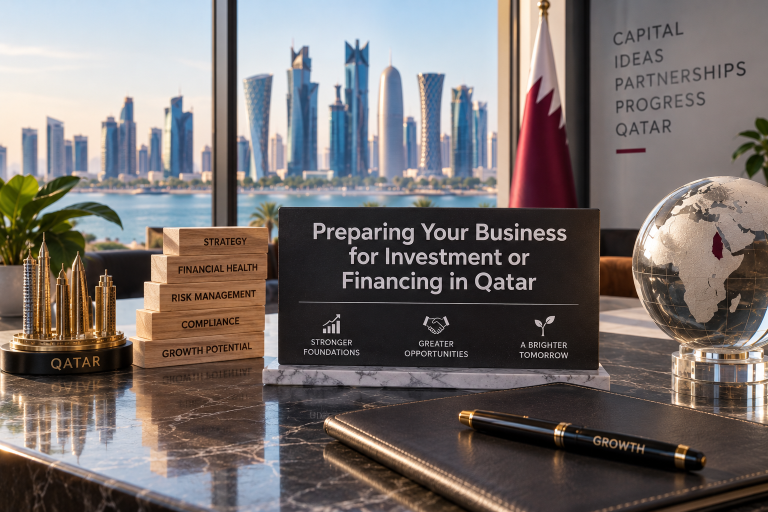
What Are Investors and Lenders in Qatar Looking for in 2026?
Heading into 2026, funders across Qatar are prioritising businesses that can demonstrate diversification away from a single client or sector, consistent with the country’s wider National Vision to reduce dependency on any one source of revenue. Beyond the numbers, reviewers are also weighing governance. Who signs off on spending. Whether management accounts are produced monthly or reconstructed at year end. Whether the founder can explain a variance in gross margin without checking with their bookkeeper first. A business in West Bay or Lusail applying for growth capital will be judged on the same fundamentals as one in London, but the documentation expectations and licensing route will differ depending on whether the company sits inside the Qatar Financial Centre, a free zone, or the mainland market.
What Financial Documents Do You Need Before Approaching Investors in Doha?
Most funders and lenders in Doha will ask for a broadly similar core document set, though the exact requirements vary by financing route. As a starting point, businesses should have the following ready before any first conversation with a fund, bank or government programme.
| Document | Why It Matters |
| Three years of financial statements | Shows trend, not a single snapshot that could be an outlier year |
| 12 to 24 month cashflow forecast | Demonstrates the business understands its own runway and funding gap |
| Business plan with named market and competitor context | Required by most Qatar Development Bank and venture programmes |
| Company licensing and ownership documents | Confirms legal structure, whether QFC, free zone or mainland |
| Management accounts, produced monthly | Signals financial discipline beyond year end reporting |
How Does the Qatar Financial Centre Support Business Financing?
The Qatar Financial Centre gives eligible businesses 100 percent foreign ownership and operates under an English common law framework, which many international investors find more familiar than mainland Qatari commercial law. This structure is one reason QFC-licensed companies often find it easier to demonstrate legal clarity to overseas investors, particularly funds based in the UK, Europe or wider GCC. If your business is not yet QFC licensed and is planning a funding round, it is worth reviewing whether the QFC route better suits your investor base before the application process begins, rather than restructuring midway through due diligence.
What Are the Main Financing Routes Available to Businesses in Qatar?
Businesses in Qatar generally have three broad financing paths open to them, each suited to a different stage and risk profile.
| Financing Route | Best Suited To | What Reviewers Focus On |
| Qatar Development Bank programmes | Early stage and growth SMEs | Business plan, viability, local market fit |
| Venture capital via Invest Qatar Gateway | Tech, fintech and scalable sector startups | Growth trajectory, unit economics, founder track record |
| Traditional bank debt or facilities | Established businesses with trading history | Historic financial statements, collateral, cashflow stability |
Does Where Your Business Is Based in Doha Affect Investment Readiness?
Location itself does not determine whether a business secures funding, but it does shape the type of investor conversation you are likely to have. Businesses operating from West Bay and Lusail tend to sit closer to the corporate and financial services cluster, which can mean earlier exposure to institutional investors and banks headquartered in those districts. Businesses based around The Pearl or Msheireb, often retail, hospitality or lifestyle brands, are more likely to be approached by regional GCC investors looking at consumer sectors. What matters more than the district itself is whether your financial reporting is built to the standard that investor in that sector expects.
What Financial Systems Should Be in Place Before Seeking Investment?
Before any funding conversation, a business should have a proper bookkeeping system that reconciles monthly, a clear chart of accounts that separates revenue streams, and a KPI or dashboard view that shows margin, cash runway and customer concentration at a glance. Investors and lenders read inconsistent or late management accounts as a governance risk, not just an administrative gap. If your systems currently rely on year end reconstruction rather than live tracking, this is usually the single biggest blocker to a fast due diligence process, and it is worth addressing through a proper financial systems review well ahead of any application.
How Can British Expats in Qatar Manage UK Tax Obligations While Raising Finance?
Many British expat founders in Doha continue to hold UK tax residency ties, UK registered companies, or UK based income alongside their Qatar operations, and this can complicate an investment or financing process if it is not addressed early. Investors will often ask about the group structure, and lenders may want to see how UK and Qatar entities relate to each other financially. Coordinating both sides of the compliance picture at the same time, rather than treating UK tax as a separate matter handled later, avoids delays once due diligence begins. GMPA LLC supports businesses and British expats across Doha and the wider Qatar market while also managing continuing UK tax obligations, which is a common gap in investment readiness for expat founders.
What Mistakes Commonly Delay Investment Readiness in Qatar?
The most common delay is founders approaching investors before their numbers are audit ready, which then triggers weeks of back and forth during due diligence rather than a smooth review. A second common issue is founders underestimating how much detail reviewers expect on customer concentration and cash runway. A third is failing to align the legal structure, such as QFC licensing, with the type of investor being approached. Each of these is avoidable with preparation that starts three to six months before any formal application, not the week the term sheet arrives.
According to guidance published by the Qatar Financial Centre, businesses that structure their licensing and governance correctly from the outset generally experience a more straightforward path through investor and regulatory review, reinforcing why early preparation, not last minute paperwork, remains the most reliable route to successful financing in Qatar.
Frequently Asked Questions
|
How long does it take to prepare a business for investment in Qatar? |
|
Most businesses need three to six months to get financial records, forecasts and governance to an investor ready standard, depending on how far current reporting is from monthly management accounts. |
|
Do I need to be QFC licensed to raise investment in Qatar? |
|
No, but QFC licensing can make the process smoother for businesses targeting international investors, since it offers 100 percent foreign ownership and a common law framework many overseas funders recognise. |
|
Can British expats in Qatar raise business finance while keeping UK tax obligations up to date? |
|
Yes, this is common and manageable, provided the UK and Qatar sides of the business are coordinated together rather than treated as separate, unconnected processes. |
|
What financial records do lenders in Qatar ask for most often? |
|
Three years of financial statements, a cashflow forecast, monthly management accounts and clear ownership and licensing documentation are the most commonly requested items. |
Getting a business investment ready in Doha is a preparation exercise as much as a financial one. Businesses that build clean financial systems ahead of time, understand which financing route fits their stage, and coordinate any UK tax matters early, tend to move through funder review with far fewer delays. If you are also reviewing the wider financial foundations of your business, our guides on the financial systems every scaling business needs in Qatar and how financial health impacts business valuation in Qatar cover related ground, alongside our broader look at business growth and strategy in Qatar.
|
|
|