










|
Written by Saira Khan, Co-Founder of GMPA LLC, whose team has 15+ years of UK accounting experience advising British expats and SMEs operating across the UK and Qatar. Updated for 2026. |
Financial Systems Every Scaling Business Needs in Qatar (2026 Guide for Doha and British Expats)
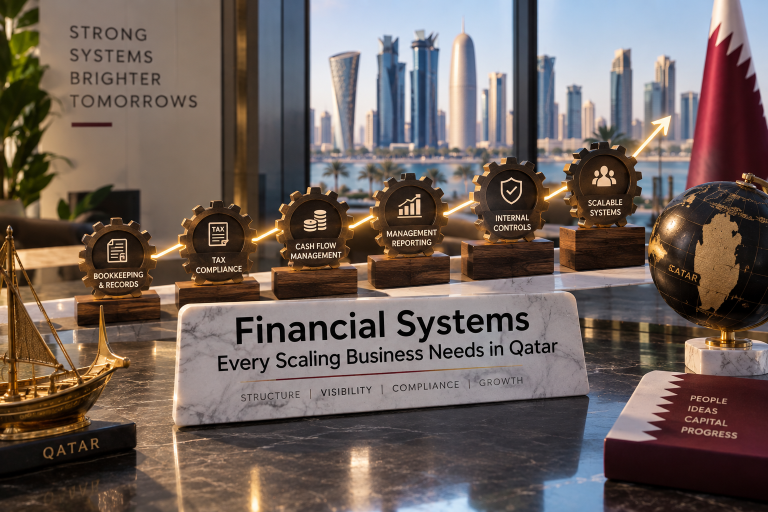
A scaling business in Qatar needs five core financial systems: cloud based bookkeeping, cash flow forecasting, internal financial controls, KPI reporting dashboards, and either an in house or virtual CFO function. Without these five in place, growth in Doha tends to create chaos rather than profit, and British expat owners face the added risk of falling behind on UK obligations while they focus on Qatar operations.
|
Definition: Financial systems for a scaling business are the connected set of tools and processes, bookkeeping software, cash flow forecasts, internal controls, and management reporting, that give owners real time visibility and control as transaction volume, headcount, and complexity grow. |
|
Key Takeaways
|
What Financial Systems Does a Scaling Business in Qatar Actually Need?
Most owners in Doha start with a spreadsheet and a personal bank feel for the numbers. That works when revenue is small and transactions are few. It stops working the moment a business adds a second client contract, a first employee, or a second office across Lusail or West Bay. At that point five systems become non negotiable: cloud accounting software for real time bookkeeping, a rolling cash flow forecast, documented internal controls with approval limits, a KPI dashboard that reports weekly or monthly performance, and CFO level financial leadership, whether in house or outsourced. See our financial record keeping best practices for Qatar businesses for the foundational layer beneath all five systems.
Why Do Growing Businesses in Doha Outgrow Basic Bookkeeping So Quickly?
Doha is a fast moving market. A trading company in Msheireb or a consultancy operating out of The Pearl can double its client base within a single year, particularly with the pace of Qatar National Vision 2030 diversification projects feeding demand into professional services. Growth of that speed exposes weak systems immediately. Version control problems appear when multiple people edit the same spreadsheet. Month end close slows to days instead of hours. Cash flow visibility disappears exactly when it matters most, during a hiring push or a new contract mobilisation. The businesses that scale sustainably in Qatar are the ones that install proper systems before the growth arrives, not after the first crisis. This is also a wider GCC pattern. Saudi Arabia and the UAE have both seen a surge in SME formalisation as regulators tightened reporting expectations, and Qatar is following the same trajectory as it diversifies away from hydrocarbons under Qatar National Vision 2030. A business that builds GCC standard financial systems now is better placed to expand into Riyadh or Dubai later without rebuilding its finance function from scratch.
How Do the Core Financial Systems Compare for a Scaling Qatar Business?
Use the table below to see what each system covers, when a Qatar business typically needs it, and whether GMPA LLC implements it directly.
| System | What It Covers | Needed From | GMPA LLC Supported |
| Cloud Bookkeeping | Invoicing, reconciliation, expense tracking | First employee or client | Yes |
| Cash Flow Forecasting | Rolling projections, scenario planning | First hiring round or new contract | Yes |
| Internal Controls | Approval limits, segregation of duties, audit trail | Second entity or team of five or more | Yes |
| KPI Dashboards | Profit and loss, debtor days, margin tracking | Consistent monthly revenue | Yes |
| Virtual CFO Oversight | Strategic planning, investor readiness, risk review | Revenue milestones or funding rounds | Yes |
Which Financial Controls Protect a Scaling Business in Qatar From Risk?
Once a business in Qatar moves beyond a single owner making every decision, informal trust stops being a control. We recommend three layers for scaling clients across Doha. First, approval hierarchies for spend above a set threshold, so no single individual commits company funds without sign off. Second, segregation of duties, so the person raising an invoice is never the same person approving payment. Third, a monthly management review comparing actual results against forecast, catching errors and fraud risk early rather than at year end audit. Our guide on improving financial transparency in your organisation covers this in more depth, and directly affects how investors and banks view your business, which we explain further in how financial health impacts business valuation in Qatar. Businesses registered through the Qatar Financial Centre carry an additional layer of expectation here, since QFC regulated entities are required to maintain auditable records to a standard that international investors and banks recognise, making early investment in controls a direct commercial advantage rather than a compliance chore.
How Should British Expats in Qatar Structure Financial Systems for Dual UK Compliance?
British expats running businesses in Doha carry a second layer of complexity that GCC founders do not. Alongside Qatar reporting, many retain UK rental income, pension contributions, or company dividends that still fall under HMRC Self Assessment. The financial system you build needs to separate Qatar and UK income cleanly from day one, using multi currency ledgers that track QAR and GBP without manual conversion errors. GMPA LLC serves clients across Doha and the wider Qatar market, and supports British expats with continuing UK tax obligations, making sure nothing falls between the two jurisdictions.
What Role Does a Virtual CFO Play as a Qatar Business Scales?
A full time CFO is rarely justified for a business under a certain revenue threshold, yet the strategic function that role provides becomes essential earlier than most owners expect. A virtual CFO reviews your numbers monthly or quarterly, models the financial impact of a new hire or a new office in Lusail before you commit, and prepares your business for a bank facility, investor conversation, or eventual sale. Businesses across the GCC that treat financial leadership as optional tend to plateau earlier than those that build it into the growth plan from the start. This is also the point where growth strategy and financial systems intersect directly, a connection we explore in business growth and strategy in Qatar. For businesses operating across multiple Doha districts, a virtual CFO also standardises reporting between locations, so a team in West Bay and a team in Msheireb are working from the same numbers rather than reconciling two versions of the truth at month end.
Is VAT Readiness Part of Financial Systems Planning in Qatar in 2026?
Yes, and it should be built into your systems now rather than added later. Qatar remains part of the GCC Unified VAT Agreement, and the IMF’s Article IV consultations on Qatar continue to flag fiscal diversification, including indirect taxation, as part of the country’s medium term economic strategy. Saudi Arabia and the UAE have already implemented VAT, and the lesson from both rollouts is consistent: businesses running VAT ready accounting systems before legislation passed avoided the disruption that hit businesses relying on manual processes. Scaling businesses in West Bay, Lusail, and across Qatar should treat VAT readiness as a system requirement, not a future project. The Qatar Financial Centre and Qatar Central Bank have both signalled continued alignment with the wider GCC fiscal framework, and businesses that wait until legislation is confirmed typically face a rushed migration under time pressure, with backdated reconciliation work and a higher risk of filing errors in the first reporting cycle.
How Does GMPA LLC Help Scaling Businesses Build These Systems in Doha and Qatar?
GMPA LLC works with SMEs and British expats across Doha, West Bay, The Pearl, Lusail, and Msheireb to design and implement the financial systems that support genuine scaling, not just growth on paper.
| 1 | Financial Systems Review A full audit of your current bookkeeping, controls, and reporting to identify gaps before they cause problems. |
| 2 | Cloud System Setup and Migration Implementation of cloud accounting software with VAT ready configuration and multi currency support. |
| 3 | Internal Controls Design Approval hierarchies, segregation of duties, and fraud prevention measures built for your team size. |
| 4 | KPI Dashboard Build Monthly reporting dashboards giving real time visibility over profit, cash, and performance. |
| 5 | Ongoing Virtual CFO Support Quarterly strategic reviews and dual UK and Qatar compliance oversight for British expat owners. |
Frequently Asked Questions About Financial Systems for Scaling Businesses in Qatar
| At what revenue level does a Qatar business need proper financial systems? |
| There is no fixed threshold, but most businesses in Doha reach a tipping point once they add a first employee, cross roughly QAR 500,000 in annual transactions, or take on a second client contract requiring separate reporting. At that point spreadsheets stop being reliable and cloud based systems become necessary. |
| Do British expat business owners in Qatar need separate financial systems for the UK? |
| Not entirely separate systems, but they do need software and processes that cleanly track QAR and GBP income streams. GMPA LLC structures a single system that reports correctly for Qatar purposes while keeping UK Self Assessment obligations clear and up to date. |
| Can a small business in Qatar afford a virtual CFO? |
| Yes. A virtual CFO model provides strategic oversight on a monthly or quarterly basis, which is significantly more accessible than a full time hire. Most scaling SMEs in West Bay and Lusail use this model until their finance function justifies an in house appointment. |
| What happens if a scaling business in Qatar delays building financial systems? |
| Delayed systems typically surface as cash flow surprises, inaccurate management information, and difficulty securing bank finance or investment, since lenders and investors expect auditable, real time financial data before committing funds. |
| Does GMPA LLC work with businesses outside Doha in the wider Qatar market? |
| Yes. GMPA LLC serves clients across Doha and the wider Qatar market, and supports British expats with continuing UK tax obligations, regardless of which district or free zone the business operates from. |
|
Ready to Build the Financial Systems Your Qatar Business Needs to Scale?
|
|
About the Author: Saira Khan is the Co-Founder of GMPA LLC, a Qatar based financial consultancy serving SMEs and British expats across Doha, West Bay, The Pearl, Lusail, and Msheireb. Backed by her team’s 15+ years of UK accounting experience, Saira advises scaling businesses on financial systems, internal controls, and cross border UK and Qatar tax obligations in 2026. GMPA LLC serves clients across Doha and the wider Qatar market, and supports British expats with continuing UK tax obligations including HMRC Self Assessment, rental income reporting, and offshore disclosure requirements. |