










Creating Accurate Business Budgets in Qatar: A Guide for British Expats and SMEs in Doha |
| Written by Raja Zaman, 2026. Head of Business Performance at GMPA LLC, with 10 years of experience in accounting and tax and over 10 years managing stores for Tesco and Iceland. |
| Yes, you can build an accurate business budget in Qatar by working from real bank and financial statement data, separating fixed and variable costs, and reviewing your figures against actual performance every quarter rather than every year. Most inaccurate budgets in Doha fail because they are built once from optimistic assumptions and never checked again. An accurate budget is a living document, not a one time exercise. |
|
Key Takeaways
|
| An accurate business budget is a financial plan built from verified income statements, bank data and signed contracts rather than assumptions, giving Qatar business owners a reliable benchmark to measure actual performance, control costs and plan tax obligations throughout the year. |
What Is a Business Budget and Why Does Accuracy Matter in Qatar?
A business budget sets out expected income, operating costs and cash position for the year ahead. In Qatar, accuracy matters because companies registered through the Ministry of Commerce and Industry or the Qatar Financial Centre are required to keep proper accounting records and prepare annual financial statements in line with International Financial Reporting Standards. An inaccurate budget does not just cause poor decisions, it makes that year end reporting process far harder to reconcile.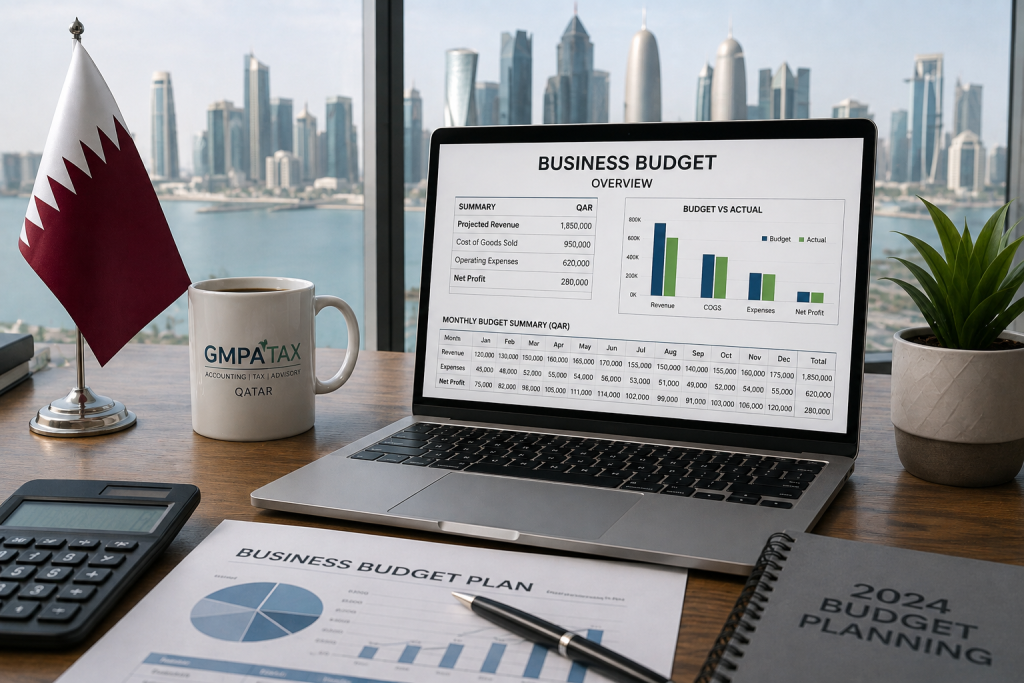
|
What Information Do You Need Before Building an Accurate Budget?
| Start with your prior year income statement, balance sheet and cash flow statement, plus any known fixed cost changes such as office lease renewals in West Bay or Lusail, staff sponsorship and visa renewals, and signed supplier contracts. If your business is new to Doha and has no prior year data, base your first budget on signed contracts and quoted supplier costs rather than an optimistic revenue guess, since optimistic first year budgets are the single biggest driver of inaccuracy we see among new SMEs in Qatar. |
How Do You Build an Accurate Business Budget Step by Step?
| Step | Action |
| 1 | Pull real bank statements and last year financial statements, not memory or estimates. |
| 2 | Forecast income from signed contracts and realistic market trends only. |
| 3 | Separate fixed costs, such as rent and sponsorship fees, from variable costs. |
| 4 | Add a contingency line of 5 to 10 percent of income for unplanned costs. |
| 5 | List UK tax and filing obligations as a separate line if you are a British expat director. |
| 6 | Compare actual results against the budget every quarter and correct the remaining months. |
| If you have already built your first annual budget and want to strengthen it, our guide on how to build an annual budget for your limited company in Qatar walks through the full year one process in more depth. |
What Makes Budgeting Different for a Qatar Company Compared to a UK Company?
| Budget Item | UK Limited Company | Qatar Limited Company |
| Corporate tax rate | Up to 25 percent | 10 percent on taxable profit above QAR 100,000 |
| Filing deadline | 9 months after year end | 4 months after the accounting period ends |
| Currency exposure | Minimal for domestic trading | QAR to GBP movement affects expat directors with UK income |
| Record retention | 6 years | 10 years, kept within Qatar |
What Local Costs Should Doha and Qatar Businesses Budget For?
| Your location within Qatar changes your cost base meaningfully. A firm operating from West Bay or Lusail typically carries a higher commercial lease line than one based in Msheireb or The Pearl, and hospitality or retail businesses should budget for seasonal swings tied to the tourism calendar. Companies trading across the wider GCC should also budget for cross border VAT and customs costs, since compliance requirements differ across Qatar, the UAE and Saudi Arabia. GMPA LLC supports clients across Doha and the wider Qatar market, and we also support British expats who continue to carry UK tax obligations alongside their Qatar business. |
How Can British Expats Keep UK and Qatar Budgets Accurate Together?
| Many British expat directors running a Qatar limited company still carry UK obligations such as a UK rental property, a UK registered company, or Self Assessment tied to their residency status. These should sit as a distinct line in your budget rather than being absorbed into general costs, since UK deadlines run on a different calendar to Qatar. For a wider view of how forecasting choices affect this planning, our comparison on rolling forecasts versus annual budgets sets out which approach suits a dual jurisdiction business best. |
What Are the Most Common Budgeting Mistakes to Avoid?
| The most common mistake is building a budget once a year and never returning to it. A budget only stays accurate if it is compared against actual performance regularly, with variances investigated rather than ignored. The second most common mistake is confusing profit with cash flow, since a business can look profitable on paper while still struggling to pay suppliers or staff on time. According to the International Monetary Fund, sound financial planning depends on accurate, forward looking budgeting rather than reactive spending, a principle that holds at company level as much as national level. The Qatar Financial Centre also requires registered firms to maintain proper accounting records that a well built budget makes far easier to produce. |
How Often Should You Review Your Budget for Accuracy?
| Review your budget quarterly at minimum. Comparing actual income and costs against your projections every three months lets you correct course while there is still time in the year to act, rather than discovering a shortfall in month eleven. Businesses in seasonal sectors or those exposed to currency movement should consider a monthly check instead. |
Frequently Asked Questions
| How often should a business in Doha update its budget for accuracy? |
| At least every quarter, comparing actual results against your projections so you can adjust the remaining months rather than waiting until year end. |
| What causes most budget inaccuracy in Qatar SMEs? |
| Optimistic first year revenue assumptions and confusing profit with cash flow are the two leading causes we see among SMEs in Doha and across Qatar. |
| Do I need separate line items for UK tax if I run a Qatar company? |
| Yes, if you retain UK obligations such as Self Assessment or a UK registered company, these should sit as a distinct budget line since UK deadlines run independently of your Qatar accounting period. |
| What exchange rate should I use for forecasting? |
| Use a conservative recent average rather than a single day rate, and revisit it each quarter if you hold significant income or costs in GBP alongside QAR. |
| Can GMPA LLC help me review a budget I have already built? |
| Yes, we support SMEs and British expats across Doha and the wider Qatar market with budget review, forecasting, and ongoing UK and Qatar compliance in one place. |
| For a broader view of the advisory support available beyond budgeting, see our financial advisory services in Qatar page. |
| Speak to One of Our UK Accountants, Book Your Free Consultation |
| View Our Services |
| GMPA LLC is a UK and Qatar focused accountancy practice supporting SMEs and British expats across Doha, West Bay, The Pearl, Lusail, Msheireb, and the wider Qatar market. Guidance current as of 2026. This article is general information and is not a substitute for advice tailored to your specific circumstances. |