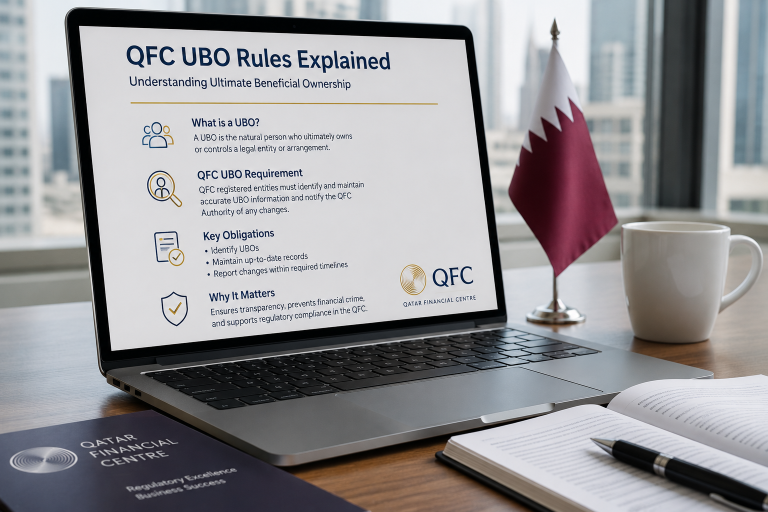
QFC UBO Rules Explained: Beneficial Ownership Reporting for British Expats and Firms in Doha, QatarWritten by Saira Khan, Co-Founder of GMPA LLC, whose team has 15+ years of UK accounting experience advising British expats and SMEs operating across the UK and Qatar. Updated for 2026. Every entity licensed in the Qatar Financial Centre must identify its ultimate beneficial owner and report that person to the Companies Registration Office. Missing a UBO filing, or reporting it incorrectly, carries real financial penalties in Doha. This guide sets out what the QFC UBO rules actually require in 2026, who counts as a UBO, and what British expats running a QFC entity in Qatar still owe HMRC alongside it.
What Are the QFC UBO Rules?
The rules sit under General Rule 8A of the QFCA Rules, updated in December 2021 to align with the QFC Anti Money Laundering and Combating the Financing of Terrorism Rules. Every body corporate, partnership, branch, or legal arrangement registered with the QFC falls under this regime, whether it is based in West Bay, The Pearl, Lusail, Msheireb, or elsewhere in Qatar. The goal is transparency, so regulators can trace ownership through layers of corporate structure until they reach the real, natural person behind it.
Who Counts as an Ultimate Beneficial Owner Under QFC Rule 8A?A UBO is a natural person who exercises, or has the legal right to exercise, control or influence over the management of a QFC entity, including a chief executive officer or director acting in that capacity. Where a shareholder is itself a company or a legal arrangement rather than an individual, the entity must trace through each layer until it identifies the natural person who ultimately controls it. Trusts carry their own version of this obligation, extending to settlors, trustees, and beneficiaries. Nominee shareholders and nominee directors are treated as beneficial owners regardless of the size of their shareholding, and firms must also keep a separate Register of Nominees where these arrangements exist. What Information Must a QFC Firm Collect on Its UBOs?Firms operating from Doha’s commercial districts must gather and keep current the following before they can submit a compliant UBO filing.
When Must a QFC Entity in Doha Report Its UBO?UBO information must be identified and verified at the point of incorporation or registration, and updated whenever there is a change in control. On top of this ongoing duty, every QFC entity must file an Annual UBO Report within 30 days of the date set by the Companies Registration Office each year. Registers of UBO Information, Basic Information, and Nominees, where applicable, must be held at the entity’s registered office and made available to the QFCA on request. Firms in West Bay, Lusail, The Pearl, and Msheireb all follow the same reporting cycle, regardless of location within Qatar. What Happens If a QFC Firm Gets UBO Reporting Wrong?Enforcement has tightened steadily across the QFC. Providing false or misleading beneficial ownership information can trigger a penalty of up to QAR 182,000 and a formal regulatory investigation. Failing to report a UBO at all can lead to public censure and a permanent mark on the firm’s compliance record, while persistent non compliance risks suspension or revocation of the QFC licence itself. Firms should treat every UBO update, not only the annual filing, as a fixed regulatory duty rather than an administrative afterthought. How Does QFC UBO Reporting Compare to Mainland Qatar and the UK?
This distinction matters most for British expats who hold both a UK registered company and a QFC entity, since they must satisfy two different disclosure standards at once, a public Persons with Significant Control register in the UK, and a confidential regulator held register in Qatar. Do British Expats in Qatar Still Have UK Disclosure Duties Alongside QFC UBO Rules?Yes. Moving to Doha and setting up a QFC entity does not end UK obligations. HMRC applies the Statutory Residence Test to decide ongoing tax residency, and many British expats remain partially or fully UK tax resident, particularly in their early years in Qatar or where UK property or income continues. A British expat who owns a UK registered company as well as a QFC entity must keep the UK PSC register updated with Companies House on top of the QFC UBO filing described above. GMPA LLC serves clients across Doha and the wider Qatar market, and supports British expats with continuing UK tax obligations, including Self Assessment, dividend planning, and PSC register updates, alongside their QFC compliance calendar. For the wider annual picture, see our QFC annual filing requirements: a complete compliance checklist, and if your firm is entering its first audit cycle, our guide on how to prepare your QFC firm for its First Audit covers what auditors expect alongside UBO records. How Can GMPA LLC Help With QFC UBO Compliance in Doha and Across Qatar?GMPA LLC manages the full QFC UBO identification and reporting cycle for firms across Doha, West Bay, The Pearl, Lusail, and Msheireb, alongside continuing UK obligations for British expats and SMEs. Our team maps ownership structures through each corporate layer, prepares and files UBO information through the QFC Client Portal, and keeps registers current between annual reporting dates. If your business is still deciding between structures, our comparison of QFC vs Mainland Qatar: Which is Right for your Business sets out how UBO and reporting duties differ between the two. For firms already inside the QFC, our breakdown of Understanding the QFC Tax: Corporate Tax for QFC Entities explains how UBO records feed into your annual tax return. This article is intended for general guidance only and does not constitute regulated legal or tax advice. Regulatory requirements may change; always confirm current rules with the QFC Authority or a qualified adviser. Source: Qatar Financial Centre Authority, Ultimate Beneficial Owner Public Guidance. Frequently Asked Questions
Written by Saira Khan, Co-Founder of GMPA LLC, whose team has 15+ years of UK accounting experience advising British expats and SMEs operating across the UK and Qatar. |